
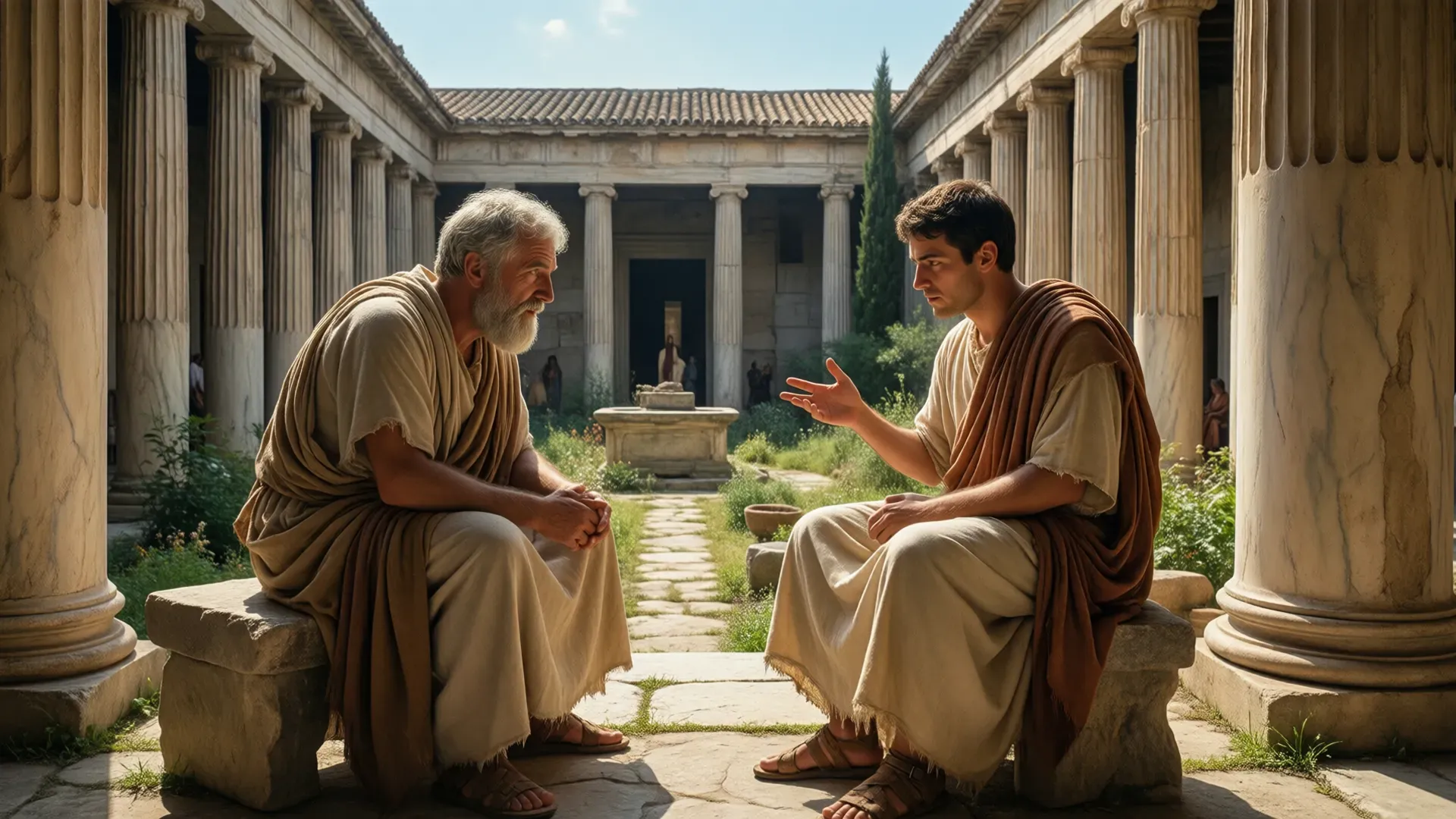
Epictetus: How a Slave Gave Psychotherapy Its Foundations
The Stoic slave whose one idea about judgement became the foundation of REBT and CBT
In the 1950s, Albert Ellis was developing what would become rational-emotive behaviour therapy — one of the most influential models of psychological treatment of the twentieth century. At the heart of his model was a single, deceptively simple claim: emotional disturbance is not caused by events. It is caused by the beliefs we hold about events.
Ellis did not arrive at this independently. He credited it, in his foundational texts, to a philosopher who had stated it with equivalent precision roughly nineteen centuries earlier.
That philosopher was Epictetus. And the text was chapter five of the Enchiridion, written around 100 AD:
“Men are disturbed not by the things which happen, but by the opinions about the things.”
Ellis called the Stoics “the philosophical forebears of REBT.” He was not speaking loosely.
The Man Behind the Claim
The context in which Epictetus developed this insight matters — not as biography for its own sake, but because it changes what the claim means.
Epictetus was born into slavery around 50 AD in Hierapolis, in what is now western Turkey. He was owned by Epaphroditus, a freedman who had himself served the Emperor Nero. He was lame — some accounts attribute this to injury inflicted by his master; Epictetus dismissed the story as beside the point. He was, by the legal standards of his time, property.
He eventually gained his freedom, moved to Rome, and began teaching philosophy. When the Emperor Domitian expelled philosophers from Rome around 93 AD, he relocated to Nicopolis in northwestern Greece and taught there until his death, probably around 135 AD.
He wrote nothing. What we have comes from his student Arrian, who recorded his lectures in the Discourses and distilled the core of his teaching into the Enchiridion — a forty-two chapter handbook that remains one of the most direct works of practical philosophy ever produced.
The argument that inner freedom is the only freedom that cannot be taken away is not abstract theorising when it comes from a man who was owned. When Epictetus said that no external circumstance determines your inner life, he had tested the claim against conditions most of his readers will never face. That is part of why it carries weight.
The Enchiridion: What It Actually Says
The Enchiridion opens with what may be the most consequential sentence in Stoic literature:
“There are things which are within our power, and there are things which are beyond our power. Within our power are opinion, aim, desire, aversion, and, in one word, whatever affairs are our own. Beyond our power are body, property, reputation, office, and, in one word, whatever are not properly our own affairs. Now the things within our power are by nature free, unrestricted, unhindered.”
This is the dichotomy of control. Not a motivational heuristic. A structural claim about what the mind can and cannot govern — and therefore what it should and should not be invested in.
That is the dichotomy of control. Not a motivational heuristic. A structural claim about what the mind can and cannot govern — and therefore what it should and should not be invested in.
The practice that follows from it is simple to state. Train your attention to remain fixed on the things in your control. Hold the things outside your control lightly — pursue them where available, but without making your wellbeing contingent on their outcome.
Chapter five extends the argument into emotional life directly:
“Men are disturbed not by the things which happen, but by the opinions about the things; for example, death is nothing terrible, for if it were it would have seemed so to Socrates; for the opinion about death that it is terrible, is the terrible thing. When then we are impeded, or disturbed, or grieved, let us never blame others, but ourselves — that is, our opinions.”
And then, in the same passage, something clinically precise: a developmental sequence.
“It is the act of an ill-instructed man to blame others for his own bad condition; it is the act of one who has begun to be instructed, to lay the blame on himself; and of one whose instruction is completed, neither to blame another, nor himself.”
Three stages. External blame, then self-blame, then the transcendence of blame entirely — not as complacency, but as accurate perception. Modern psychology calls the same movement a shift from external to internal locus of control, followed by the integration of self-responsibility without self-punishment. Epictetus got there first and said it more cleanly.
Prohairesis: The Faculty That Makes the Practice Possible
The central concept in Epictetus is prohairesis — a Greek term usually translated as “faculty of choice” or “moral purpose.” It refers to the capacity to choose how to respond to any situation: the inner faculty that remains free even when everything external has been removed.
Animals respond to stimuli automatically. Humans have something animals do not: the capacity to insert a pause between stimulus and response. To examine what has happened, choose an interpretation, and act from that choice rather than from reflex. Prohairesis is the name for that capacity.
The practice of Stoic philosophy, for Epictetus, is the practice of using that capacity consistently. Not occasionally. Not when conditions are favourable. In slavery, in exile, in illness, in the presence of people who intend you harm.
From the Discourses, on what cannot be taken:
“You may fetter my leg, but my will not even Zeus himself can overpower.”
This is not defiance for its own sake. It is a precise statement about the architecture of the mind. The body can be restrained. Prohairesis cannot.
The REBT Connection
Albert Ellis built rational-emotive behaviour therapy on the ABC model: Activating event → Belief → Consequence. The emotional consequence of any event is not produced by the event itself, but by the belief held about it. The therapeutic intervention is to identify and challenge the irrational belief.
This is Enchiridion chapter five in clinical language.
Ellis was explicit about the lineage. He quoted Epictetus in his foundational texts and named the Stoics as philosophical forebears of the model. The structural parallel is not approximate — it is exact, at least for REBT specifically. The claim that emotional disturbance is produced by judgements rather than events is the same claim in both systems.
The broader CBT tradition has components that Stoicism does not anticipate — behavioural activation, exposure hierarchies, the conditioning models that underpin some interventions. The Epictetan connection is most precise when applied to the cognitive restructuring component: the practice of identifying an automatic belief, examining whether it is accurate, and choosing not to assent to it if it is not.
Epictetus called those automatic beliefs phantasiai — impressions that arise without invitation and demand assent. The Stoic practice is to pause before assenting and ask whether the impression reflects reality. The CBT practice is to identify automatic thoughts and test them against evidence. The structure is the same.
Frankl: The Same Insight, Different Conditions
Viktor Frankl developed his concept of the “last human freedom” — the freedom to choose one’s attitude in any given set of circumstances — in the Nazi concentration camps during World War II. Epictetus arrived at the same position in Roman slavery roughly nineteen centuries earlier.
Whether Frankl drew directly on Stoic sources or arrived at the conclusion independently through his own experience and through existentialist philosophy is not definitively established. What is clear is that two people, working in conditions of extreme external constraint — one ancient, one modern — arrived at the same insight through different routes: that the mind’s orientation toward its circumstances is the one thing that cannot be taken by force.
That convergence is not proof of anything except the reliability of the observation. When the same conclusion appears across nineteen centuries and radically different intellectual traditions, it is worth taking seriously.
What Epictetus Demands That Others Don’t
Most philosophy that reaches a general audience has been softened somewhere along the way — qualified, contextualised, made comfortable. Epictetus has not been softened. He is the most demanding of the three major Stoic writers, and the most consistent.
Marcus Aurelius writes from the inside of a struggle — his Meditations are private notes, not finished arguments, and they show a man trying to live up to a standard he frequently misses. Seneca wrote brilliantly about simplicity and independence while living in extraordinary wealth and political compromise. Both are worth reading, partly because of the gap between their ideals and their circumstances.
Epictetus has no such gap. He had been property. He had experienced the most complete possible removal of external freedom. And he concluded — not theoretically, but from experience — that external freedom is not the thing that matters.
That places full responsibility on the individual. No circumstance, in Epictetus’s framework, justifies a disordered inner life. That is not a comfortable position. It is not designed to be. If you find his severity uncomfortable, that discomfort is pointing at something.
The Practice
The Enchiridion is forty-two chapters. The Discourses are four surviving books out of an original eight. Neither of them is asking to be admired. They are asking to be used.
James Stockdale, the American naval officer who spent seven years as a prisoner of war in Vietnam, credited the Enchiridion with keeping him psychologically intact through conditions of sustained torture and isolation. He had read it as a graduate student and carried the ideas with him into captivity. Not because they made captivity pleasant, but because they gave him a framework for determining what he could and could not govern — and for directing his attention accordingly.
Marcus Aurelius read Epictetus. So did Descartes, Frederick the Great, and Albert Ellis. The Enchiridion is short — forty-two chapters, an afternoon’s reading. Its usefulness depends not on how quickly you finish it but on whether you return to it.
The daily practice Epictetus described — the examination of your judgements, the identification of which impressions you are assenting to and whether they deserve assent — is what the Citewise Evening Review is built around. Three questions, five minutes, applied to whatever happened today. Not therapy. Not journalling as self-expression. The practice of noticing what your mind is doing with events, and deciding whether to agree. Epictetus was not alone. Marcus Aurelius built an entire private practice on the same foundations, and 1,800 years later Albert Ellis would cite Epictetus directly in the founding text of cognitive therapy — a lineage explored in The therapy that worked already. For the broader tradition connecting Stoic philosophy to modern cognitive therapy, see CBT and Stoicism. For the full Stoic tradition, see our guide to Stoic philosophy.
Frequently asked questions
- What is Epictetus known for?
- Epictetus is known for one deceptively simple idea: that we are disturbed not by events, but by our judgements about events. Born into slavery and later teaching as a freedman in Rome, he taught a practical Stoicism organised around the distinction between what is in our power (our judgements, desires, and responses) and what is not (everything else). His teachings survive in the Discourses and the Enchiridion, compiled by his student Arrian — and that one insight about judgement became, eighteen centuries later, the founding claim of cognitive behavioural therapy.
- What is Epictetus's most famous quote?
- His best-known line is the opening idea of the Enchiridion: "It is not events that disturb people, it is their judgements concerning them." It's the sentence Albert Ellis credited as the seed of rational-emotive behaviour therapy. A close second is his framing of the dichotomy of control — that some things are within our power and some are not, and that peace begins with telling the two apart.
Free download
Stop staring at a blank journal. Start here.
The Three-Question Evening Review — five minutes, three questions, no blank page.