
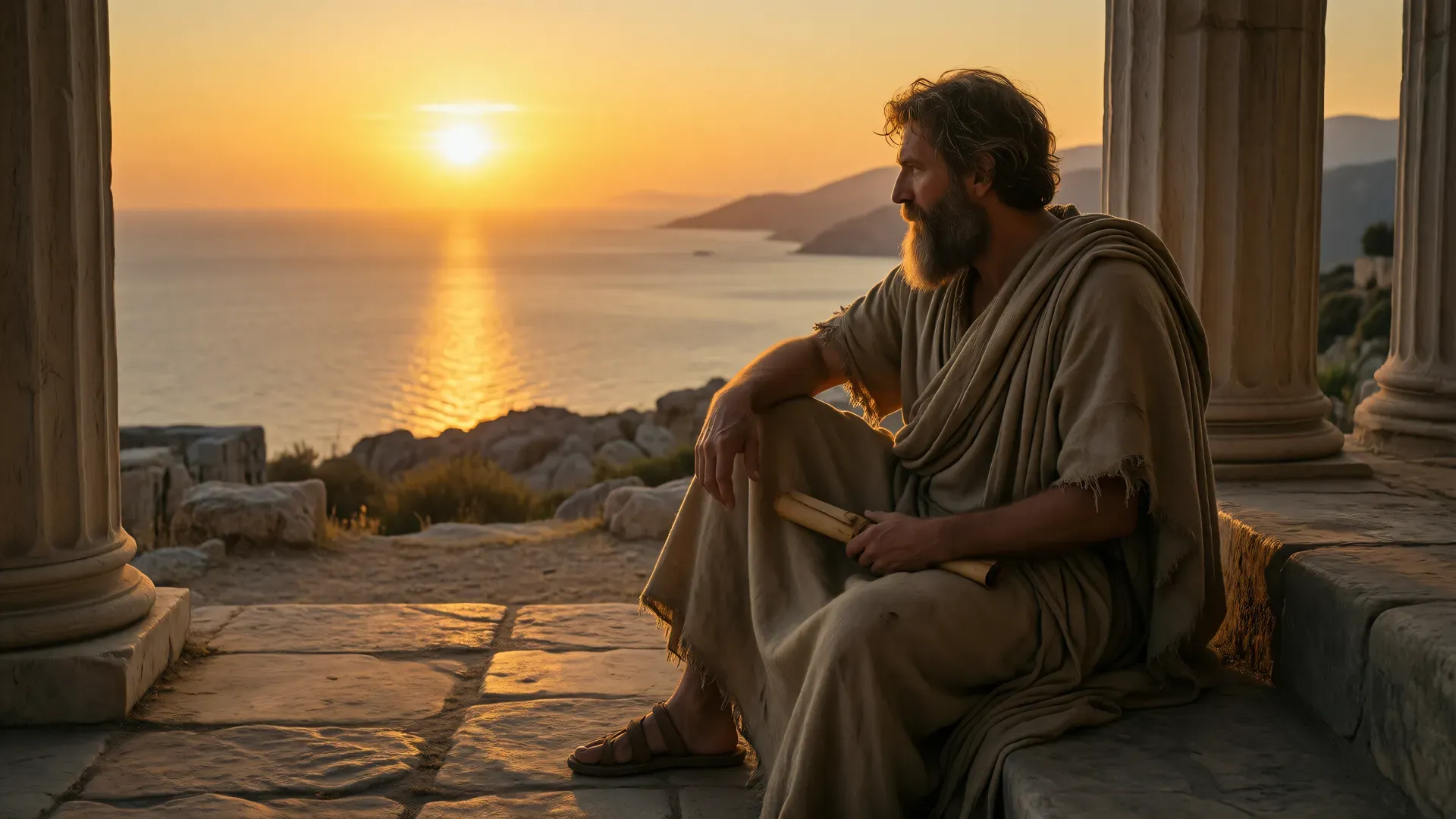
Nothing New Under the Sun — Ancient Wisdom as Diagnosis
What Ecclesiastes and ancient wisdom actually say about perennial human problems — and why the answers still hold
There is a sentence in Ecclesiastes, written somewhere between 450 and 200 BC, that most people treat as a kind of elegant resignation. There is nothing new under the sun. What has been will be again. What has been done will be done again. It sounds like the philosophy of someone who has given up — or given in.
It isn’t. It is a diagnosis. And once you read it that way, it becomes one of the most practically useful things anyone has ever written.
The Problems Haven’t Changed
Consider the specific feeling of being behind. Not behind on a task — behind on your life. The nagging sense that you should be further along by now. That other people your age are doing more, achieving more, moving faster. That time is running out and you are somehow failing to keep pace with an invisible schedule that nobody agreed to but everyone seems to be following.
This feeling is not a product of social media, or late capitalism, or the particular pressures of the twenty-first century. Seneca was writing about it in Rome in the first century AD. Not as a passing observation — as the central argument of On the Shortness of Life, one of the most precise psychological documents from the ancient world.
“The greater part of mankind complains of the unkindness of Nature, because we are born only for a short space of time,” he wrote. And then, two paragraphs later, the correction that changes everything: “We do not receive a short life, but we make it a short one.”
We do not receive a short life, but we make it a short one.
The mechanism Seneca is naming is not laziness. It is postponement — the specific cognitive habit of treating the present moment as preparation for a future when real life will begin. “Postponement,” he writes, “is the greatest waste of life: it wrings day after day from us, and takes away the present by promising something hereafter.”
An Ancient Mechanism With an Ancient Name
The feeling of being behind is, at its root, a misuse of time — not a shortage of it. The comparison is not between you and other people. It is between where you are and where you have decided you should be, at a point in time that hasn’t arrived yet and may not exist in the form you’re imagining. Seneca called this “busy-ness of mind” — a state of perpetual forward-leaning that consumes the present in order to secure a future that recedes as fast as you approach it.
Marcus Aurelius, writing his private notes in the second century — notes not intended for publication, not for posterity, just for himself — returns to the same ground. “The age and time of the world is as it were a flood and swift current,” he writes in Meditations. Not as comfort. As fact. The current moves whether you are ready or not. Standing upstream, calculating the gap between where you are and where you should be, does not change its speed.
Neither man was writing philosophy in the abstract. Both were under considerable pressure — Seneca was one of the most powerful political figures in Rome; Marcus Aurelius was governing an empire during a plague. They were not writing about the feeling of being behind from a position of leisure. They were writing about it because they felt it, and had worked out what it actually was.
That is the pattern Ecclesiastes points to. Not that everything is futile. That the same human experiences — the same drives, fears, cognitive traps, and emotional states — recur across every generation because they are features of being human, not bugs introduced by any particular era. The problems have not changed. The solutions, therefore, remain valid.
Stoic Philosophy Is Part of the Answer
The ancient world was not short of thinkers working on these questions. Seneca and Marcus Aurelius were Stoics, but Ecclesiastes predates Stoicism, and the insight is the same. The specific mechanism of temporal self-comparison — the gap between where you are and where you think you should be — appears in Confucian texts, in Buddhist philosophy, in Montaigne. Not because they borrowed from each other, but because they were observing the same human pattern. The same convergence runs through Stoicism and Christianity — two traditions that arrived at nearly identical daily practices from opposite theological starting points, each finding the same answer to the same human problem.
The question this site starts from is not “what did the Stoics say?” It is “what have human beings already worked out about this problem, wherever and whenever they worked it out?” That is what the Stoic philosophy pillar is built around — not doctrine, but mechanism. For the wider ancient tradition — Plato, Socrates, and the pre-Stoic schools — ancient philosophy as psychology maps the territory. And for a direct encounter with Plato’s account of why most people never examine their assumptions, the allegory of the cave is the place to start. For the practice Socrates considered the foundation of everything else — the self-examination method that CBT later inherited — that is a different article.
The answer to the feeling of being behind, across these traditions, is not a productivity system. It is a reframe of time itself. Seneca’s version: you are not short of time, you are wasting what you have by treating the present as a waiting room. Marcus Aurelius’s version: the current moves; be in it. Ecclesiastes’ version: the sun rises, the sun sets, the rivers run to the sea — the pattern is not yours to control, only your response to it.
That is not resignation. It is precision. The ancient writers were not telling you to give up. They were telling you exactly what the feeling is, where it comes from, and what to do about it — with a specificity that most contemporary writing on the subject never reaches, because most contemporary writing is either too academic to be useful or too motivational to be honest.
The thing that has been is the thing that shall be. The problems are old. The answers are already written. The only question is whether you can find them before you spend too many years feeling behind.
Free download
Stop staring at a blank journal. Start here.
The Three-Question Evening Review — five minutes, three questions, no blank page.