
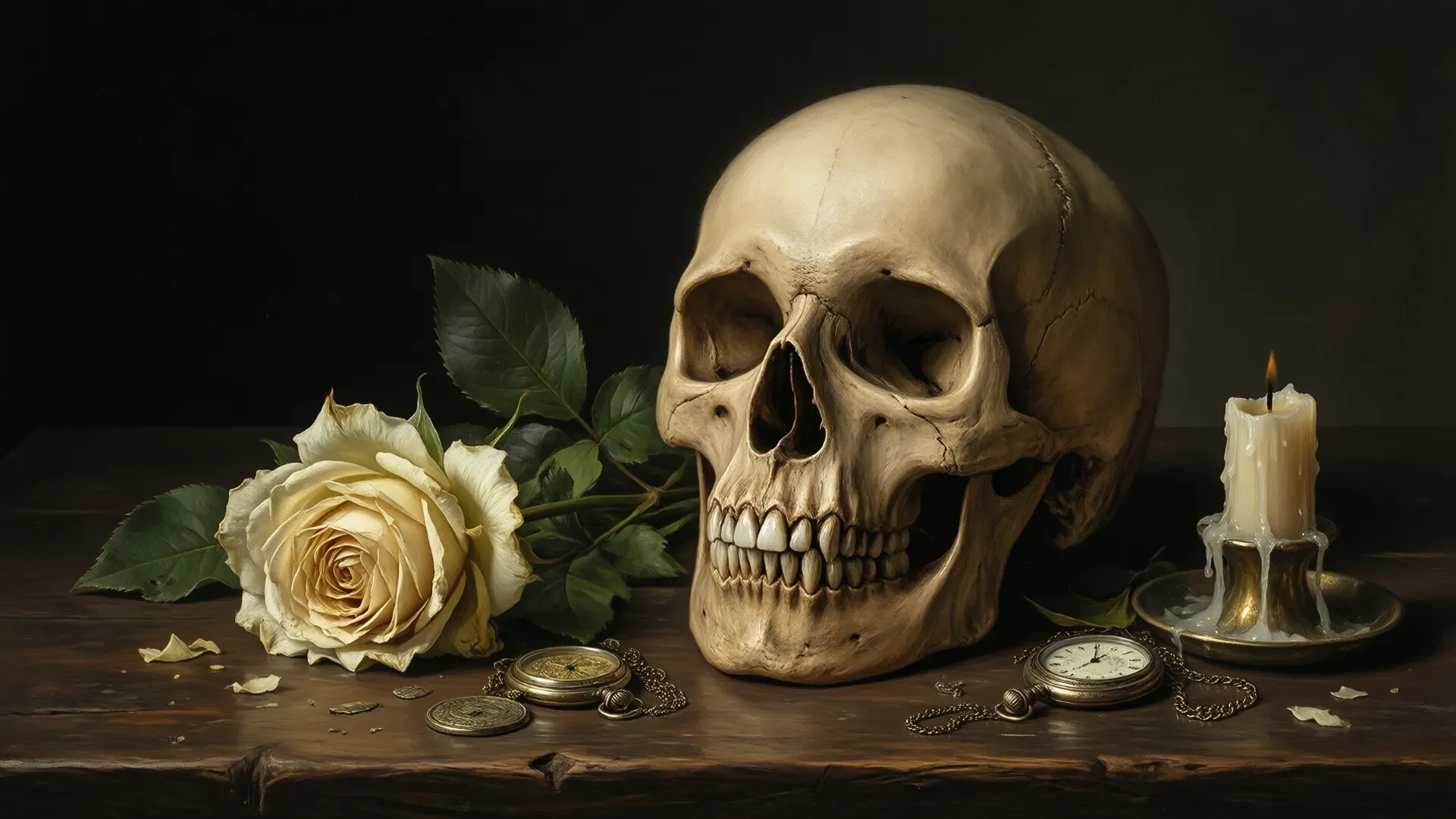
Memento Mori Meaning: The Technique Seneca Used
Memento mori meaning: what the Latin phrase actually does, and why Seneca prescribed it daily
Most people who encounter the phrase do so on a coin, a piece of jewellery, or the cover of a book. They look it up, find the translation — remember that you must die — and feel roughly as informed as they did before.
That is the right response. The translation is technically accurate and practically useless. Knowing that memento mori means “remember death” tells you almost nothing about what the Stoics were actually doing when they used it, or why it worked.
It was not a philosophy. It was a technique. The distinction matters.
What the Phrase Actually Does
A philosophy gives you a position on death. The Stoics had those too — Seneca wrote at length about death being nothing to fear, about its necessity, about the absurdity of living in dread of something universal and certain. But memento mori is not that kind of thing. It is not a consolation.
It is a cognitive intervention. A deliberate interruption of the mind’s default tendency to treat tomorrow as guaranteed.
Left to itself, the mind operates on a quiet assumption: that there will be more time. Not infinite time — even the most committed procrastinator does not believe they will live forever. But enough time. Time to have that conversation, finish that project, become whatever version of yourself you have been meaning to become. The postponement is not a decision. It is a background hum, running continuously beneath whatever you are actually doing today.
Memento mori is the interruption of that hum.
Is Memento Mori Good or Bad?
That question — which most people do ask, in some form — assumes the practice is about cultivating a relationship with dread. It isn’t.
The Stoics were explicit that the goal was the opposite: clarity, not fear. When Epictetus wrote in the Enchiridion that death should be “daily before your eyes,” he was not recommending morbidity. He was describing a calibration tool. The full passage:
“Let death and exile, and all other things which appear terrible, be daily before your eyes, but death chiefly; and you will never entertain an abject thought, nor too eagerly covet anything.”
The payoff is in the last clause. You will never too eagerly covet anything. The practice does not produce paralysis or grief. It produces proportion. What seemed urgent shrinks. What you were avoiding comes into focus.
The Catholic tradition has its own version of this — memento mori imagery in medieval church art, the Ash Wednesday reminder — and it shares the same structural logic: the awareness of death is meant to clarify how you live, not shadow it. The Stoic version differs in that it is prescriptive and deliberate rather than liturgical. It is something you do, not something you observe.
Why Terror Management Theory Explains the Mechanism
In 1974, cultural anthropologist Ernest Becker argued in The Denial of Death that most of human civilisation is, at its core, a defence against the awareness of mortality. People construct elaborate systems of meaning — religion, status, legacy, achievement — not only because these things are valuable in themselves, but because they buffer the existential anxiety of knowing that we will cease to exist.
The psychologists Jeff Greenberg, Sheldon Solomon, and Tom Pyszczynski built this into Terror Management Theory, beginning with their 1986 paper. Their consistent finding across decades of research: when people are reminded of their own mortality, two things happen. The first is predictable — anxiety spikes, defences activate, people cling harder to their existing beliefs and identities. The second is more interesting: when that initial defensive wave passes and the mortality awareness is processed rather than suppressed, people shift toward what they actually value. Status concerns recede. Presence in relationships increases. The work that feels meaningful matters more than the work that merely looks impressive.
Seneca described this effect — in the first century AD, without the experimental apparatus — with considerable precision. The mechanism is the same. What changes when you hold death in view, briefly and deliberately, is the signal-to-noise ratio of daily life. The noise quiets. The signal becomes legible.
What Seneca Was Actually Prescribing
Seneca’s Letters to Lucilius are the most sustained record we have of a Stoic working through these ideas in real time. He was old when he wrote most of them — old enough to feel the proximity of death not as abstraction but as something in the room. The letters are not theoretical. They are instructions from someone who was actually doing the work.
His central move with mortality was not acceptance in the passive sense. It was urgency reframing. The question he returned to was not “how do I become comfortable with dying?” but “given that I am dying — now, at whatever rate — what does that make non-negotiable?”
He wrote in Minor Dialogues of life as something brief and easily mislaid: “Born for a very brief space of time, we regard this life as an inn which we are soon to quit that it may be made ready for the coming guest.” Not as a cause for despair. As a reason to look carefully at what you are doing with the lodging while you have it.
Marcus Aurelius, working in the same tradition a century later, made the practical question explicit:
“Whatsoever it is that thou goest about, consider of it by thyself, and ask thyself, What? because I shall do this no more when I am dead, should therefore death seem grievous unto me?”
The question reframes the awareness entirely. Death becomes a filter, not a source of dread. Held in view, it makes certain things — the meeting you are avoiding, the conversation you have postponed, the creative work you keep planning to begin — much harder to justify delaying.
The Practice the Stoics Used
The Stoics gave memento mori structure. They built it into specific moments of the day — morning preparation, evening review — not as morbid ritual but as calibration. A brief, deliberate return to the question: given what is actually finite here, what matters?
The evening is particularly well-suited. The day is visible and complete. You can ask, without distortion, which parts of it were consistent with what you actually value and which were not. Seneca put it plainly in On Anger: “What bad habit have I put right today? In what respect am I better?” The death awareness in the background is what makes the question worth asking. Without it, the day recedes into the undifferentiated mass of days that you assumed would keep coming.
This is not the same as guilt or self-criticism. The practice is information, not punishment. If the thought of not having tomorrow makes today feel different, that difference is the data.
Most people who encounter memento mori as a phrase get the translation and stop there. What the Stoics were actually offering was a daily practice — brief, specific, aimed at a precise cognitive outcome. Understanding it is the easy part. Doing it is the part that changes anything.
The Stoic practice of daily self-examination runs through every text in this tradition. The specific structure Seneca and Marcus Aurelius used — three questions, end of day — is the same structure the Evening Review is built on. Five minutes. No blank page. If you want to try the practice rather than just read about it:
If you want to go deeper on how Stoic philosophy approaches the examined life, and why Marcus Aurelius used the Meditations as a daily practice tool, that piece traces exactly how the evening review structure worked in practice.