
What Anxiety Actually Is
Anxiety doesn’t feel like a choice. It arrives — chest tight, thoughts accelerating, some future scenario running on a loop you didn’t ask to watch. The experience is involuntary enough that most people treat it as a fact of life, like weather. Something that happens to you.
The Stoics had a different account. Not a more comforting one, necessarily — but a more precise one. And precision matters here, because if you don’t know what anxiety actually is, you can’t locate the part of it that’s in your power to change.
What the Stoics Said Fear Actually Is
The Stoics produced a formal taxonomy of emotional disturbance. Grief, fear, desire, and pleasure — these four they called the major perturbations, and they classified every variant of emotional suffering as a species of one of them.
What is striking about this taxonomy is not its comprehensiveness, but its claim about what these perturbations are.
They are judgements.
Diogenes Laërtius, recording the Stoic philosophy in the third century, is explicit about this: perturbations “are judgements, as Chrysippus contends in his work on the Passions; for covetousness is an opinion that money is a beautiful object.” He then provides the taxonomy of fear:
Fear is the expectation of evil. And the following feelings are all classed under the head of fear: apprehension, hesitation, shame, perplexity, trepidation, and anxiety. Anxiety is a fear of some uncertain event.
Read that again slowly. Anxiety — specifically — is classified as fear about something uncertain. Not about something bad that has happened. Not even about something bad that will definitely happen. About something that might happen. A future event whose nature has not yet been determined.
The judgement involved is that this uncertain event is evil, or will be. And according to the Stoics, that judgement is the source of the disturbance — not the event itself.
Why Calling It a Judgement Isn’t the Same as Calling It a Choice
Here the Stoics are careful in a way most summaries miss.
Seneca distinguishes between three stages of what he calls passion. The first emotion is involuntary — “a preparation for a passion, and a threatening of one.” The next involves a kind of wish or assent. The third is already beyond control: reason is overridden.
He compares the first stage to flinching when a hand is raised near your eyes: “We are not able by means of reason to escape from that first impression on the mind.” The initial physiological response — the tightening, the alertness, the arousal — is not yours to prevent. That is not what the Stoics are claiming you control.
What you control is the second movement: whether you assent to the judgement that the uncertain event is evil. Whether you allow the first impression to escalate into a sustained perturbation. Whether you endorse the thought that the thing you’re worried about is, in fact, a genuine evil — as opposed to simply an uncertain future.
This is a meaningful distinction. It is not “just think positively.” It is: the feeling arrived on its own, and now you have a decision to make about what to do with it.
What the Dichotomy of Control Actually Means for Anxiety
Epictetus opens the Enchiridion with his most famous observation: some things are in our power, and others are not. Our judgements and opinions are in our power. External events are not.
The relevance to anxiety is direct. What you are anxious about — the uncertain future event, the outcome of the situation you cannot yet see — is, by definition, not in your power. It hasn’t happened. It may not happen. Its nature is uncertain. Treating it as a present evil, letting it contract your thinking and accelerate your responses as though it were already real — that is what the Stoics mean by assenting to a false judgement.
Epictetus puts the core mechanism in a single sentence: “Men are disturbed not by the things which happen, but by the opinions about the things.”
This is not a motivational observation. It is a causal claim. The disturbance is not caused by the situation. It is caused by the opinion — the judgement — you have formed about the situation. Which means the disturbance lives, at least in part, in your faculty of judgement. The part that is in your power.
Marcus Aurelius, working through the same framework at the end of each day in what became the Meditations, writes: “as long as I conceive no such thing, that that which is happened is evil, I have no hurt; and it is in my power not to conceive any such thing.”
Not: “I can prevent bad things.” But: “I am not required to judge uncertain things as evil.”
What Stoic Anxiety Practice Actually Looks Like
The Stoics were not interested in producing philosophers who could explain anxiety. They were interested in producing people who could examine their judgements in the moment — and revise them.
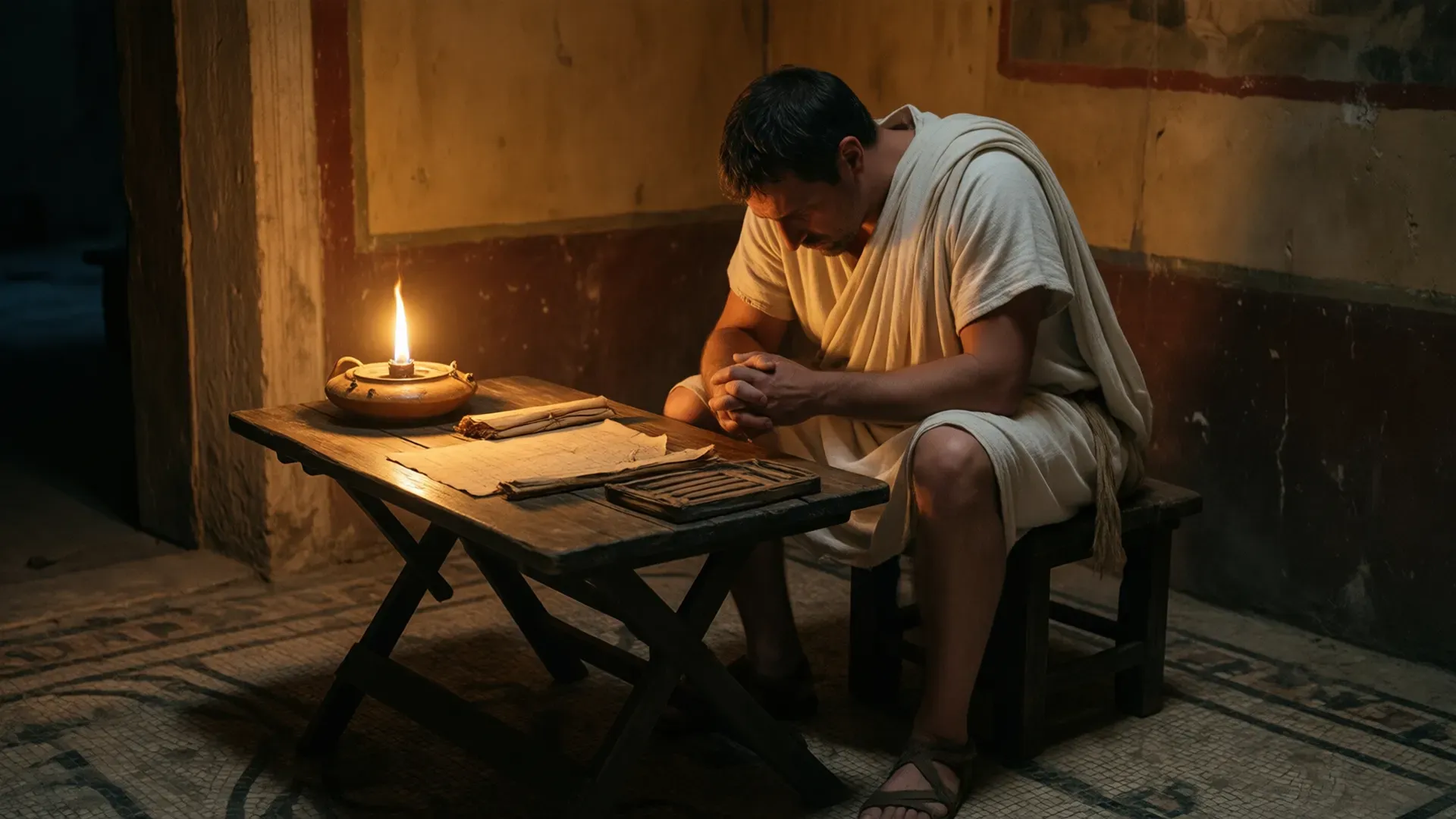
The tool Marcus Aurelius used was an evening practice. Seneca describes the same structure: pass the whole day in review before yourself, and repeat all that you have said and done. Conceal nothing. Omit nothing. This was not journaling for its own sake. It was an audit of judgements — including the judgements that produced anxiety during the day.
The underlying logic: if anxiety is a judgement about an uncertain future event, then the practice of examining that judgement — what am I treating as evil here, and is it actually evil, or is it merely uncertain? — is the practice of interrupting the escalation Seneca describes at stage two.
You cannot prevent the first movement. But you can, with practice, catch the second one.
That is what the Evening Review is. Three questions: what happened, what did I make it mean, what would I examine more honestly. Five minutes. The Stoic framework in its simplest application — applied specifically to the judgements that produced distress during the day, before they compound into chronic perturbation.
The Stoic account of anxiety is not “stop worrying.” It is: locate where the worry lives — in your judgement about an uncertain event — and examine whether that judgement is actually warranted. Most of the time, you will find that the event is genuinely uncertain. That you have been treating a possibility as a certainty, and a neutral future as a predetermined evil. And that discovering this is, in itself, relief.
If you want to start tonight, the Evening Review is one page, free, and built on exactly this structure. Three questions. The Stoic framework, applied before bed. And if you want to go deeper on the Stoic philosophy behind this — how Epictetus built an entire practical system from the same principle — that’s where to go next. The same mechanism applied to anger rather than anxiety is covered in The First Flash of Anger Wasn’t Yours — Seneca’s three-stage model maps directly onto this one.