
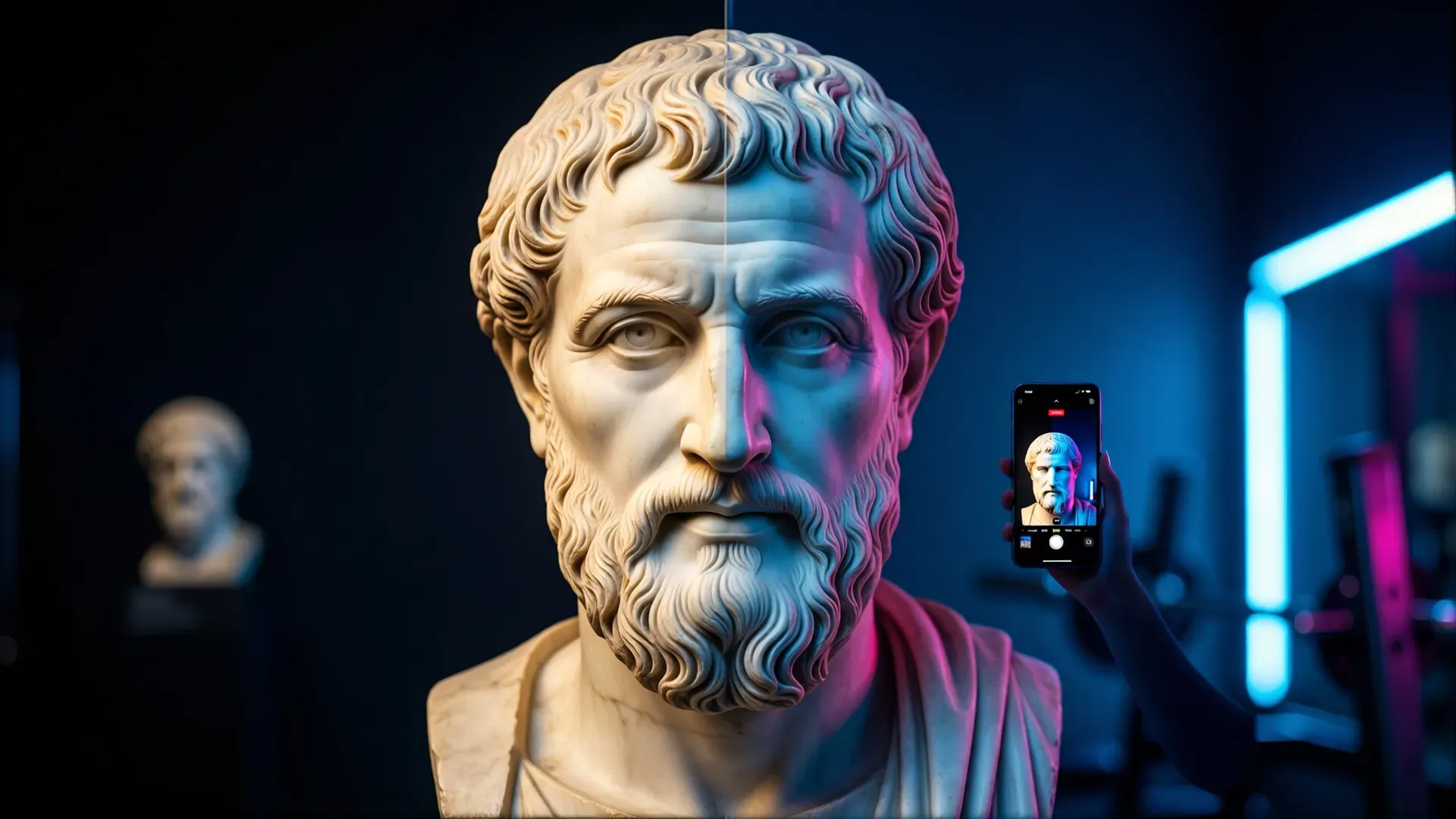
Broicism: How the Gym-Bros Rebranded Stoicism — and Broke It
The gym-bro rebrand of Stoicism inverts the one thing the Stoics were actually doing
Broicism is the gym-and-hustle rebrand of Stoicism: be unmoved, feel nothing, dominate the room, grind until you win. It is everywhere now — the supplement ads, the cold-plunge reels, the “high-value man” threads quoting Marcus Aurelius over a photo of a Lamborghini. And it gets the one thing that actually matters exactly backwards. Real Stoicism was never about not feeling. It was about examining the judgment underneath the feeling — the same move modern therapists later rebuilt from scratch and called cognitive reappraisal. The bros kept the marble busts and threw out the method.
The term is usually credited to the philosopher Massimo Pigliucci, who has spent years writing about Stoicism and watching it get flattened into a personality brand. It caught on because it names something real. There is a version of this ancient philosophy circulating online that shares its vocabulary and almost none of its content. This is a sharper, more specific failure than the general drift covered in what the modern revival gets wrong — broicism is the named, gym-and-grind end of that same problem.
What broicism actually is
Broicism keeps the aesthetics of Stoicism — the Roman statues, the “memento mori” tattoos, the clipped quotes about discipline — and swaps the substance for a self-optimisation pitch. The promise is control: control your face, control your reactions, control other people’s perception of you, and the wins follow. Tim Ferriss packaged Seneca’s letters as “an operating system for thriving in high-stress environments.” Ryan Holiday turned the whole tradition into a daily-meditation product line. Neither man invented broicism, but the market they helped build did, and the influencers downstream stripped out what little nuance remained.
What’s left is a mood, not a philosophy. Stoicism becomes a synonym for unbothered. The goal is to look like nothing touches you. And once that’s the goal, the practice collapses into something much older and much dumber: just don’t show it.
The mechanism the bros invert
Here is the part no supplement ad will tell you. The Stoics were not trying to feel less. They were trying to think more clearly about what they felt — to catch the automatic judgment that turns a sensation into a full-blown reaction, and to interrogate it before assenting to it.
Seneca is blunt about this in his essay on anger. He notes that the bravest soldier still turns pale putting on his armour, that the great general’s heart leaps into his mouth before the lines clash, that the most eloquent orator’s hands go cold before he speaks. These are not failures of Stoicism. They are involuntary — what Seneca calls the first movements, the body reacting before the mind has had a word in. The passion, the thing the Stoic actually works on, comes later: it’s the assent, the moment you accept the first impression as true and act on it.
The bravest of men often turns pale while he is putting on his armour; the heart even of a great general leaps into his mouth just before the lines clash together.
Read that again with the bro version in mind. Broicism says the brave man feels nothing. Seneca, who actually thought about this, says the brave man’s knees shake and then he does the thing anyway — because he examined the fear instead of obeying it. The feeling was never the enemy. The unexamined reaction was.
This is why the comparison to modern therapy isn’t a stretch. When Albert Ellis built rational emotive behaviour therapy in the 1950s, and cognitive behavioural therapy grew from it, he credited Epictetus directly — specifically the line that people are disturbed not by events but by their judgments about events. That is the best-documented case of a modern discipline re-deriving an ancient one. The Stoics had located the leverage point two thousand years earlier: not the event, not even the emotion, but the appraisal in between. Broicism, for all its talk of mental toughness, never finds that leverage point at all.
Is Stoicism toxic masculinity?
This is the question the bro version makes unavoidable, and it deserves an honest answer rather than a defensive one.
Stoicism is not toxic masculinity. But it would be dishonest to pretend the ancient Stoics were all warmth. They aimed at apatheia — freedom from being ruled by the passions — and some of them described it in genuinely austere terms. Cicero reports that the Stoics held the wise man to be, in a strict sense, incapable of pity, and praised their “bold and manly turn of thought.” There is a real thread of severity in the tradition. The bros didn’t hallucinate it.
What they did was collapse the distinction. The orthodox Stoic separated the involuntary first movement, which even the sage feels, from the assent, which the sage withholds. Lose that distinction and “don’t be ruled by your emotions” degrades into “don’t have any” — and from there it’s a short step to “needing people is weakness,” which is the actual content of most toxic masculinity. The ancient idea was about sovereignty over your reactions. The bro idea is about looking like you have no reactions, which usually means burying them somewhere they’ll do damage.
The tell is the opposite of what broicism advertises. The most-quoted Stoic of all, Marcus Aurelius, opens his private notebook — never meant for publication — with a long list of the people he loved and what he learned from each: kindness from one, self-control from another, tenderness from his adopted father. He was not performing detachment. He was an emperor cataloguing his gratitude. The men who put his face on their motivation posts would not recognise the book.
What the Stoics actually taught (the part that doesn’t sell supplements)
Strip away the rebrand and the real philosophy is almost embarrassingly unglamorous. It asks you to sort what’s in your control from what isn’t, and to invest your effort only in the first category. It asks you to treat your own snap judgments as suspects, not facts. It defines a good life around character — the four virtues of justice, courage, temperance, and wisdom — rather than around outcomes you can post about.
None of that flatters anyone. There is no protein powder in it, no morning routine to buy, no enemy to feel superior to. Which is precisely why the influencer economy couldn’t sell the real thing and had to manufacture broicism instead. A philosophy that tells you to be kind, examine your reactions, and stop chasing reputation does not move units.
The good news is that the genuine article is free and short. Meditations can be read in an afternoon. Epictetus fits in a pocket. You do not need a course, a coach, or a subscription — and the single loudest complaint under every “Stoicism scam” video online is some version of people will do anything to avoid reading the actual book.
How to tell real Stoicism from broicism
A few reliable signals, once you know what you’re looking at.
Broicism is about other people seeing you as unmoved; Stoicism is about you not being secretly ruled by your reactions, whether anyone’s watching or not. Broicism treats emotion as the enemy; Stoicism treats the unexamined judgment as the enemy and lets the emotion be data. Broicism is upsold — the threshold to entry is a purchase; Stoicism’s primary texts are public domain. And broicism is always, somehow, about winning: status, money, dominance. The Stoics held that those things were indifferents — fine to have, but not where a good life is decided.
If the version of Stoicism you’ve met made you feel slightly worse about yourself for having feelings, you didn’t meet Stoicism. You met its costume. The real one is gentler and more demanding at the same time: it doesn’t ask you to feel nothing. It asks you to look honestly at what you feel, and to decide what you do next with your own reason instead of your reflexes. That’s harder than going to the gym. It’s also the entire point.
Frequently asked questions
- What is the difference between Stoicism and broicism?
- Stoicism is a practice of examining the judgments that produce your emotions, so you respond from reason rather than impulse. Broicism is the modern gym-and-hustle rebrand that mistakes this for emotional suppression — 'feel nothing, dominate everyone.' The first interrogates emotion; the second just buries it.
- Is Stoicism toxic masculinity?
- Stoicism isn't, but broicism borrows its language to dress up something that is. The bro version uses 'be stoic' to mean 'show no feeling and never need anyone' — which the actual Stoics would have called a failure of reason, not a strength. Marcus Aurelius opens his private journal by thanking people for their kindness and tenderness.
- What is the dark side of Stoicism?
- The honest one: orthodox Stoicism aimed at apatheia — freedom from being ruled by the passions — and some ancient Stoics framed this in austere, even harsh terms. Misread, that becomes an excuse for coldness and avoidance. The corrective is that the Stoics never claimed not to feel; they claimed not to be governed by the feeling.
- Who coined the term broicism?
- The philosopher Massimo Pigliucci, who writes extensively on Stoicism, is credited with the term. It names the masculinised, self-improvement-influencer version of the philosophy that spread online in the 2020s.
Free download
Stop staring at a blank journal. Start here.
The Three-Question Evening Review — five minutes, three questions, no blank page.