
Guide to
Ancient Wisdom — Stoicism, Plato, and the Examined Mind
The ancient philosophers were not building systems for academics to argue about. They were solving practical problems — why people act against their own interests, what a well-functioning mind looks like, and what to do when yours isn't working that way. Modern psychology reinvented these answers in clinical language. The vocabulary changed. The territory did not.
Trace the reinvention case by case and the pattern is hard to unsee. The mechanism behind CBT was described by Epictetus. The structure of motivated reasoning was mapped by Plato. The link between examined principles and emotional stability was the whole of Socratic philosophy. Each was later restated in clinical language and presented as new — the terminology modernised, the underlying observation unchanged.
This is the through-line of everything below. Not a museum tour of dead Greeks and Romans, but a working toolkit — the oldest and, in places, still the most precise accounts of how a mind actually operates and what a good life asks of it. Read it as a map. Each section below opens onto a fuller treatment; follow the ones that name a problem you recognise.
A word on why the age of these ideas is a feature, not an apology. A claim that has survived two thousand years of people trying to live by it has been stress-tested in a way no recent framework has. The merely clever ideas fell away. What remains was kept because it kept working — a slower, cruder kind of evidence than a study, and a harder one to fake. When an ancient observation and a modern clinical finding land on the same conclusion from opposite ends of history, that convergence is the strongest signal either one could carry.
What philosophy is actually for
Most people meet philosophy as a set of questions to have opinions about. That is the wrong frame, and it is why it feels useless. What philosophical questions actually do is closer to what a doctor does with symptoms — they are a diagnostic instrument, a way of finding where a life is misfiring, not a quiz. The questions themselves aren’t the point; what they surface is.
Which matters because you are already answering them, whether or not you’ve noticed. You already have a philosophy of life — it assembled itself out of your upbringing, your defeats, and the ambient assumptions of your era, and it is running your decisions right now. The only real choice is whether to examine it or let it keep running unread. That is the case for treating ancient philosophy as a way to learn how to think, not what to think: a method for auditing the beliefs you already hold and deciding which are worth keeping.
There is a reason these old answers keep proving adequate to new problems. The line from Ecclesiastes that nothing is new under the sun is usually read as elegant resignation. It is better read as a diagnosis: the human situation is stable enough that people who watched it carefully two thousand years ago were watching the same thing you are.
It helps to lower one expectation at the outset. The philosophers did not agree, and the temptation is to treat that as a failure — as if the whole enterprise would be redeemed by one of them turning out to be right. But the disagreement is the instrument. Reading what the philosophers said about the meaning of life, the useful thing is not the answer you adopt but the map of live options their quarrel lays out — each position a real pressure the others had to withstand. A single answer would tell you less.
Stoicism: the core
Start with the correction, because almost everyone arrives with the wrong idea. What Stoicism actually means is not feeling nothing, not gritted-teeth endurance, not the emotional flatline the word now implies. It is a precise account of what is in your power, what is not, and what happens to your mind when you confuse the two. Get that straight and the rest follows; miss it and you end up practising a caricature.
The tradition has a structure worth knowing. Roman Stoicism is where the philosophy stopped being a lecture and became a discipline three very different men actually put to the test — a statesman, a former slave, and an emperor. Its ethical core is smaller than it looks: the four Stoic virtues — wisdom, justice, courage, temperance — turn out to be one idea wearing four faces, which changes how you use them. And its account of failure is unusually honest. The opposite of virtue is vice, but two ancient schools disagreed about what vice even is, and which of them you believe changes how you handle your own faults.
Two harder questions sit at the edges of the school. Modern Stoicism — the podcast-and-app version — gets some real things wrong while missing what is actually there to use. The sharpest version of that drift has its own name: broicism, the gym-and-hustle rebrand that keeps the vocabulary of discipline and quietly deletes the justice and self-examination that made it a philosophy rather than a mood. Worth understanding, because it’s the form most people now meet first. And the tradition’s relationship to religion is more tangled than either side admits: the overlap between Stoicism and Christianity is real, largely unexplained, and revealing about both.
Stoicism was also not the only school preaching self-command in the ancient world, and its most extreme cousin makes it look moderate. Diogenes the Cynic lived in a barrel, owned almost nothing, and made a public argument out of his own poverty — a deliberately uncomfortable challenge to the idea that a good life needs any of the things you are anxious about losing. The Stoics learned from him and then softened him. Reading the two together shows what they kept and what they wouldn’t.
Marcus Aurelius and the Meditations
The most-quoted Stoic text is also the most misread, because of how it was made. Marcus Aurelius was writing to himself — the Meditations is a private notebook, not a book for an audience, which is exactly why it lands: you are reading a man arguing with himself, not performing for you. That single fact reorganises how the whole thing reads.
If you want to actually read it, two practical guides help. The best translation of Meditations is a real decision — the wrong one turns a living voice into a Victorian sermon — and a reading guide to the Meditations for modern readers gives you a way in that doesn’t start at page one and stall. What survives the reading is a method, not a mood: the practice Marcus Aurelius actually used was a nightly review of the day, which is closer to a cognitive-behavioural exercise than to anything mystical — and it is the direct ancestor of the evening review.
Epicurus and the rival school
Stoicism had a serious competitor, and the contrast sharpens both. Stoicism versus Epicureanism sets two rival maps of the good life side by side — one built on virtue and acceptance, the other on the careful management of desire — and the disagreement is more useful than either answer alone. Epicurus is routinely libelled as a hedonist; his letter to Menoeceus is the short text where he says plainly what he meant, and where its limits show.
His most durable contribution isn’t about pleasure at all. The Epicurean paradox — the oldest sharp formulation of the problem of evil — is a piece of reasoning that has outlived its author by more than two millennia and still forces a real choice from anyone who takes the question seriously.
Plato and Socrates
Before the schools, there was the method. Socratic questioning was not a debating trick; it was a technique for examining the principles you live by, on the conviction that unexamined ones do a specific, invisible kind of damage. It survives, almost unchanged, as a core move in modern therapy.
Plato built the pictures that carry those ideas. The allegory of the cave is not really about knowledge — it is a description of why comfortable false beliefs are preferred to difficult true ones, and what preferring them costs. It rewards a second look, because most people think they’ve already escaped the cave, which is itself the point. Underneath the image sits the argument: Plato’s divided line is the map of reality the cave dramatises, the reason the story has a structure and not just a moral.
Aristotle: virtue as habit
Aristotle’s answer to how to live is the least mystical and, for that reason, the most immediately usable. Aristotle’s virtue ethics says goodness is not a rulebook you consult but a set of habits you build — character is what you repeatedly do, made durable. This is a quietly radical claim. It means virtue is not something you have or lack by temperament; it is trained, the way a skill is, through repetition until the right response stops requiring a decision. You do not become patient by resolving to be patient. You become patient by acting patiently often enough that it sets.
The aim of all that habituation has a name: eudaimonia, badly translated as “happiness,” better understood as a life functioning well over its full length. The mistranslation does real damage — it turns a claim about how a whole life goes into a claim about how you feel this afternoon, which are not the same thing and often point in opposite directions. Positive psychology re-derived the whole framework in the last thirty years, largely without crediting him: its character strengths are Aristotelian habits, its distinction between pleasure and flourishing is his distinction, relabelled.
Nietzsche and the modern turn
The modern philosopher most often set against the ancients turns out to be in closer conversation with them than the slogans suggest. What Nietzsche really thought of Stoicism was not contempt — it was a sharp, respectful quarrel with a school he’d read closely. His own central demand runs parallel to the Stoic one. Amor fati is not acceptance: where the caricature hears passive resignation, Nietzsche meant an active love of one’s fate, a saying-yes that takes more nerve than any stoic calm. Its engine is the hardest thought he set: the eternal return asks whether you could will to live this exact life, unchanged, an infinite number of times — and uses your flinch as data.
Living with death in view
The Stoics turned mortality into a tool, and it is one most people only half pick up. What memento mori means is not morbid brooding but a technique Seneca used to clarify what actually matters by keeping its end in view. It has a long visual history — the skull, the hourglass, the guttering candle — each image a compressed argument about time.
The most sustained ancient treatment of this sits in a single essay. Seneca on the shortness of life makes an argument people misfile as a productivity tract: the problem is not that life is short but that we squander most of it, handing our hours to other people’s demands and our own distraction, then complaining there wasn’t enough time. It is less a lament than an accusation, and it holds up uncomfortably well against a calendar.
But the phrase has a neglected other half. Memento vivere — remember to live — is the harder instruction, because remembering you will die costs nothing until it changes what you do with the afternoon in front of you. That is where this pillar points: not at the contemplation of death, but at the conduct it is supposed to sharpen.
Where this connects
The ancient account of the mind is the foundation the rest of Citewise builds on. Where these ideas meet modern clinical practice — Stoicism and CBT, Socratic method and cognitive therapy — that is the work of Philosophy as Psychology. Where they meet the question of what a life is for, that is Meaning & Purpose. The oldest maps are still in use because the territory never changed.
Explore every article in this pillar
Nothing New Under the Sun — Ancient Wisdom as Diagnosis
There is a sentence in Ecclesiastes, written somewhere between 450 and 200 BC, that most people treat as a kind of elegant resignation.

He Was Writing to Himself — Marcus Aurelius and the Meditations
What the Meditations reveals about what Marcus Aurelius actually was doing — and what Stoicism actually is.
Seneca on the Shortness of Life — Not a Productivity Book
Seneca wasn't writing a productivity book. He was indicting busyness itself — and the people who believe managing time will solve their problem.

The Ancient Philosophy That Teaches You How to Think, Not What
Stoicism is not a philosophy of endurance. It's a method for examining the beliefs you already hold — and deciding which ones are worth keeping.

Meditations by Marcus Aurelius: A Guide for Modern Readers
The first thing most people notice about Meditations is that it repeats itself. Here is what that repetition was actually doing.

The Practice Marcus Aurelius Actually Used — The Evening Review
What his Meditations reveal about stoicism — and why everything sold in his name misses it You have probably encountered stoicism by now.

Plato's Allegory of the Cave — and Why You Think You Escaped
The most-liked comment on the most-watched video about Plato's cave reads: 'I love how everyone feels they've escaped it when they hear this.' The person who wrote it is also doing it.

Memento Mori Meaning: The Technique Seneca Used to Live Better
Memento mori isn't a philosophy — it's a technique. Seneca used it daily to interrupt the mind's assumption that there will always be more time.
Socratic Questioning: The Ancient Self-Examination Practice
CBT teaches Socratic questioning as a clinical technique. What it left out is the part Socrates considered essential: the questions were always directed inward first.

You Already Have a Philosophy — You Just Didn't Choose It
Your philosophy of life is already running. You didn't choose it — it assembled itself. Here's why that matters.

The Question Nobody Answered Properly — Philosophers on Meaning
The philosophers disagreed about the meaning of life. That disagreement is more useful than any single answer they gave.
Roman Stoicism — Three Thinkers Who Actually Put It to the Test
Zeno founded it. The Romans field-tested it — under conditions of enslavement, exile, and empire. Here is what stoicism actually means.

The Overlap Nobody Fully Explains: Stoicism and Christianity
Stoicism and Christianity arrived at the same practices from different directions. Here's what the overlap is — and where they genuinely part ways.
Eudaimonia Meaning: Why "Happiness" Is the Wrong Translation
The word happiness has been pointing you at the wrong target for 2,000 years. Here is what Aristotle actually meant.
What Philosophical Questions Actually Do — Why It Matters
Philosophical questions about life aren't a list — they're a diagnostic tool. Here's the mechanism.

What Modern Stoicism Gets Wrong — and What's Actually There
Modern Stoicism sells a posture. The original texts describe a method — specific practices with identifiable psychological mechanisms. Here is what they actually do.

What the Four Stoic Virtues Really Are (and Why It's One)
The four Stoic virtues look like a list to memorise. They are really one idea wearing four faces — and that changes how you use them.
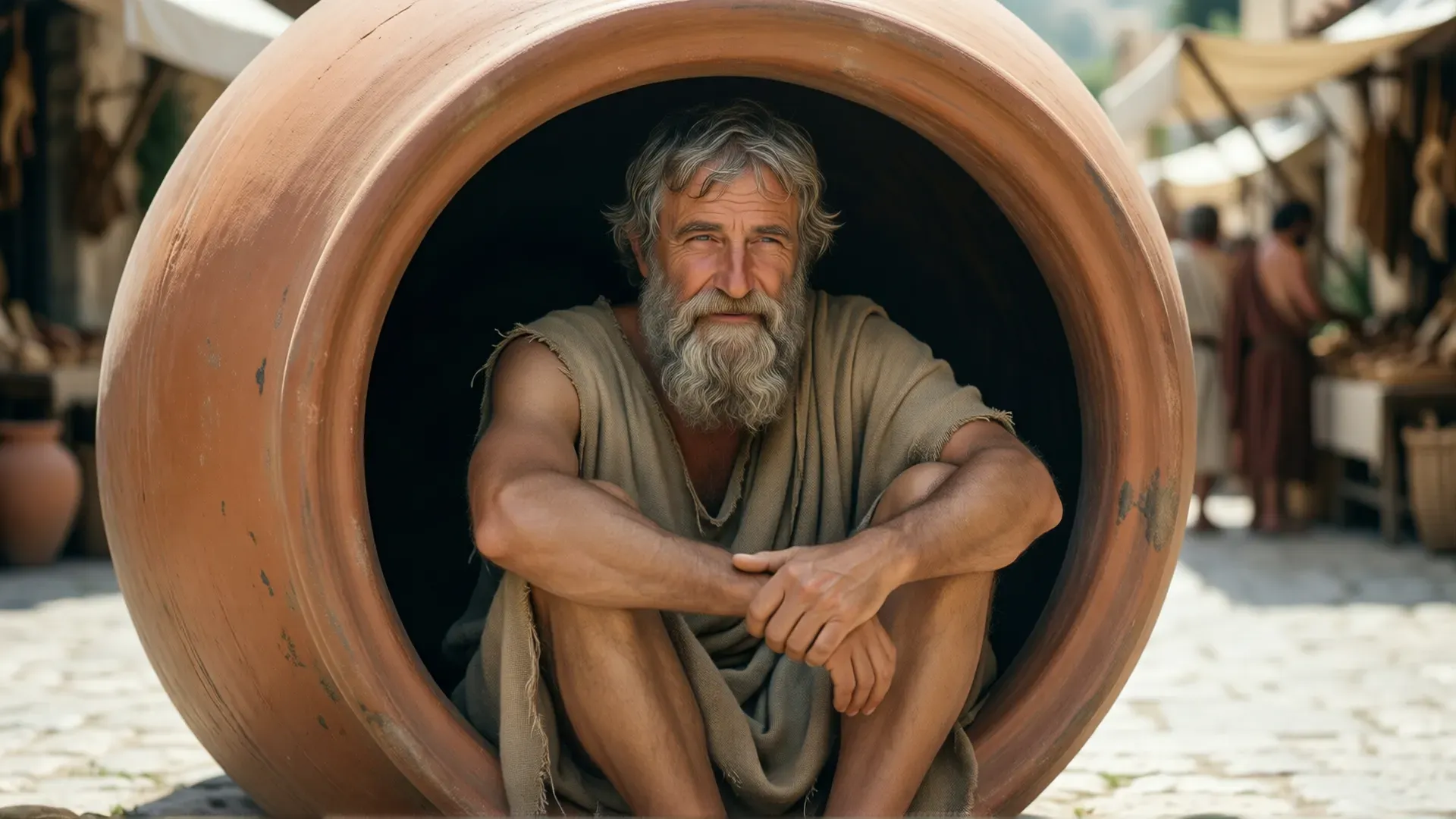
Diogenes the Cynic: The Philosopher Who Lived in a Barrel
Diogenes the Cynic lived in a jar and mocked Alexander the Great. The stunts weren't trolling — they were arguments, and one of them is a freedom technique.

Memento Mori Symbolism: What the Skull and Hourglass Mean
The skull, the hourglass, the wilting flower — what memento mori symbols mean, and the Stoic practice they were built to trigger.

Aristotle's Virtue Ethics: Why Goodness Isn't a Rulebook
Aristotle's virtue ethics asks who you should become, not what you should do. The golden mean isn't a halfway point — and that changes everything.

Memento Vivere Meaning: Why "Remember to Live" Is Harder
Everyone knows memento mori. Almost nobody practises its other half — the one that actually asks something of you.
Broicism: How the Gym-Bros Rebranded Stoicism — and Broke It
Broicism sells Stoicism as 'feel nothing, grind harder.' That's the exact opposite of what the Stoics taught — and here's how to tell the difference.

The Opposite of Virtue: Is It Vice, or the Absence of It?
The opposite of virtue is vice — but two ancient schools disagree about what vice even is, and the answer changes how you handle your own faults.

Stoicism vs Epicureanism: Two Rival Maps for How to Live
Stoicism and Epicureanism look like opposites. They were rivals chasing the same thing — a calm life — by routes that disagree on one real point.

The Epicurean Paradox: The Oldest Argument About Evil, Examined
An ancient trilemma that still ends faiths: what the Epicurean paradox actually claims, who really wrote it, and why it hits harder than logic should.

Amor Fati Isn't Acceptance: Nietzsche's Life-Affirmation
Nietzsche's amor fati isn't acceptance — it's loving your fate, the regret included. The harder life-affirmation he actually meant.

The Best Translation of Meditations: Which to Actually Read
There is no single best translation of Meditations — there is a best one for why you're reading. Here is the rule that ends the dithering, and the editions to avoid.

Eternal Return: Nietzsche's Hardest Question, Explained
Nietzsche's eternal return asks if you'd live this exact life again, forever. Your answer reveals more about you than about the universe.

Epicurus's Letter to Menoeceus: What It Says (and Its Limits)
Epicurus's most famous letter is usually flattened to a soundbite about death. Read whole, it's a system for sorting what you actually want.

Plato's Divided Line: The Map Behind the Allegory of the Cave
Most people meet Plato's cave and never meet the diagram that explains it. The Divided Line is the map the cave is a story about.
What Nietzsche Really Thought of Stoicism — It Wasn't Hatred
The whole internet says Nietzsche destroyed Stoicism. He didn't — and the real critique is sharper, and stranger, than the fight everyone keeps staging.

The Dichotomy of Control: What Epictetus Actually Meant
The dichotomy of control is the most quoted and most misunderstood Stoic idea. What Epictetus actually meant, why 'just focus on what you can control' misses it, and how to use it without going numb.
What "Stoicism" Actually Means — It Isn't "Feeling Nothing"
The popular meaning of "stoic" gets the philosophy backwards. Stoicism isn't feeling nothing — it's the idea that your emotions follow your judgements.

Apatheia Is Not Apathy: The Emotions a Stoic Actually Keeps
Apatheia sounds like giving up on feeling. It means the opposite — and names the three emotions a Stoic keeps on purpose.

Zeno of Citium: The Shipwreck That Began the Stoic School
Stoicism was founded by a bankrupt merchant who lost his cargo at sea, wandered into an Athens bookshop, and never left. We don't have a single word he wrote — here's how we still know what he taught.

Seneca: The Stoic Philosopher Who Admitted He Wasn't a Sage
Rome's most quoted Stoic said plainly that he had not arrived. Everything else about his strange, compromised life follows from that admission.
Frequently asked questions
- What is Stoicism?
- Stoicism is a practical philosophy founded in Athens around 300 BC and developed most fully by the Romans — Epictetus, Seneca, and Marcus Aurelius. Its central insight is the distinction between what is in your power (your judgements, intentions, and responses) and what is not (everything external). Stoicism is not a philosophy of suppression or resignation. It is a precise account of where human agency actually lies, and what follows from taking that seriously.
- What is the dichotomy of control?
- The dichotomy of control is Epictetus's foundational distinction: some things are up to us (our judgements, impulses, desires, aversions) and some things are not (our bodies, reputation, property, other people's actions). Anxiety and suffering, in the Stoic account, arise from treating things in the second category as if they were in the first. The practice is not indifference to external things, but clarity about where your agency actually operates.
- What is Plato's allegory of the cave?
- Plato's allegory of the cave, from the Republic, describes prisoners chained in a cave who take shadows on a wall to be reality. When one prisoner escapes and sees the sun, he struggles to look at it directly — and when he returns to tell the others, they refuse to believe him. The allegory is not primarily about epistemology. It is a description of why comfortable false beliefs are preferred over difficult true ones, and what the cost of that preference is.
- Who was Epictetus?
- Epictetus was a Stoic philosopher who was born into slavery in the first century AD and eventually founded a philosophical school in Nicopolis. He wrote nothing himself — his teaching survives through his student Arrian's notes. His core claim was that freedom is internal: the enslaved body is irrelevant to the free mind. Albert Ellis cited him as the direct philosophical source for rational emotive behaviour therapy, the precursor to CBT.
- What is memento mori?
- Memento mori is a Latin phrase meaning 'remember that you will die.' The Stoics used deliberate contemplation of death as a practical technique, not a morbid one: by keeping mortality in mind, you clarify what actually matters. Marcus Aurelius returned to it repeatedly in his Meditations. The practice interrupts the hedonic treadmill, restores perspective on minor frustrations, and — according to the research on terror management theory — tends to make people more generous, not less.
- What is the relationship between Stoicism and nihilism?
- Nihilism holds that life has no inherent meaning. The Stoic response is not to assert meaning emotionally but to argue for it structurally: the universe is rationally ordered, human beings are part of that order, and a life aligned with reason and nature has a purpose built into its structure. This is not comforting in the way an assertion of cosmic meaning is comforting. It is a reasoned position — and it was the Stoics' direct answer to the same view when it appeared in ancient philosophy.