
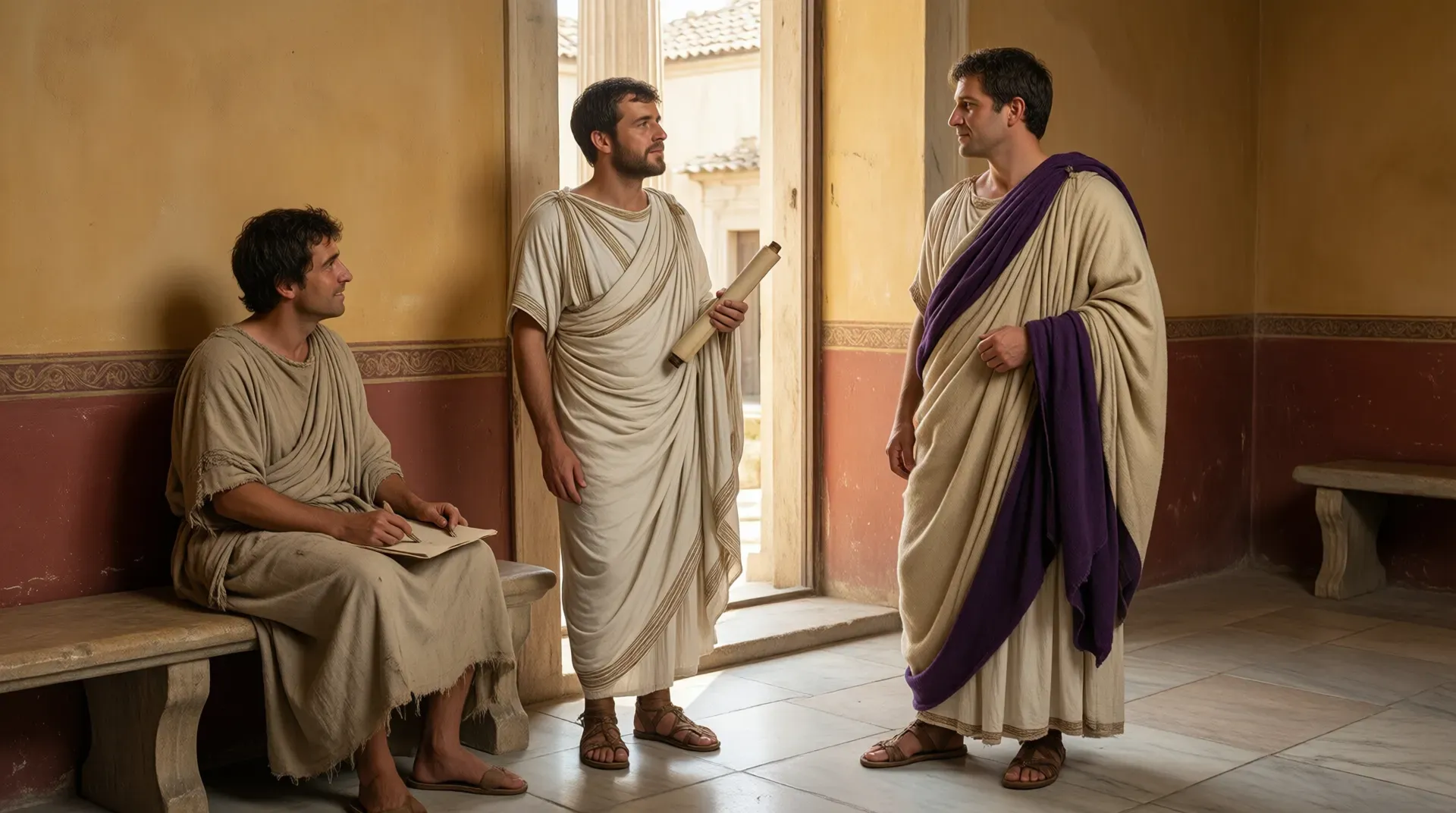
Roman Stoicism — Three Thinkers Who Actually Put It to the Test
What stoicism means — and why the Roman version is the one that survived
The philosophy was already 400 years old when the Romans got hold of it. Zeno had founded it in Athens around 300 BCE, teaching in a painted porch — stoa — which is where the name comes from. His followers developed it into a complete system: logic, physics, ethics, a theory of the cosmos and the soul. By the time Marcus Aurelius was writing his private notes in the second century CE, Stoicism had been refined across a dozen generations of Greek philosophers.
What the Romans did was not invent it. They stress-tested it.
Three men in particular. A slave who was tortured by his owner and forbidden from complaining about it. A playwright and financier exiled twice and eventually ordered to kill himself by the emperor he had tutored. And the emperor himself, who spent most of his reign fighting wars he didn’t want to fight, managing an empire that was visibly starting to crack, while writing notes to himself in Greek about how to think correctly. The philosophy these three men practised was not inherited without modification. It was rebuilt — under conditions that required it to actually work.
Understanding what stoicism means starts here.
The Problem Stoicism Was Solving
The Greek founders were working on a philosophical question: what does it mean to live a good life? Their answer was that a good life depends on virtue — specifically on the rational capacity to distinguish what is genuinely good from what merely seems good. External things — wealth, health, reputation, political power — are useful, and worth pursuing under normal conditions. But they are not required for a good life, because they are outside our ultimate control. Virtue, which is purely internal, is the only thing that cannot be taken from you.
This is a coherent philosophical position. What the Roman Stoics noticed is that it has a very practical implication that the Greeks, living in a democratic city-state with genuine civic participation, had not been forced to test as severely. What happens when you apply this framework to a life where almost everything external has been removed or threatened?
Epictetus — born a slave, probably in the 50s CE — had no civic rights, no property, no freedom of movement, and at some point a master who broke his leg to demonstrate that Epictetus couldn’t stop him. The philosophical question this creates is not abstract: if external circumstances are genuinely irrelevant to a good life, does that remain true in conditions of actual enslavement? Epictetus’s answer was yes, and his reasoning is precise enough that you can trace the seam between what is his and what he inherited.
What the Romans Actually Taught
The core of Epictetan Stoicism is a distinction so simple it looks obvious until you try to live it.
Everything that exists falls into one of two categories. The first contains things that are, in his phrase, “up to us” — our opinions, our judgments, our desires, our responses to events. The second contains everything else: our bodies, our reputations, our property, other people’s behaviour, the weather, the political situation, what happens to us. The first category is genuinely ours. The second is, ultimately, not.
The Enchiridion — the manual Epictetus’s students compiled from his lectures — opens with this distinction and never really leaves it:
“Within our power are opinion, aim, desire, aversion, and, in one word, whatever affairs are our own. Beyond our power are body, property, reputation, office, and, in one word, whatever are not properly our own affairs. Now the things within our power are by nature free, unrestricted, unhindered; but those beyond our power are weak, dependent, restricted, alien.”
The word “alien” is important. Not simply beyond your control — foreign to you. Belonging to a different category of reality than your own character and judgment. If you treat things in the second category as though they belong in the first — if you stake your peace of mind on your reputation, or your health, or whether people approve of you — you have made a philosophical error with practical consequences. You will be anxious, disappointed, angry, and constantly vulnerable to circumstances you cannot govern.
This is not the motivational poster version of Stoicism. It is a precise account of why suffering happens and what the mechanism of relief looks like — precise enough that a twentieth-century clinical psychologist read Epictetus and built a therapy on it. The same gap between event and judgment that Epictetus mapped is the gap modern cognitive therapy works in. More on that below; hold the thought.
The Nuance Most People Miss
Here is where the popular version of Stoicism tends to go wrong. The dichotomy of control does not mean external things are worthless. The Stoics were explicit about this.
They coined a category called preferred indifferents. Things like health, wealth, friendship, and reputation sit in this category. They are called “indifferent” because they are not required for a good life — you can be virtuous and flourish without them. But they are “preferred” because, all else being equal, having them is better than not having them. They have what the ancient sources call “proper value” — a genuine but conditional worth. It is rational to pursue good health. It is not rational to stake your equanimity on it.
The distinction matters because it separates Stoicism from nihilism and from the motivational-detachment content that misrepresents it. A Stoic does not stop caring about outcomes. They pursue the preferred indifferents with effort and skill. What they do not do is allow the outcome to govern their inner state. The effort is within their power. The outcome is not.
Seneca, who was wealthy enough to lend the Roman province of Britain enough money to cause a debt crisis, and who wrote the sharpest critiques of wealth in the ancient world, embodied this tension. He knew what money was worth — and he knew what it was not worth. The Letters to Lucilius return to this question obsessively: how do you pursue success in the world without being owned by it?
Who the Three Romans Were
The slave, the financier, the emperor. What is striking is that they arrived at the same philosophy from opposite ends of the social order.
Epictetus (c. 50–135 CE) was born into slavery in Phrygia. He was eventually freed, set up a school in Nicopolis, and became one of the most influential teachers of antiquity — his students included senators. He wrote nothing himself. What survives is what his student Arrian recorded from his lectures: the Discourses and the shorter Enchiridion. His philosophy has the compression of a man who has tested every idea under pressure.
Seneca (c. 4 BCE–65 CE) was born into a wealthy equestrian family in Roman Spain, became a playwright and Stoic essayist in Rome, served as tutor and then advisor to the emperor Nero, was exiled to Corsica for eight years on a politically motivated charge, returned to enormous wealth and influence, and was finally ordered by Nero to commit suicide when he was suspected of conspiracy. He had time to write. His Letters to Lucilius, composed in the last years of his life, are the most psychologically acute documents in the Stoic tradition — a man reckoning with the gap between what he knew and how he had lived.
Marcus Aurelius (121–180 CE) was emperor from 161 until his death. He spent much of his reign on military campaigns fighting the Marcomannic Wars on the northern frontier. The Meditations — also written for himself, not for publication — are notes he made during this period. A man with more external power than almost anyone in history, writing private reminders to himself about why external power is not what matters. The paradox runs through Stoic philosophy as a whole.
The Mechanism, in Plain English
What stoicism means, stripped to its core: the quality of your life is determined by the quality of your judgments, not by your circumstances.
This sounds like a motivation poster until you examine the mechanism. What the Stoics were identifying is the gap between an event and your response to it. The event happens. The event is external — outside the first category. What you make of the event, how you interpret it, what you tell yourself about it, whether you call it a disaster or an inconvenience or an interesting problem — that is internal. That is yours.
The Roman Stoics were not the first to notice this gap. But they were the ones who mapped it with the greatest precision, because their lives required it. Epictetus in chains, Seneca in exile, Marcus Aurelius in a military tent writing to himself — these are not thought experiments. These are field reports.
The things within our power are by nature free, unrestricted, unhindered; but those beyond our power are weak, dependent, restricted, alien.
What This Has to Do With Modern Psychology
The gap between event and response is not a Stoic discovery — it is a structural feature of human cognition that several independent traditions identified. In the twentieth century, Albert Ellis built Rational Emotive Behaviour Therapy on the same premise: that emotional disturbance comes not from events but from the beliefs we hold about them. His ABCDE model maps almost exactly onto the Stoic framework. Ellis acknowledged the connection explicitly, citing Epictetus as a direct influence.
The Stoic technique that modern therapists use most directly is what CBT calls cognitive defusion — the practice of observing your own thoughts rather than being fused with them. When Epictetus tells his students to say to any distressing impression “you are an appearance, and not at all what you seem to be,” he is describing defusion before the vocabulary existed. The same mechanism applied to modern conditions — specifically, the way the attention economy is engineered to collapse the gap between impression and response — is what the Stoicism and attention economy piece covers in detail.
This is the through-line: a cluster of ideas about how the mind works that Epictetan Stoics arrived at through philosophy, that modern cognitive therapists arrived at through clinical research, and that turned out to be the same idea. The Romans weren’t prescient. They were thorough.
If you want to engage with the primary source directly, the Meditations reading guide explains how to approach Marcus’s notes as a working document rather than a treatise — which is how he wrote them.
The Romans kept returning to the same question across three centuries and across every social condition human life makes available. A slave, a financier, an emperor — all asking what it means to live well when circumstances are not cooperating. Their answer was not comforting in the motivational sense. It was more useful than that. It was also not uniquely theirs — Stoicism and Christianity arrived at nearly the same daily practices from opposite theological directions, which is its own kind of evidence that the Romans were onto something real.