
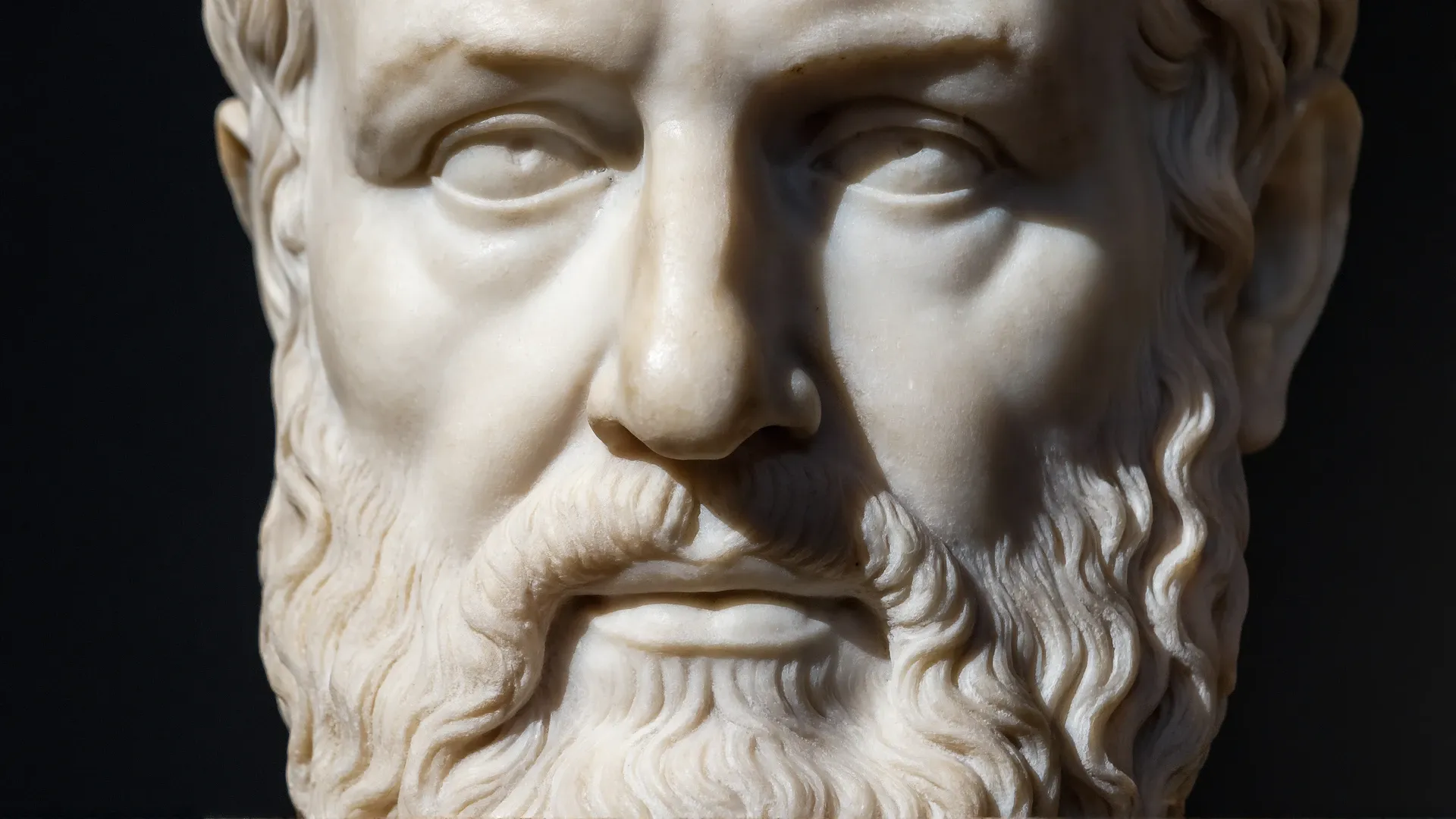
What "Stoicism" Actually Means — It Isn't "Feeling Nothing"
The word describes a face. The philosophy describes what's behind it — and asks you to change it.
Stoicism does not mean suppressing your emotions or gritting your teeth through hardship. That is the one thing almost everyone gets wrong, and it gets the philosophy backwards. Stoicism is a practical system for living well, built on a single idea: your emotions follow your judgements about things, not the things themselves. So a Stoic doesn’t mute a feeling — they examine the belief underneath it. The word you know, “stoic,” describes a face. The philosophy it comes from describes what is going on behind the face, and asks you to change it.
That gap — between the small-s adjective and the capital-S philosophy — is where most people lose the thread. You already have a picture of a “stoic” person: unmoved, tight-lipped, absorbing blows without flinching. It is not a wrong picture of the word. It is a wrong picture of the philosophy, and the difference is not a technicality. It is the whole thing.
What the word means, and what the philosophy means
Open a dictionary and “stoic” (lowercase) means someone who endures pain or hardship without showing feeling. That is a description of a temperament — the strong, silent type. Plenty of people are stoic in that sense who have never read a word of Stoic philosophy, and plenty of committed Stoics are visibly warm, funny, and moved by things.
Stoicism (capital S) is a school of philosophy founded in Athens around 300 BC by a merchant named Zeno, who taught on a public colonnade called the Stoa Poikile — the “painted porch.” That porch is where the name comes from. It has nothing to do with feeling nothing; it is just the address where the first lectures happened.
Here is where the everyday word actively misleads you. The popular sense says the goal is to feel less. The philosophy says something close to the reverse: the goal is to feel accurately — to stop your emotions being jerked around by things you have misjudged. The temperament hides the reaction. The philosophy re-examines the thought that produced it. Those are not the same project. They are barely related.
Two things Stoicism is not
Before the real idea, clear the two misreadings that block it — because you are almost certainly holding at least one.
It is not emotional suppression. Suppression is feeling something and forcing it down. The Stoics were not after that. They drew a line between the first involuntary jolt — the flinch when you get bad news, the heat that rises before you have decided anything — and the full-blown emotion that comes after, once you have agreed with the story your mind is telling (“this is a disaster, I can’t cope”). You cannot suppress your way out of the first jolt; nobody can, and the Stoics knew it. Their work happens at the second stage — the agreement — not by clamping down on the feeling but by questioning the judgement that inflates it. The aim was apatheia, which sounds like “apathy” but means almost the opposite: freedom from being ruled by destructive passions, not the absence of feeling — the Stoics even named the three good emotions a wise person keeps.
It is not passive resignation. The other caricature is the Stoic as a doormat — “accept whatever happens, don’t resist.” That misses the engine of the whole system. A Stoic sorts the world into what is up to them (their own judgements, choices, actions) and what is not (other people, outcomes, the past, their own reputation). You accept the second category not to give up, but so that all your effort lands on the first — the part you can actually move. Acceptance and action are not opposites here. They are the same move seen from two sides: you let go of what you don’t control precisely so you can act hard on what you do.
The idea that ties it together
Everything above rests on one sentence, written by a former slave named Epictetus, in a handbook his student wrote down about nineteen centuries ago:
Men are disturbed not by things, but by the views which they take of things.
Read slowly, that is a startling claim. It says the event is not the cause of your distress. Your judgement about the event is the cause. Two people are passed over for the same promotion. One is humiliated for a week; the other is mildly annoyed for an afternoon. Same event. The difference is entirely in what each of them decided it meant — “I am not good enough, everyone can see it” versus “that stung, and it wasn’t the outcome I wanted.” Epictetus’s point is that you have been handing the steering wheel to the event, when it was always in your hands.
It is in our power to have no opinion about a thing, and not to be disturbed in our soul; for things themselves have no natural power to form our judgments.
Marcus Aurelius — a Roman emperor writing privately to himself — put the same idea a different way in his Meditations: things themselves have no power to form our judgements; that power is ours. This is why the popular version gets it exactly backwards. The strong-silent stoic is working on the feeling — hide it, endure it, feel less of it. The actual Stoic is working one step upstream, on the judgement that generates the feeling in the first place. Change the judgement and the feeling changes on its own — no suppression required, because there is nothing left to suppress.
One caution, because it is where the pop version turns toxic. “Emotions follow judgements” does not mean you consciously choose every feeling like ordering from a menu, or that a person in genuine grief has simply judged wrong. The first movement — the shock, the grief, the surge — is not up for negotiation. The claim is narrower and more useful than the slogan: the lasting emotional state, the one that sets in and runs your week, is built on a judgement you can inspect. That is the part with a handle on it.
What the Stoics were actually aiming at
If Stoicism were only “manage your judgements,” it would be a stress-management technique, not a philosophy — and this is the trap the modern, productivity-flavoured version falls into. The judgement work is the how. The what for is bigger.
The Stoic goal was a good life, which they defined as a life of virtue — living in accordance with reason and nature. They named four cardinal virtues, though they insisted these were really one thing wearing four faces: wisdom, courage, justice, and self-control. On this view, virtue is the only thing that is good without qualification. Everything else people chase — money, health, status, even comfort — is at best a “preferred indifferent”: nice to have, worth pursuing, but not what a good life is actually made of. The reason a Stoic works so hard on their judgements is not to feel calm for its own sake. It is because clear judgement is what virtue requires. You cannot act well if you are seeing the situation through fear, vanity, or self-pity. It is one strand of the wider tradition of ancient wisdom that treats character, not circumstance, as the thing worth building.
This is the part the gym-bro rebranding drops entirely, and it is worth seeing why that matters — the distortion that turns Stoicism into a hustle aesthetic keeps the tough-guy posture and throws away the ethics that were the entire point. Calm without virtue is just composure. The Stoics wanted both, and ranked the second one higher.
Who the Stoics were
Three Romans wrote most of what survives, and they could not have led more different lives. Seneca was a fabulously wealthy statesman and playwright, adviser to an emperor who eventually ordered his death. Epictetus was born a slave, taught after he was freed, and owned almost nothing. Marcus Aurelius ran the entire Roman Empire and wrote his Meditations as private notes he never meant anyone to read. A slave, a statesman, and an emperor — reaching, from opposite ends of fortune, for the same tools. If you want the fuller story of how the philosophy survived by being field-tested under enslavement, exile, and absolute power, the Roman generation is where it was proven.
That range is itself an argument. A philosophy that works as well for the person who has nothing as for the person who has everything is telling you where it locates the good life — not in circumstances, which those three did not share, but in the one thing they did: how they judged what happened to them.
How you actually practise it
The technique that follows most directly from “emotions follow judgements” is one the Stoics called the premeditation of adversity — deliberately picturing, in advance and in plain detail, the things you fear losing. Not to be morbid. To adjust the judgement before the event, so it cannot ambush you.
Seneca put it plainly in a letter: if an evil has been pondered beforehand, the blow is gentle when it comes. The reasoning is exact. Most of the sting in a loss is its shock — the “I never thought this would happen” — and shock is a judgement (“this is unthinkable, this cannot be happening”) that you can dismantle ahead of time. The person who has quietly accepted that a job, a relationship, a body will not last forever is not colder when the loss comes. They are simply not blindsided. They have already done the judging, calmly, instead of having it forced on them in a crisis.
Notice what this is not. It is not positive thinking, and it is not visualising success. It is the opposite — rehearsing loss so that its arrival finds you already reconciled. This is what a Stoic practice looks like: not a mood you perform, but a small piece of mental work done in advance, so the feeling that comes later is the right size.
The one-line version
Stoicism is not the art of feeling nothing. It is the art of feeling accurately — of noticing that your reactions are built on judgements, and that judgements can be inspected, questioned, and changed. The strong, silent type manages the face. The Stoic manages the thought behind it, in the service of living well. Once you see that difference, you cannot unsee it — and every quote you have half-remembered about “being stoic” starts to read the other way round.
Free download
Stop staring at a blank journal. Start here.
The Three-Question Evening Review — five minutes, three questions, no blank page.
Frequently asked questions
- What is a Stoic person, really?
- Not the unmoved, tight-lipped figure the word suggests. A Stoic is someone who works on the judgements underneath their reactions — questioning the belief that inflates a feeling rather than hiding the feeling. In practice that often looks calm, but the calm is a by-product of accurate judgement, not a performance of having no emotions.
- What are the four principles of Stoicism?
- The core is the four cardinal virtues, which the Stoics treated as one thing in four aspects: wisdom, courage, justice, and self-control. Underneath them sits the dichotomy of control — separating what is up to you (your judgements and choices) from what is not (outcomes, other people, the past) — and the claim that virtue is the only unqualified good; everything else is a "preferred indifferent."
- Do Stoics believe in God?
- The Stoics believed in the logos — a rational, ordering principle running through the universe, closer to "nature is intelligible and governed by reason" than to a personal God who answers prayers. It isn't atheism and it isn't conventional theism; it's a third position that the God-or-not question struggles to hold, which is why modern readers find it hard to place.
- Are there 7 rules of Stoicism?
- No — "the 7 rules of Stoicism" is a modern listicle framing, not something the Stoics wrote. The philosophy has recurring practices (examining your judgements, the dichotomy of control, premeditation of adversity) and the four virtues, but no canonical numbered rulebook. Any list of "7 rules" is one writer's summary, useful at best as a mnemonic, not doctrine.
Free download
Stop staring at a blank journal. Start here.
The Three-Question Evening Review — five minutes, three questions, no blank page.