
Plato's Allegory of the Cave — and Why You Think You Escaped
Everyone who hears this story thinks they've escaped it — and that's the trap
The most-liked comment on the most-watched video about Plato’s allegory of the cave has 18,874 likes. It reads: “I love how everyone feels that they are the ones that have escaped the cave when they hear about this allegory.” Plato’s analogy of the cave — sometimes called the parable of the cave — is one of the most recycled images in philosophy, and that comment catches why.
That comment is funnier than it looks. Because the person who wrote it is also doing it.
The cave allegory is one of the oldest stories in Western philosophy and one of the most misread. Not because people get the plot wrong — they don’t — but because they extract the wrong lesson from it. The plot is simple: prisoners chained in a cave mistake shadows on a wall for reality; one is freed, sees the true world outside, and returns to tell the others — who reject him. The meaning is not that most people are ignorant. It is that people who could see the truth choose not to, because believing it would cost them the only reality they have ever trusted. That is a diagnosis of resistance, not a story about enlightenment — the part most retellings skip. They come away thinking it’s about enlightenment, about seeing through illusions, about being the kind of person who asks hard questions. They leave the video feeling like the philosopher, not the prisoner.
Plato wrote it to produce the opposite effect.
What the Story Actually Describes
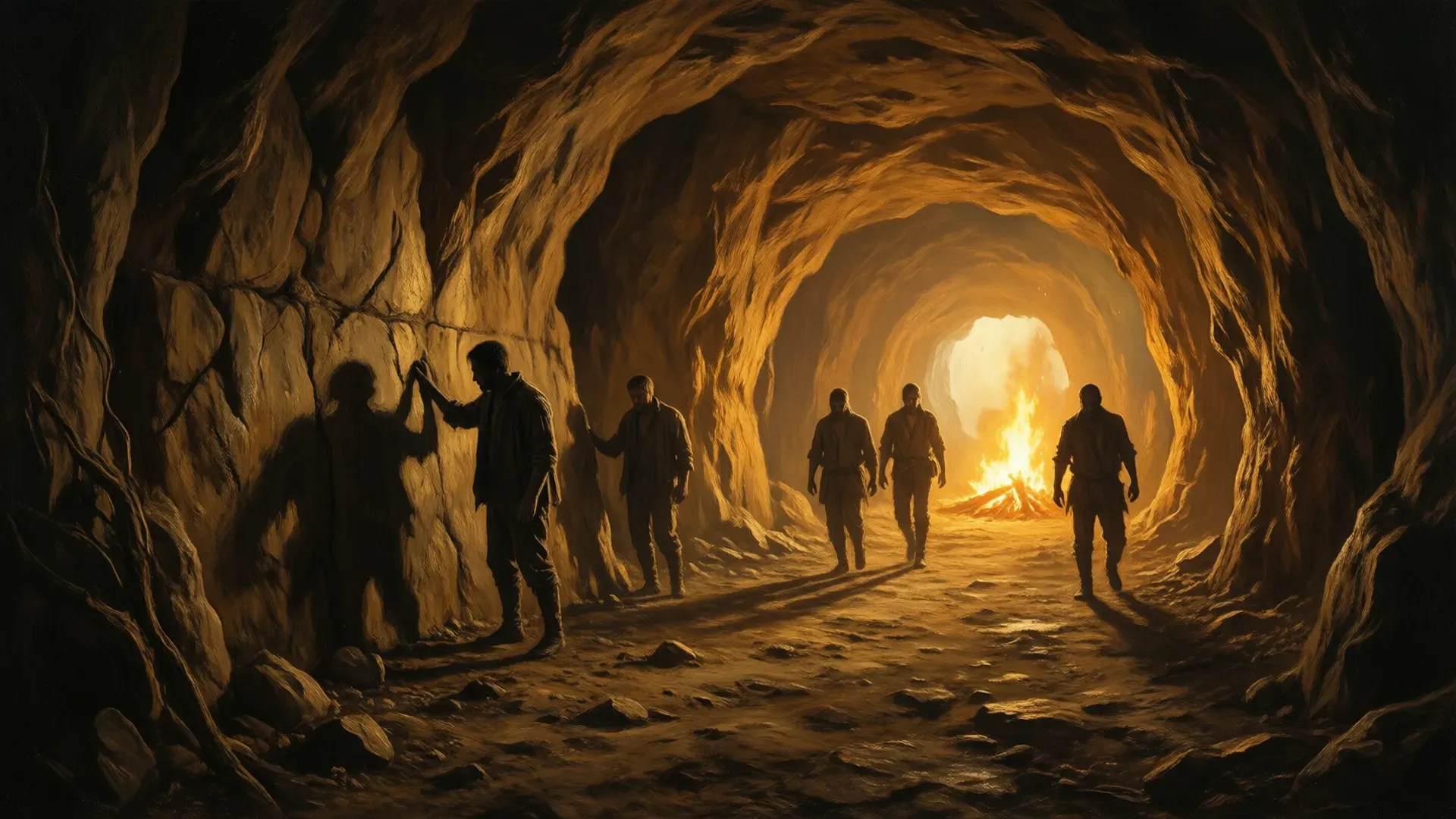
The setup is in Book VII of the Republic, immediately after the diagram that explains it — Plato’s Divided Line, which maps the same ascent the cave dramatises. Prisoners are chained in a cave, facing a wall. Behind them, a fire casts shadows of objects onto the wall. The prisoners have never seen anything else. They take the shadows for reality — they name them, debate them, build a whole understanding of the world from them.
One prisoner is freed. He turns, sees the fire, is blinded by it, is dragged out into sunlight, can’t see at all. Gradually his eyes adjust. He sees the real world. He understands, for the first time, what the shadows were.
Then he goes back.
He returns to the cave to tell the other prisoners what he has seen. They cannot understand him. His eyes have adjusted to the light and now struggle in the dark — he stumbles, he seems confused. The prisoners conclude that leaving the cave damaged him. Anyone who tries to free them, they say, deserves to be killed.
That last line is the one most people skip past.
What Plato Was Really Talking About
The standard reading is epistemological: the allegory is about the difference between appearance and reality, between the shadows of things and the perfect originals Plato called the Forms. That reading isn’t wrong. But it’s incomplete in a way that makes the whole story toothless.
Read as epistemology, the allegory is a story about ignorance and enlightenment. Read as psychology — which is the more uncomfortable reading — it is a story about why people choose the cave. Not out of stupidity. Out of something more defensible: the cave is warm, familiar, and socially safe. The shadows are all they have ever known. Updating their entire worldview would cost more than they are willing to pay.
Read as psychology — which is the more uncomfortable reading — it is a story about why people choose the cave.
What Plato was mapping, in the vocabulary available to him in 380 BC, is what psychologists now call identity-protective cognition — the tendency to evaluate new information not on its merits but on whether accepting it would threaten who you already are. The prisoners don’t reject the freed prisoner because they are fools. They reject him because believing him would require dismantling the only reality they have ever had.
The cave allegory, on this reading, is not a compliment to the reader. It is a description of the default state of the human mind.
Why Leaving the Cave Is Painful, Not Liberating
The story makes this explicit, and it is the part that gets cut from most summaries. When the prisoner is first freed and turned toward the fire, he is in pain. The light hurts. He wants to go back to the wall. When he is dragged into sunlight, he can see nothing — he is temporarily more blind than the prisoners who never moved.
This is not incidental. It is the mechanism.
The modern mind works the same way. When a genuinely held belief turns out to be wrong — not a small factual error, but a belief that is load-bearing for your identity — the immediate experience is not relief or insight. It is disorientation, then resistance. The information that contradicts the belief gets evaluated more sceptically than information that confirms it. Sources that challenge the belief seem less credible than sources that support it. This is not irrationality. It is the mind protecting something it has built its understanding on.
Epictetus named the same mechanism from a different angle. In the Discourses, he wrote:
Now there are two kinds of hardening, one of the understanding, the other of the sense of shame, when a man is resolved not to assent to what is manifest nor to desist from contradictions.
He was describing the person who has been shown the truth and refuses it anyway — and noting that this refusal is not weakness but a kind of armour.
The cave, in other words, is not a prison you were put in. It is a structure you maintain, because the alternative is standing in a light that will initially blind you.
What This Looks Like in a Modern Mind
Here is a concrete version. A person has spent fifteen years building a career in an industry they no longer believe in. The evidence has been accumulating for some time: the work doesn’t interest them, the outcomes don’t matter to them, the identity the job provides is the only thing still holding. When a friend points this out, the response is not relief at being understood. It is irritation. The friend doesn’t understand the financial reality. The friend doesn’t see what the person has invested. The friend is being naive.
Every one of those responses may have a grain of truth. But notice what is absent: any serious engagement with whether the friend is right. The evaluation of the argument has been replaced by the evaluation of the cost of the argument being true. That cost is too high to pay, so the argument loses before it is heard.
This is not a failure of intelligence. Some of the most intellectually capable people are the most committed cave-dwellers, because intelligence applied in service of identity protection is more effective at generating counter-arguments than intelligence applied honestly to a question. The better you are at reasoning, the better you are at finding reasons to believe what you already believe.
What Socrates Did About It
Plato wrote the cave allegory. Socrates — his teacher — lived it.
Socrates spent his life in the cave. Not his own cave: Athens. He walked around asking people to examine the principles they were living by. Not to humiliate them. Because he believed that unexamined principles were the mechanism of the cave — the thing that kept people mistaking shadows for walls. He understood, better than almost anyone, that the prisoners don’t need the light forced on them. They need to be shown that they are looking at shadows.
He did this long enough that Athens killed him for it. The prisoners concluded he was dangerous. That, too, is in the allegory — and it is not a metaphor. It is a warning about what happens to the person who takes the return trip seriously.
The practical response to the cave allegory is not the TED-Ed version — the smug recognition that others are trapped while you have seen through it. It is the Socratic version: a daily practice of examining what you actually believe and why, before the stakes of being wrong get too high to see clearly. The Stoics pushed this further: even if the metaphysical question — whether the universe is ordered or merely a chaos of shadows — has no answer, the practical question of how to act remains. That is the move the Stoic account of meaning makes against nihilism.
That practice takes five minutes. Three questions, at the end of the day. The point isn’t to reach enlightenment — it is to build the habit of noticing when you are reasoning toward a conclusion you need rather than one you’ve earned. As Seneca understood about the examined life, the daily review is not a destination. It is the daily refusal to let the shadows win by default. The broader tradition Plato belongs to — and what other ancient schools found when they asked the same questions — is the subject of ancient philosophy as psychology. For the Stoic branch of that tradition, and why it teaches you how to think rather than what to think, see the ancient philosophy that teaches you how to think.
Free download
Stop staring at a blank journal. Start here.
The Three-Question Evening Review — five minutes, three questions, no blank page.