
Eternal Return: Nietzsche's Hardest Question, Explained
A thought experiment that measures your life by your own reaction to it.
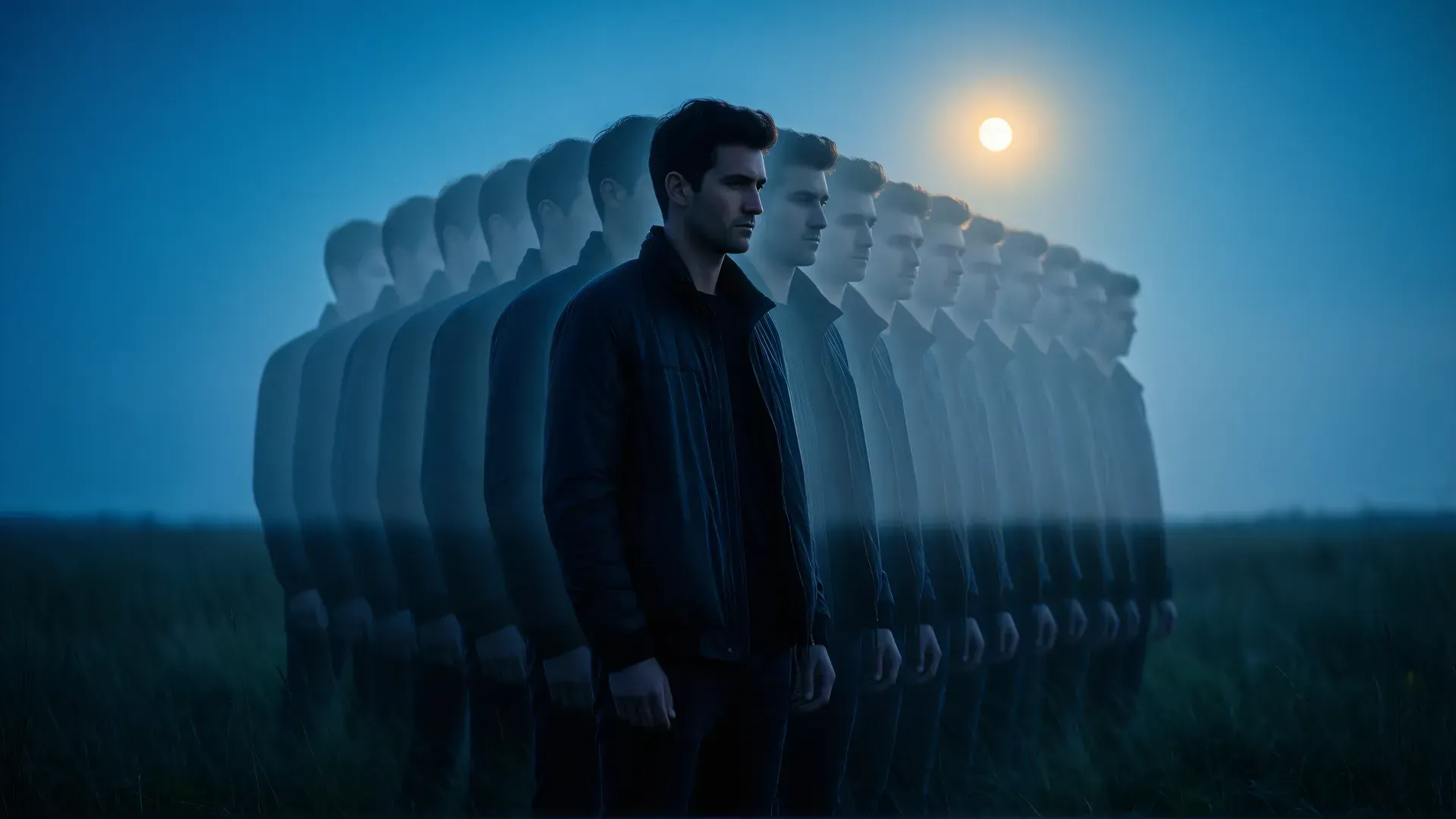
The eternal return is Nietzsche’s thought experiment: imagine that you will live this exact life again — every detail, every joy, every humiliation, every loss, in the same order, with nothing changed — and that you will live it not once more but an infinite number of times. The question is not whether this is literally true. The question is what happens in you when you imagine it. That flinch, that small recoil at the thought of all of it, again — Nietzsche treats it as data. It measures the distance between the life you are living and the life you could say yes to.
He first put it in writing in The Gay Science in 1882, in a passage he titled “The Heaviest Weight.” It is one of the strangest and most demanding ideas in philosophy, and most explanations of it miss the point entirely — they treat it as a riddle about time, or a piece of trivia about a difficult German. It is neither. It is a mirror.
The demon’s question: Gay Science §341
Nietzsche stages it as a visitation. A demon creeps into your loneliest loneliness, he writes, and says: this life, as you now live it and have lived it, you will have to live once more and innumerable times more — every pain and every joy and every thought and sigh, everything in the same succession. The eternal hourglass of existence is turned over again and again, and you with it.
Then the demon asks the only question that matters: would you gnash your teeth and curse the demon who spoke this — or have you experienced a tremendous moment in which you would answer, “you are a god and never have I heard anything more divine”?
That is the whole device. Not a theory you assess from the outside, but a question that catches you mid-life and asks you to react.
What your flinch reveals
Here is why the recoil matters. Most of us live in a quiet, permanent forward-lean — toward the weekend, the next job, the version of ourselves that finally has it together, the moment this difficult stretch is behind us. We treat the present as a corridor to somewhere better. The demon’s question removes the corridor. There is no “later” if everything recurs; there is only this, on repeat, forever.
So your reaction tells you something you can’t easily fake. If the thought of reliving your actual life fills you with dread, that dread isn’t really about eternity. It’s about now. It is the felt sense that you are living a life you are enduring rather than choosing — postponing the real thing, waiting for permission, spending your days in a way you secretly hope to escape rather than repeat.
Every moment you spend wishing you were elsewhere is a quiet “no” to the demon’s question — and you make that answer dozens of times a day without noticing.
The test is sharp precisely because it doesn’t let you answer in the abstract. You can’t say “yes, in principle, I affirm life.” It asks about this life. This commute. This relationship. This unglamorous Tuesday. Could you will it again?
A thought experiment, not a theory of physics
A lot of confusion around eternal return comes from mixing up two completely different ideas that happen to share a name.
The older one is cosmological. The belief that time is cyclical — that the universe runs through vast cycles and repeats — is ancient and widespread, one of the recurring patterns across the traditions of ancient wisdom. The Stoics had it: they called the periodic destruction and rebirth of the cosmos ekpyrosis, and imagined a “Great Year” after which everything recurs. Pythagoras is said to have taught something similar. In the twentieth century the historian of religion Mircea Eliade gave this whole family of beliefs a name — the myth of the eternal return — and showed how common it was across early cultures. That is a claim about how the universe actually works.
Nietzsche’s version is not that. He occasionally toyed with whether recurrence might be literally true, but he never built the idea on it, and you don’t need it to be true for the thought experiment to do its work. The demon doesn’t ask you to believe anything. It asks you to imagine, and then watch your own response. Whether the cosmos literally loops is beside the point — the test runs on the imagining alone.
This is also why it belongs alongside the rest of Nietzsche’s project as a psychologist of the inner life rather than with metaphysics. He was rarely interested in describing the universe. He was interested in what a given belief does to the person who holds it — and the eternal return does more to a person than almost any idea he devised.
“But what if my life has been hell?”
This is the objection every explanation dodges, and it is the one that actually matters.
It is easy to talk about affirming your life when your life has been, on balance, good. The demon’s question is a pleasant game for someone with a warm marriage and work they love. But what about the person reading this who has buried a child, or lived through years of abuse, or watched addiction or chronic illness hollow out a decade they will never get back? Telling that person to say “yes, again, infinitely” sounds obscene. It sounds like being asked to be grateful for their own worst suffering.
If that is your objection, you have understood the test better than the people who pass it easily. So let’s take it seriously rather than around.
Nietzsche is not asking you to enjoy your suffering. He is not asking you to call your worst experiences good, or to want them in the way you’d want a pleasure. The eternal return is not a command to feel a particular way about your past. It is a measure of the orientation you bring to a life that includes that past — whether you can stand inside your whole history, harm and all, and still take hold of the life that grew out of it rather than disown it.
That is a much harder, and much more honest, thing than the inspirational version. It does not ask you to relabel pain as a gift. It asks whether, knowing everything, you would still claim this life as yours — or whether you would rather not have existed at all. For many people the answer is not immediate, and Nietzsche knew that. In Thus Spoke Zarathustra, the thought of recurrence nearly breaks Zarathustra himself; he calls it his “most abysmal thought” and has to grow large enough to bear it. The flinch is not a failure. It is where the work starts.
Running the test on a life you’re not sure you’d repeat
So what do you actually do with this, today, in a life that hasn’t asked your permission to be hard?
You use the demon’s question as an instrument rather than an inspiration. Not “would I relive my whole life?” — that’s too big to feel. Instead, narrow it. Take the next ordinary stretch of your day and ask: if this exact hour recurred forever, would I want to be living it the way I’m about to? Most of the time the honest answer is no — you’re about to half-live it, attention elsewhere, waiting for it to be over.
That “no” is not a verdict on your life. It’s a pointer. It marks the gap between how you’re spending your time and how you’d spend it if you actually believed it counted twice — or infinitely. The value of the test isn’t the cosmic yes-or-no. It’s the way it keeps catching you treating your one actual life as a rehearsal.
There’s a quieter version of this the Stoics would have recognised, even though they’d have argued with Nietzsche about almost everything else: the practice of holding your own mortality close enough to make the present weigh something. The eternal return is the strange inverse of memento mori. Instead of “remember you will die, so this moment is scarce,” it says “imagine this moment never stops returning, so how you meet it is everything.” Both are trying to break the same spell — the forward-lean that treats now as a thing to get through.
Where this leads: amor fati
The eternal return is the question. Nietzsche’s answer to it has its own name: amor fati, the love of fate. If you could reach the point of meeting the demon with “yes, again,” you would have arrived at a particular relationship to your own life — not passive acceptance of it, but active willing of it.
That is a whole subject in itself, and an easily misread one — it is not Stoic resignation, and it is not telling yourself everything happens for a reason. If the eternal return has landed, the natural next step is understanding what amor fati actually asks of you, and why it isn’t the same as acceptance. The test sets up the demand; amor fati is the orientation that answers it.
What’s worth holding onto from the recurrence itself is simpler than the doctrine around it. You are already answering the demon’s question, every day, in how you spend your hours. The only real choice is whether you start answering it on purpose.
Frequently asked questions
- What is the myth of the eternal return?
- The myth of the eternal return is the old idea — found in Pythagoras, the Stoics, and many ancient cultures — that time is cyclical and the universe repeats itself in vast cycles. Mircea Eliade used the phrase for this cosmological belief. Nietzsche borrowed the image but used it differently: not as a claim about physics, but as a test of how you feel about your own life.
- What is Nietzsche's most controversial book?
- Thus Spoke Zarathustra is usually named his most provocative work, where eternal recurrence is dramatised as the thought that almost crushes Zarathustra. The doctrine first appears, more quietly, in The Gay Science (1882), section 341, which Nietzsche titled 'The Heaviest Weight.'
- What is Nietzsche's law of eternal return?
- It isn't a scientific law. Nietzsche occasionally speculated about whether recurrence might be literally true, but its real force is as a thought experiment: imagine living this exact life, every detail, infinitely. The 'law' is really a question — and your reaction to it is the point.
- What is the belief of eternal return?
- As a belief, eternal return is the ancient cosmological idea that history repeats in endless cycles. As Nietzsche used it, it isn't a belief to hold at all — it's a test to run on yourself. The question is not whether it's true, but whether you could bear it being true.
This article is reflection, not treatment. If anything here describes your life and it is hard to carry, free and confidential help is available from trained services — see this list of support resources.