
What Philosophical Questions Actually Do — Why It Matters
And why lists miss the point entirely
You have probably read a list of philosophical questions about life. Maybe several. “What is the meaning of existence?” “Is free will an illusion?” “What makes a life well-lived?” You read them, felt a brief stirring of something, and moved on.
That is not a failure of attention. That is the format failing the material.
A list of philosophical questions treats them as objects to observe. You look at the question, decide how interesting it is, and file it. The question stays outside you. That is the opposite of what a philosophical question is supposed to do.
What Actually Makes a Question Philosophical
A question becomes philosophical when you cannot hold the answer at a comfortable distance.
Most questions allow you a position of relative safety. “What is the capital of France?” has an answer that doesn’t implicate you. “What is the best approach to this project?” requires judgement, but you can change the project. Even hard practical questions allow you to think about them from the outside.
A philosophical question collapses that distance. “What makes a life well-lived?” is not a question about life in the abstract. It is a question about yours, today, given how you have spent the last week. The moment you hold it seriously, you are no longer observing it — you are inside it, and it is showing you something about yourself you may not have intended to see.
That is what lists cannot produce. You cannot passively consume a question that is designed to turn on you.
What Socrates Actually Understood
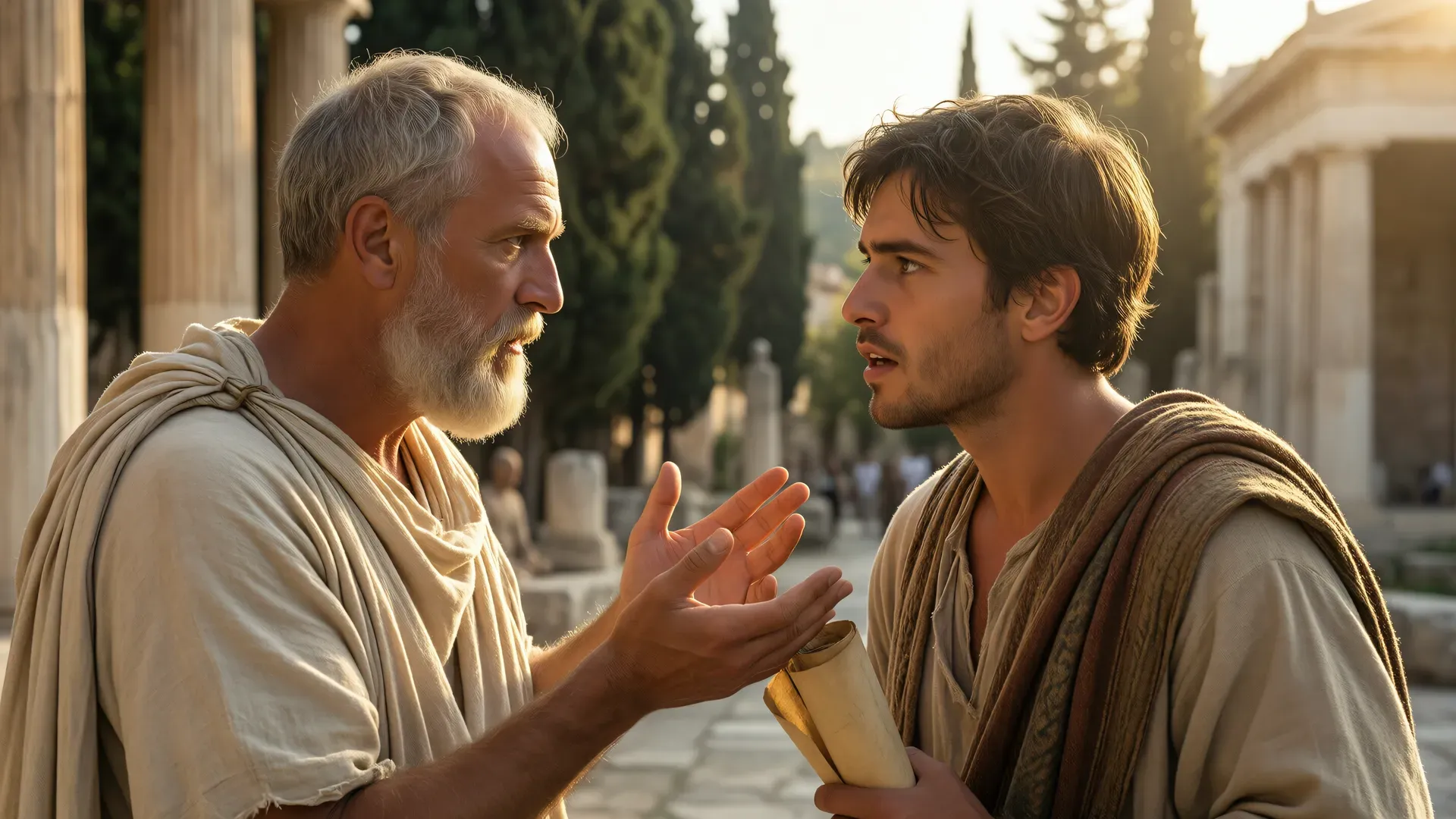
Plato records something in the Phaedo that most readers walk past. Socrates is describing what happens when a question is put correctly: “If you put a question to a person in a right way, he will give a true answer of himself, but how could he do this unless there were knowledge and right reason already in him?”
The question, in other words, doesn’t introduce information. It surfaces what is already there.
This is why philosophical questioning was a practice, not a topic. Socrates did not hand Athenians lists of interesting puzzles. He asked them questions about what they believed and then asked them to follow the logic of those beliefs. The discomfort was the point — not as a teaching technique, but because discomfort is what happens when a question reveals a gap between what you claim to believe and how you actually act.
The gap was already there. The question just made it visible.
Why the Big Questions Feel Like Someone Else’s Business
Every introductory philosophy course covers the same ground: consciousness, free will, ethics, knowledge, meaning, death. These are real territories. The ancients spent their lives in them.
But notice what happens when you encounter them as a list. They become categories rather than live questions. “Free will” becomes a philosophical position you hold, or don’t. “The meaning of life” becomes an abstract debate, interesting from a distance, not a question that changes anything about Monday.
A question stays philosophical only while it still has the power to embarrass you.
The moment a question becomes fully domesticated — slotted into a position, settled into a view — it stops functioning as a philosophical question and starts functioning as an opinion. This is why people who have read the most philosophy are not always the most examined people. Reading about the examined life is not the same as living it.
The ancient philosophy tradition understood this distinction. For Plato, for Epictetus, for Socrates himself, philosophy was not a subject you studied. It was a method you applied — specifically, to yourself.
Seneca on What Gets Lost When You Don’t Look Back
Seneca, writing in the first century, identified the mechanism directly. “This is what makes us wicked,” he wrote in his letters, “that no one of us looks back over his own life. Our thoughts are devoted only to what we are about to do. And yet our plans for the future always depend on the past.”
He is not describing laziness. He is describing a structural problem with how most people use their attention. The future is easier to think about than the past, because the past is fixed and the future is still negotiable. Looking back at what you have actually done closes off the comfortable ambiguity. You find out what your stated values were worth when they met real conditions.
Philosophical questions are, most of them, questions about the past. “What have I been treating as important?” “What did I actually do when it cost me something to act on what I claimed to believe?” These are not hypotheticals. They have answers. The answers are in the record of what has already happened.
The reason most people avoid these questions is not that they are too abstract. It is that they are too specific.
Epictetus on the Cost of Deferring
Epictetus, in his Discourses, says something about the habit of postponing attention that most readers take as encouragement to start now. It is sharper than that.
“But now when you have said, Tomorrow I will begin to attend, you must be told that you are saying this, Today I will be shameless, disregardful of time and place, mean; it will be in the power of others to give me pain.”
He is not describing a future failure. He is saying that the decision to defer examination is itself a decision — and that the cost is paid immediately, on the day of deferral. Every day that passes without asking what is actually running your choices is a day those choices are made by whatever unexamined pattern assembled itself when you were not paying attention.
The question you do not ask is not a neutral absence. Something else answers in its place.
The One Question
There is a version of this that works.
Not a list. One question, specific enough to fail, asked about something that already happened.
What did I do today that I would not have done if I had been living according to what I say I value?
That is the structure. The specifics are yours. The question only works if it has an answer — if you can think of something, even something small, that sits uneasily when you look at it plainly.
This is what the Stoics called the evening review — not journalling as self-expression, but a brief and honest account of where the gap appeared today. Five minutes. No blank page required. The question provides the frame.
If you want the specific format they used, The Evening Review has it.