
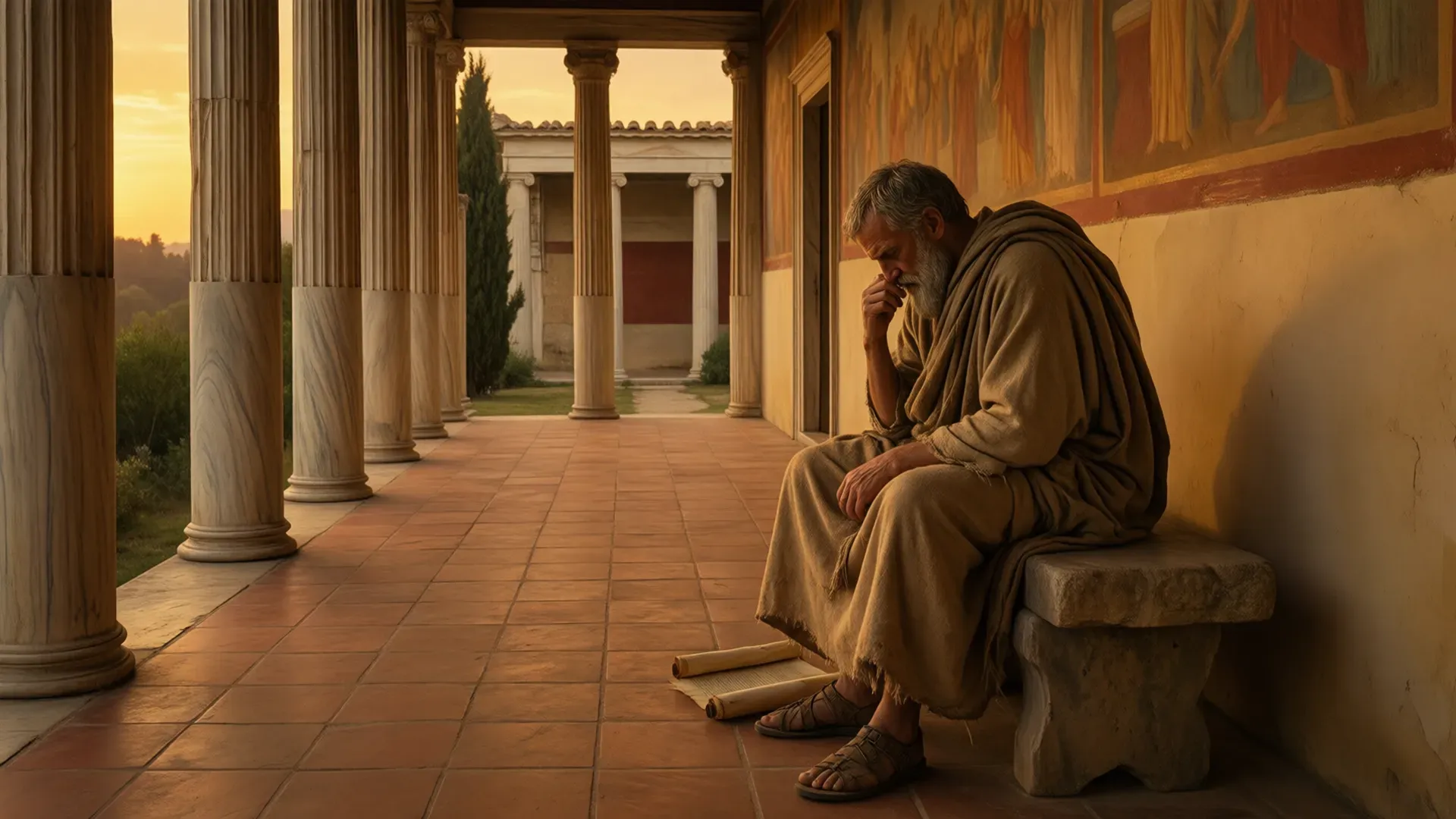
Socratic Questioning: The Ancient Self-Examination Practice
Socratic questioning as self-examination — and what the method lost on its way to therapy
You have almost certainly encountered Socratic questioning without knowing its name. A therapist who asks “what evidence do you have for that thought?” A coach who responds to every statement with another question. A worksheet in a CBT workbook that takes you through your assumptions one column at a time.
The technique works. That is not in dispute. What most people who encounter it in a clinical context are never told is who invented it, what they were actually doing with it, and why the version that arrived in the therapy room is missing the part Socrates considered most essential.
Socrates directed the questions at himself first.
What Socratic Questioning Actually Is
The term gets used as though it describes a conversational style — a way of asking rather than telling. That is accurate as far as it goes, but it misses the mechanism.
Socratic questioning is the practice of examining an assumption before treating it as evidence. The assumption can be a belief about the world, a belief about yourself, or an interpretation of something that just happened. The method asks: is this actually true, or does it feel true because I have not examined it?
The six types of Socratic questions — clarifying, probing assumptions, probing evidence, exploring perspectives, probing implications, questioning the question itself — exist to serve that single purpose. Each type approaches the assumption from a different angle. The goal is not debate. It is not to defeat an idea but to see whether it holds.
The four-stage sequence follows from that: identify the assumption, question the basis for it, consider alternative interpretations, and form a revised judgement based on what the questioning has surfaced. What the stages share is directionality — they all move away from the automatic response and toward something examined.
That is what the technique is. What it was for, and where it came from, is a different question.
How Socrates Used It on Himself
The dialogues Plato recorded show Socrates questioning other people — the citizens of Athens, the politicians, the poets, the craftsmen who all turned out to know less than they thought. This is the version that has been transmitted most visibly. Socrates as the gadfly, stinging other people into examining their assumptions.
But the Apology makes clear that the practice began earlier and closer to home. Socrates had received a puzzling report from the oracle at Delphi: that no one was wiser than he was. He did not accept this. He went and checked — by questioning himself about what he actually knew, before he went and questioned anyone else.
The conclusion he reached was precise: he was wiser only in the sense that he knew he did not know. The Athenians he then questioned believed they knew things they did not know. The self-examination came first.
Socratic examination was not introspection in the modern therapeutic sense. It was interrogation — of the assumptions underneath your claims.
The Stoics, who studied the Socratic tradition carefully, formalised this as a practice they called prosochē — attention to oneself, sustained and daily. Before questioning the world, you question the impressions the world produces in you. The Stoics described it this way in a passage recorded by Diogenes Laërtius:
“We must also note carefully the impressions which we receive in the presence of objects, in order to bring ourselves back to that point in the circumstances in which it is necessary to suspend the judgment.”
Suspend the judgment. Not abandon it — suspend it. Hold it long enough to examine it before you act on it. That is prosochē in practice, and it is the same move Socrates was making in the Apology before he ever questioned a single Athenian.
What the Four Stages Look Like in Practice
When the Stoics described their ideal of the wise person, they were insistent on one point: dialectic skill — the capacity to examine propositions and distinguish the true from the plausible — was not optional. It was the thing that made everything else possible.
“Without dialectic speculation, the wise man cannot be free from all error in his reasoning. For that is what distinguishes what is true from what is false, and which easily detects those arguments which are only plausible, and those which depend upon an ambiguity of language.” — Lives of Eminent Philosophers
The four stages, in practice, look like this.
The first move is identification: name the assumption that is doing the work. Not the feeling, not the conclusion — the assumption underneath it. “This person is dismissing me” is a conclusion. The assumption underneath it is “their tone means contempt.” Those are different claims and only one of them is examinable.
The second move is questioning the basis: what would need to be true for this assumption to hold? Is there actual evidence, or is it inference from limited information? The Stoics called an unexamined impression a phantasia — an appearance that presents itself as reality. The appearance is not the reality. It is the mind’s first draft.
The third move is perspective: what else might explain the same evidence? Not to let anyone off the hook but to calibrate the judgement against something other than the first reading.
The fourth move is revision: what does the examination actually support? Sometimes the original assumption holds. Often it does not. Either way, the judgement that emerges from the sequence is different in character from the one that arrived automatically — because it has been examined rather than merely felt.
Why CBT Inherited It — and What Got Lost
Albert Ellis read Epictetus. He said so. When he developed Rational Emotive Behaviour Therapy in the 1950s, he named the Stoics as direct sources for the core claim: that suffering comes from beliefs about events, not events themselves. Aaron Beck, developing cognitive therapy alongside Ellis, built the same insight into what he called the cognitive model. The full story of how Albert Ellis built CBT from Epictetus covers that lineage in detail.
What CBT inherited from the Socratic tradition was the questioning structure. The ABC model — Activating event, Belief, Consequence — is a formalised version of the Stoic stages: impression, assent, response. Socratic questioning in a CBT session is the tool for examining the Belief column.
What the clinical adaptation lost was the self-directed daily practice. The Stoics did not use prosochē as an intervention for when things went wrong. They used it every day, at low stakes, so that when the stakes were high the examination was already habitual. Seneca described his own evening review — going through the day’s responses, asking where the impression had taken over, where a different judgement had been available. Marcus Aurelius did the same in writing, which is what the Meditations is: a man examining his own assumptions, nightly, for years. The Stoic evening review as a formal self-examination practice — distinct from journalling — is explored in the piece on how the Stoics put themselves on trial.
CBT makes Socratic questioning something a therapist does to you or with you in a session. The original practice makes it something you do to yourself, daily, at the end of the day when you have time and distance.
This is why most people who encounter the technique in a therapeutic context understand it and do not use it. Understanding is the wrong target. Habit is the target. And habits form through repetition at low stakes, not through understanding at high ones.
One objection deserves naming. Antisthenes — founder of the Cynic school, contemporary of Socrates — dismissed dialectic reasoning as being like cobwebs: “put together on principles of art, but utterly useless.” It is the objection the careful reader is most likely to feel: isn’t this just endless self-questioning that loops back on itself without landing anywhere?
The answer is no, but the prosochē framing is what makes the answer coherent. The Socratic practice is not open-ended philosophical inquiry conducted on yourself indefinitely. It is a bounded daily review with a fixed endpoint: the revised judgement. Three questions. Five minutes. A conclusion. What the cobwebs criticism attacks is the formless version — questioning as a posture, questioning as cleverness. What Socrates and the Stoics were describing is questioning as a tool with a clear job: catching the unexamined assumption before it becomes an unchecked response.
How to Use It as a Daily Self-Examination Tool
The Stoics left a specific structure. Seneca’s version runs something like: what bad habit have I checked today, what fault have I corrected, in what respect am I better? Marcus Aurelius worked through the day’s events and held them against the principles he was trying to practise.
The structure matters more than the questions. A review without structure becomes rumination — the mind re-running events without examining them. What distinguishes Socratic self-examination from ordinary brooding is the move from description to examination: not what happened but what did I make it mean, and was that an examined judgement or just the first impression left unchecked?
The ancient philosophy of self-examination that the Stoics systematised starts with understanding what a philosophical question actually does to you — why the Socratic method works where passive reading of philosophy doesn’t. Once that mechanism is clear, a daily equivalent takes about five minutes. Three questions, applied to the day’s most significant moment — the one that produced the strongest response:
What happened? — describe it plainly, without interpretation.
What did I make it mean? — name the assumption the response was built on.
Was that assumption examined or automatic? — if automatic, what does the examination actually support?
That sequence is what Socrates was doing in the Apology. It is what the Stoics were doing in their evening reviews. It is what CBT adapted into a clinical tool. And it is what gets lost when the technique is only ever used in a session with someone else asking the questions.
The practice works when you are the one asking. Not because you are a therapist or a philosopher, but because you are the only person with access to the impression that arrived, the judgement you made about it, and whether those two things actually match.
If you want a structure for starting — three questions, a prompt, nothing to fill in from scratch — the Evening Review template is there.
Free download
Stop staring at a blank journal. Start here.
The Three-Question Evening Review — five minutes, three questions, no blank page.