
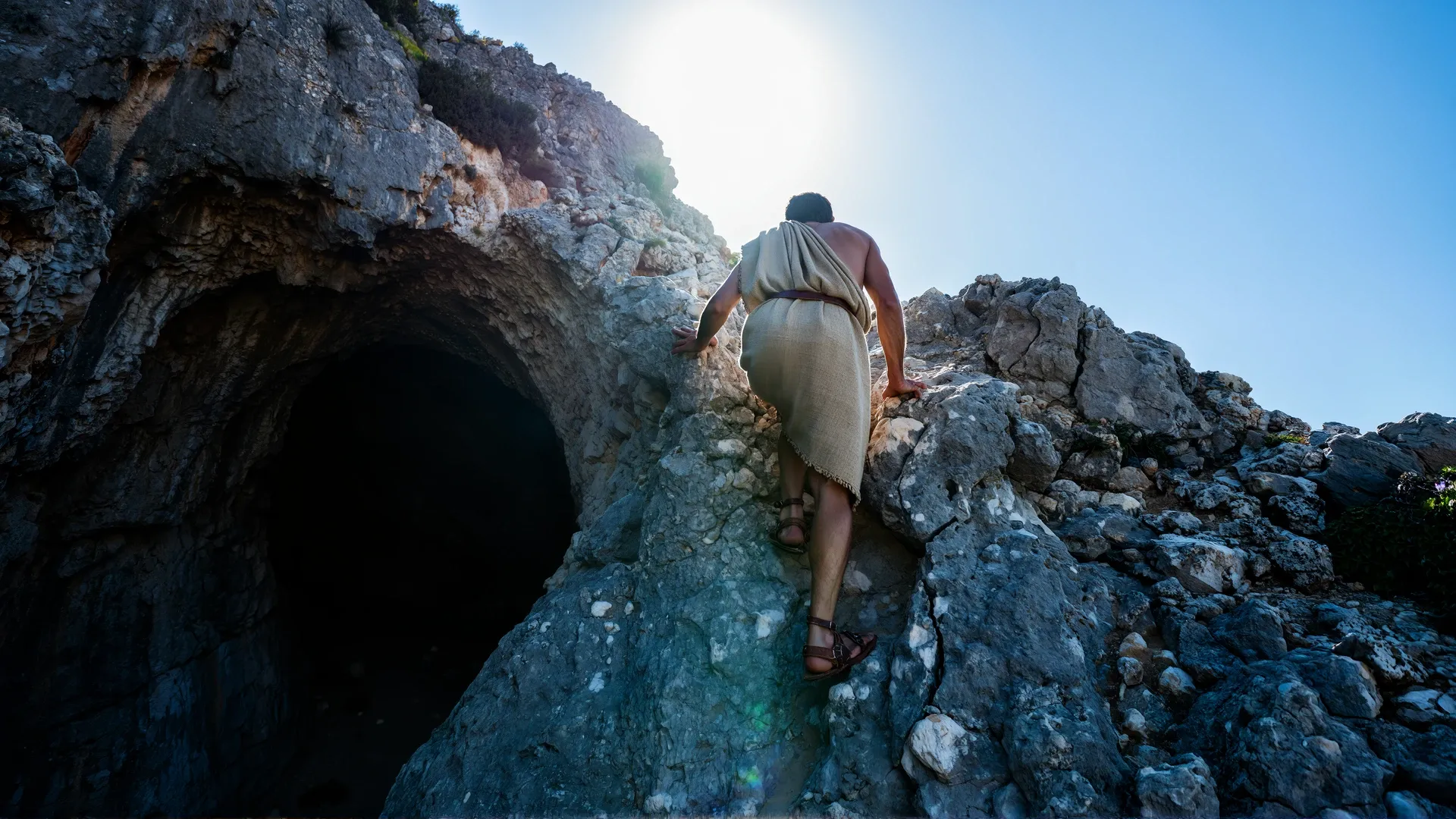
Plato's Divided Line: The Map Behind the Allegory of the Cave
Four levels of knowing, from shadows to the Forms — and how to find your own
You have probably met Plato’s cave — the prisoners chained in the dark, mistaking shadows on the wall for the whole of reality, one of them dragged out into painful sunlight. What almost no one meets is the diagram Plato draws immediately before it, in the same conversation. That diagram is the Divided Line, and without it the cave is a vivid story with no clear meaning. With it, the cave snaps into focus: it’s the journey, and the Line is the map.
Plato’s Divided Line, from Book VI of the Republic (509d–511e), is a vertical line cut into two unequal parts — the visible world and the intelligible world — with each part then cut again in the same ratio, producing four segments. Those four segments are four grades of knowing, climbing from the lowest (taking shadows and images for reality) to the highest (grasping the eternal Forms directly). It is Plato’s answer to a question we still trip over daily: what’s the difference between being sure of something and actually understanding it?
Where the Divided Line sits in the Republic: Sun, Line, Cave
The Line doesn’t arrive alone. Plato gives three images in a row, and they’re one argument in three forms — a triptych most people only ever see one panel of.
The Analogy of the Sun
Just before the Line, Plato offers the Sun. In the visible world, the sun is what lets the eye see and what lets things grow — nothing is visible without its light. In the intelligible world, he says, the Form of the Good plays the same role: it’s what makes truth knowable and what gives the other Forms their being. The Good is the sun of the mind’s world. Hold onto that, because it sits at the very top of the Line.
The Allegory of the Cave
Just after the Line comes the Cave (it opens Book VII). The prisoner who takes shadows for reality, the turn toward the fire, the agonising climb out, the blinding sun — that whole story is the Line walked. The cave dramatises as a journey what the Line lays out as a structure. (If you came here from the story, the full version is the allegory of the cave — but the Line is what tells you what the cave is about.)
The four levels of knowledge, lowest to highest
Here is the Line itself, bottom to top. The two lower segments are the visible world — the realm of doxa, opinion. The two upper segments are the intelligible world — the realm of episteme, knowledge.
- Eikasia — imagination, or illusion. The lowest rung. Taking images for reality: shadows, reflections, pictures. You’re not even dealing with the physical thing, only its copy, and you don’t know the difference.
- Pistis — belief, or trust. You’ve graduated to the physical objects themselves — trees, people, tables — and you trust your senses about them. This is where most people live most of the time. It’s not nothing. But it’s still the visible world, still appearances, still opinion rather than understanding.
Those two are opinion. The next two are knowledge — and the jump between them is the one everybody fumbles, so it’s worth slowing down.
- Dianoia — reasoning from assumptions. Now you’re thinking, properly. Mathematics is Plato’s example: the geometer reasons rigorously and arrives at truths. But notice what they do — they start from assumptions they never question. “Let there be a triangle.” They take the triangle as given and build downstream. The reasoning is sound; the foundations are simply assumed.
- Noesis — understanding. The top. Noesis refuses to leave the assumptions sitting there unexamined. It works backward and downward to first principles, grasping the Forms directly — not “let there be a triangle” but what triangularity actually is — and climbs all the way to the Form of the Good itself.
Dianoia builds on a foundation it takes for granted. Noesis digs down to the foundation itself.
That distinction — dianoia versus noesis — is the single most misunderstood part of the Line, so to be plain about it: both are real reasoning. The difference isn’t logic versus intuition. It’s that dianoia argues from hypotheses it never interrogates, while noesis interrogates the hypotheses until it reaches what doesn’t depend on any further assumption. A brilliant mathematician operating entirely in dianoia can be a genius and still never ask what number is. That last question is noesis.
Why is the line cut into unequal parts?
Plato is specific: the cuts are unequal, and each main section is divided in the same ratio as the whole. He’s much less specific about what the proportions are supposed to mean, and scholars have argued about the geometry for centuries — so it’s worth not pretending there’s one settled answer.
What’s clear is the direction of the thing. As you climb, each level has more clarity and deals with more reality than the one below. Shadows are less real than the objects that cast them; the objects are less real, for Plato, than the Forms they imperfectly embody. The unequal segments encode that hierarchy — degrees of reality matched to degrees of knowing. The map isn’t flat. It’s a climb, and the higher you go, the more real and the more knowable things become.
Opinion vs knowledge: the visible and intelligible worlds
Step back and the whole Line resolves into one division you can actually use. The bottom half — eikasia and pistis — is doxa, opinion. The top half — dianoia and noesis — is episteme, knowledge. And Plato’s point is sharp: a true opinion and real knowledge are not the same thing, even when they land on the same answer.
You can be right about something by accident — hold a true belief for no good reason, the way you might guess a coin flip. That’s still opinion. It doesn’t transfer, it doesn’t survive a challenge, and you can’t build on it, because you don’t actually understand why it’s true. Knowledge is the belief plus the grasp of why — the thing that lets you reconstruct it, defend it, and use it somewhere new. This connects directly to Plato’s theory of Forms: real knowledge, for him, is always knowledge of the Forms, the stable realities behind the shifting appearances opinion gets stuck on.
How the Divided Line maps the journey out of the cave
Now lay the cave over the Line and watch it line up exactly.
The prisoner chained at the start, watching shadows thrown on the wall and certain that’s all there is — that’s eikasia, the bottom rung, images mistaken for reality. Turned around to see the objects and the fire that cast the shadows — that’s pistis, the physical world taken as real. Dragged up the rough passage, reasoning his way toward the light, still dazzled and working it out by degrees — that’s dianoia. And finally outside, able at last to look at the sun itself — that’s noesis, grasping the Form of the Good directly. The painful climb out of the cave is, segment for segment, the ascent up the Divided Line.
That’s why the two images sit side by side in the Republic. The Line gives you the structure; the cave gives you what the climb feels like — the discomfort, the resistance, the way each stage looks like madness from the one below. Neither is complete without the other.
How to locate your own thinking on the Divided Line
Here’s the part Plato didn’t write but the Line invites — a modern way to use it. The four levels aren’t only a theory of ancient epistemology; they’re a rough diagnostic for where your own thinking is sitting on any given question.
Reacting to a headline, a thumbnail, a stranger’s hot take — responding to the image of a thing rather than the thing? That’s close to eikasia: you’re working from a shadow. Trusting how something appears, taking the obvious surface read as simply true because it’s in front of you? That’s pistis — better, but still appearances. Reasoning hard and carefully, but from premises you absorbed somewhere and never actually examined — a political assumption, a story about yourself, a “everyone knows” you’ve never tested? That’s dianoia: rigorous downstream, unexamined at the root. And the rare moments when you stop and interrogate the assumption itself — why do I believe this, and does it hold? — that’s the reach toward noesis.
Most of being wrong isn’t faulty logic. It’s flawless reasoning from a premise you never looked at.
You won’t live at the top of the line; almost no one does, and Plato didn’t think you could stay there. But knowing the rungs are there changes what you do with a strong conviction. The next time you’re completely certain about something, the useful question isn’t “am I right?” It’s “which level am I on — and have I ever actually examined the thing I’m standing on?”
Frequently asked questions
- What is Plato's Divided Line?
- It's an image from Book VI of Plato's Republic: a vertical line cut into two unequal parts — the visible world and the intelligible world — with each part cut again in the same ratio, giving four segments. The four segments represent four grades of knowing, from the lowest (mistaking images and shadows for reality) up to the highest (grasping the eternal Forms directly). It is Plato's map of how the mind climbs from illusion to genuine understanding.
- What are the four levels of the divided line?
- From lowest to highest: eikasia (imagination — taking shadows, reflections and images as real); pistis (belief — trusting ordinary physical objects and how things appear); dianoia (reasoning — thinking logically but from unexamined assumptions, as in mathematics); and noesis (understanding — grasping the Forms directly, without leaning on assumptions, up to the Form of the Good). The bottom two make up the visible world (opinion); the top two make up the intelligible world (knowledge).
- What's the difference between dianoia and noesis?
- Both are genuine reasoning, but dianoia argues from assumptions it never questions — a mathematician starts from 'let there be a triangle' and proves things about it without asking what a triangle ultimately is. Noesis refuses to leave those assumptions unexamined; it works back to first principles and grasps the Forms themselves, ending at the Form of the Good. Dianoia builds on a foundation it takes for granted; noesis digs down to the foundation itself.
- How does the divided line relate to the allegory of the cave?
- They describe the same ascent. The Divided Line maps the four levels of knowledge as a diagram; the Allegory of the Cave, which comes immediately after it in the Republic, tells the same climb as a story — the prisoner who mistakes shadows for reality (eikasia) and is dragged up and out into the sunlight (noesis, the Form of the Good). The line is the map; the cave is the journey across it.
Free download
Stop staring at a blank journal. Start here.
The Three-Question Evening Review — five minutes, three questions, no blank page.