
Memento Mori Symbolism: What the Skull and Hourglass Mean
The objects are a prompt, not a relic — here's what each one is actually for
A memento mori symbol is an object that makes death impossible to ignore: a skull on a desk, an hourglass with the sand running out, a flower already wilting. Each one encodes the same instruction — remember you will die — in a form you can keep in view. But the symbol was never the point. It is a prompt for a practice, and the practice is the part worth keeping.
That distinction matters more than it sounds, because most explanations of memento mori stop at the translation. They tell you the skull means death. They don’t tell you why a Stoic would want a reminder of death sitting on the desk in the first place — or why treating the object as sacred misses the entire mechanism.
The skull: the symbol that does the most work
Start with the one everyone recognises. A human skull, in art or on a ring or inked on a forearm, is the most direct memento mori there is — it is the thing itself, the face under the face. Its job is collapse: it takes the abstraction “I am mortal,” which the mind files somewhere distant and harmless, and forces it into the immediate present where it can actually change a decision.
That collapse is the whole function. You already know you will die. Knowing it has never once stopped you from wasting an afternoon on something that won’t matter by Friday. The skull exists because knowledge held at a distance does nothing, and an object in your eyeline holds the knowledge close.
The hourglass and the candle: death as a rate, not an event
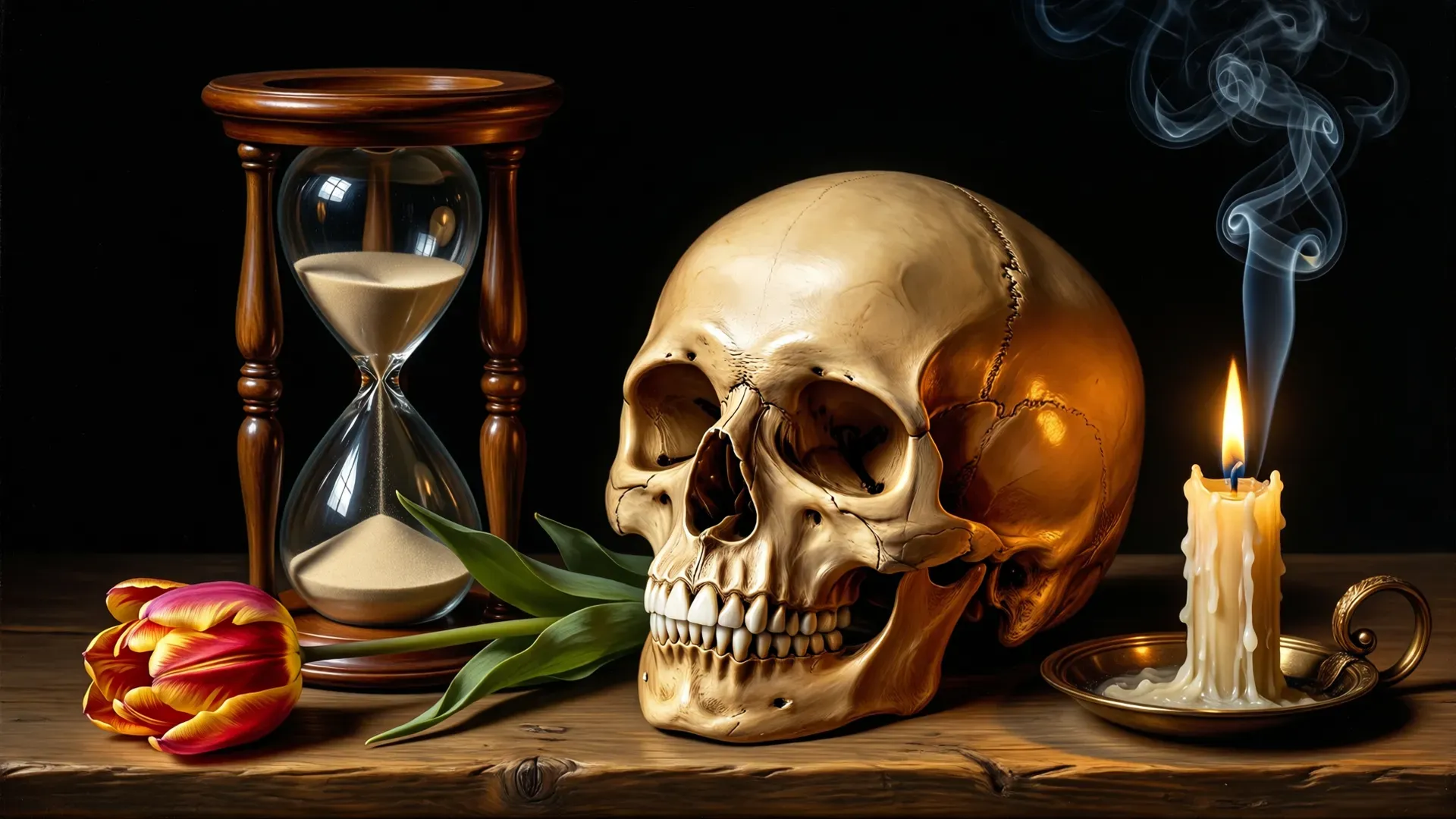
The skull says you will die. The hourglass says something sharper — you are dying now, at a measurable rate. Sand runs whether you watch it or not. A guttering candle and a wisp of smoke do the same work: they show time as something being spent, not something you have.
This is the symbol that reframes the others. Death stops being a distant appointment and becomes the slow, continuous fact of the present — which is far more useful, because you cannot change the appointment but you can change what you do with the sand still in the top of the glass.
The wilting flower and the ouroboros: decay you can’t argue with
A flower past its peak, fruit beginning to rot, a snake eating its own tail — these are the memento mori symbols that work by analogy. They show you decay in something beautiful and undeniable, and let you draw the line back to yourself. The vanitas paintings of the 1600s crowded all of these together — skull, hourglass, wilting bloom, extinguished candle — precisely to overwhelm the viewer with the same single message from five directions at once.
It is worth being honest about the history here. The dense object-symbolism — the painted vanitas, the carved skulls, the ornate reminders — is largely a later, Christian inheritance. The Stoics who originated the practice left us evidence of the discipline, not the décor. Which brings us to the part the symbols are actually for.
What the Stoics were actually doing
The Stoic practice predates the objects by centuries, and it was a mental discipline, not a collection of props. Epictetus put the instruction plainly:
Let death and exile and every other thing which appears dreadful be daily before your eyes; but most of all death: and you will never think of anything mean nor will you desire anything extravagantly.
Read what he actually claims. Keeping death in view doesn’t make you morbid — it makes you proportionate. The trivial grievance shrinks. The thing you were anxiously chasing loses its grip. Marcus Aurelius worked the same lever in Meditations, reasoning that whether you die tomorrow or in forty years is, in the only terms that matter, almost no difference at all — so the question is never how long but how.
The symbol, then, is a delivery mechanism for that daily practice. The skull on the desk is doing what Epictetus asked you to do with your attention: putting death where you can’t look away. The object has no power of its own — and this is the line a careful reader should hold onto.
That is the difference between wearing a skull because it looks like depth and keeping one because it changes how you spend a Tuesday. The symbolism is only ever as good as the practice it triggers. If the object sits there and you keep wasting the afternoon, it is decoration. If it makes you ask, once a day, what you would actually do differently knowing the sand is running — then it is doing the job the Stoics built it for.
The reminder of death was always in service of the living. That is why the same people who kept death daily before their eyes were the least morbid philosophers in the ancient world: they were not rehearsing the end. They were trying to stop wasting the middle.
Frequently asked questions
- What are the symbols of memento mori?
- The classic symbols all encode the same reminder that time is finite. The skull is the most direct — a human face stripped to what remains. The hourglass and the guttering candle show death as a rate rather than an event: sand running, wax burning down. The wilting flower (and the skull-and-flowers 'vanitas' still life) marks decay you can't argue with, and the ouroboros — a serpent eating its own tail — folds endings back into beginnings. Each object is a prompt, not a relic: it exists to trigger the practice of remembering you will die, so you spend the time you have differently.
Free download
Stop staring at a blank journal. Start here.
The Three-Question Evening Review — five minutes, three questions, no blank page.