
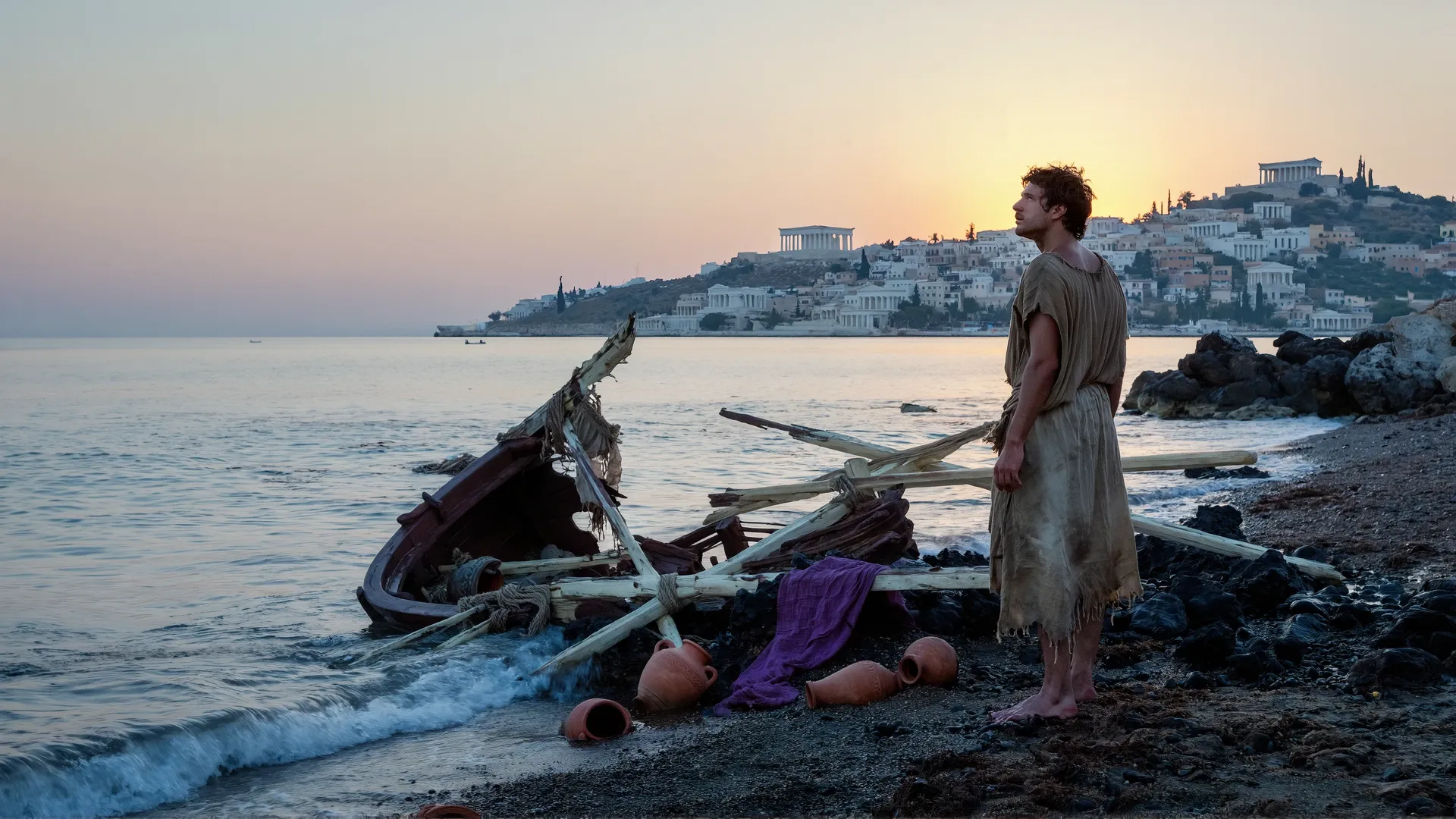
Zeno of Citium: The Shipwreck That Began the Stoic School
A merchant lost everything at sea and built the philosophy that outlasted Rome — and we don't have a word he wrote
You can name the Stoics you know. Marcus Aurelius, writing to himself by lamplight in an army camp. Seneca, the tutor who advised a monster and paid for it. Epictetus, the freed slave who became the sharpest teacher of the lot. Read a little Stoicism and those three faces arrive quickly.
Now try to picture the man who started it. Most people can’t — and that gap is strange, because every one of those famous Romans was working inside a system somebody built first. The system had a founder. His name was Zeno, he came from a small city on Cyprus, and he arrived at philosophy the way few people arrive at anything: by losing everything he owned in a single afternoon.
The merchant who washed up in Athens
The story, as the ancient biographer Diogenes Laërtius tells it, begins with cargo. Zeno was a trader — his family dealt in Phoenician purple, the expensive dye that coloured the robes of the rich — and he was carrying a shipment across the Mediterranean when the ship went down. He survived. The cargo did not. A man who had measured his life in bales of merchandise stepped ashore near Athens with nothing left to his name.
What he did next is the hinge of the whole story. He wandered into a bookseller’s shop, started reading an account of Socrates, and was struck hard enough to ask the bookseller where he could find a man like that. A philosopher named Crates happened to be walking past. The bookseller pointed: there — follow him. And Zeno did.
He is supposed to have said, later, that he “made a prosperous voyage when he was shipwrecked.” It is the kind of line too neat to be literally true, and Diogenes Laërtius — never one to settle for a single version — also passes on a plainer account: that Zeno’s father, a merchant who often travelled to Athens, had brought the boy books by the followers of Socrates while he was still young, and that Zeno went to Athens deliberately, already primed. The shipwreck may be a story the tradition told to make a philosophical point: that Stoicism begins where your possessions end.
Both versions can be true at once, in the way biography usually is. A man can be quietly drawn to something for years and still need a catastrophe to actually go and do it.
Learning from a man in a barrel
The philosopher Zeno followed was no ordinary teacher. Crates was a Cynic — a practitioner of one of the older schools of ancient wisdom, the tradition made famous by Diogenes the Cynic, the one who lived in a large ceramic jar and told Alexander the Great to stop blocking his sun. The Cynics held that almost everything people want is a convention dressed up as a need, and that virtue means stripping your life back to what nature actually requires. They made the argument not in lectures but with their bodies, in public, shamelessly.
For a wealthy merchant who had just lost his wealth, this was either the cruellest possible school or the only one that could reach him. Zeno took to it — though the stories suggest he never fully lost his sense of decorum, and that the Cynic taste for public spectacle embarrassed him. He was a founder-in-waiting who studied under a wild man and quietly decided to keep the substance while dropping the theatre.
That decision matters more than it looks. Stoicism did not appear from nowhere after a shipwreck. It grew out of Cynicism, pruned and organised and made livable for people who still had jobs and families and cities to run. Diogenes Laërtius puts the lineage plainly: the Cynics said their way was “a short road to virtue,” and “Zeno lived in the same manner.” The porch inherited from the barrel.
We must pass on to the Stoics, of which sect the founder was Zeno, who had been a disciple of Crates.
Zeno also studied with teachers from other schools — the Academy that descended from Plato, the dialecticians who specialised in tight logical argument. This is part of why Stoicism ended up as broad as it did, with a physics and a logic as well as an ethics. He was a merchant’s son assembling a system out of everything Athens had to offer, keeping what worked and discarding what didn’t. The result was less a bolt of inspiration than a long act of synthesis.
Why the school is named after a porch
Here is a detail that quietly tells you what kind of movement this was. Stoicism is not named after Zeno. It is named after a building.
When Zeno began teaching, he did not found an institution or buy a grove like Plato’s Academy. He simply talked, in a public colonnade on the north edge of the Athenian marketplace called the Stoa Poikile — the “Painted Porch,” so named for the famous battle-murals along its walls. Anyone could stand there. Anyone could listen. His followers were called, at first, “Zenonians,” but the name that stuck came from the place they gathered: the people of the stoa. The Stoics.
There is something fitting in a philosophy of the open porch taking its name from public, unwalled ground rather than from a man or a private school. It began as something you could wander into off the street — which is, more or less, exactly how its founder had wandered into it.
The one idea he planted
Strip away the biography and a genuine question remains: what did Zeno actually contribute? If Stoicism grew out of Cynicism and borrowed from Plato’s heirs, what was his?
The answer is a single, load-bearing formula. According to Diogenes Laërtius, Zeno was the first person to write down that the goal of human life — the chief good — is to live in agreement with nature. Every later Stoic spent centuries refining that sentence, but Zeno set the foundation stone.
It is easy to read that phrase as vague wellness-poster advice — go outside, touch grass, live “naturally.” It meant something far more specific and far more demanding. “Nature” here has two faces at once. There is the nature of the universe: an ordered, rational whole, governed through and through by reason. And there is your own nature: you are, distinctively, a reasoning animal. To live in agreement with nature is to bring those into line — to live by reason, in a universe run by reason, as the one kind of creature capable of doing it on purpose.
And because, for Zeno, living by reason is living virtuously, the whole of ethics follows from that one move. Virtue is not one ingredient in a good life alongside money and health and reputation. Virtue is the good life, complete. Everything else — the wealth Zeno himself had lost at sea — gets reclassified as “indifferent”: worth having, perhaps, but not what makes a life go well or badly. You can see why the idea appealed to a man who had watched his entire fortune sink and gone on to build something that couldn’t.
Zeno was the first writer who… said, that the chief good was confessedly to live according to nature; which is to live according to virtue, for nature leads us to this point.
This is the seed the Roman Stoics inherited and grew. When Epictetus separates what is “up to us” from what is not, when Marcus Aurelius reminds himself that only his own judgements are his — they are working out the consequences of Zeno’s division between virtue, which is yours, and everything else, which is on loan. The four Stoic virtues that later writers mapped in detail are all specifications of that first claim: that living well is living rationally, and living rationally is living well.
Free download
Stop staring at a blank journal. Start here.
The Three-Question Evening Review — five minutes, three questions, no blank page.
The problem of knowing any of this
Now the honest difficulty, the one the whole article has been circling. We have been quoting Zeno’s doctrine and telling his life story. But go looking for the book where Zeno says any of it in his own words, and you will not find it.
Zeno wrote a great deal — Diogenes Laërtius lists around twenty titles, including a Republic so provocative it embarrassed later Stoics who wished he had been more respectable. Not one of these works survives. Not a complete page. Everything we have is quotation, paraphrase, and summary in the writings of other people — most of it filtered through Diogenes Laërtius, a biographer compiling his Lives of the Eminent Philosophers something like five hundred years after Zeno died.
Five hundred years. To feel the size of that gap, notice that more time separates Diogenes-the-biographer from Zeno than separates us from Shakespeare. He was not a witness. He was an anthologist working from earlier sources, some reliable and some not, and he cheerfully reports contradictory versions without deciding between them — as we saw with the shipwreck.
Ancient books survived by one mechanism only: someone had to keep copying them out by hand, generation after generation, or they were gone. Papyrus rots. Libraries burn. Fashions change and unfashionable authors stop being recopied. Zeno’s works lost that lottery. What reached us is the shadow his ideas cast on other writers — enough to reconstruct the system with real confidence, because so many independent sources quote the same doctrines, but never the thing itself.
This is why the readers who go looking for Zeno so often come away faintly haunted — struck that the fountainhead of one of the most durable philosophies in history is, textually, almost silent. The feeling is worth sitting with rather than smoothing over. It is the ordinary condition of nearly all early Greek thought, most of which reaches us the same fragmentary way. We are always reading the ancients partly by inference.
How the story ends
Zeno taught at the porch for decades and became, improbably for a shipwrecked foreigner, one of the most respected figures in Athens. The Athenians — who did not hand out honours to non-citizens lightly — gave him a golden crown and a bronze statue, and, in a gesture that says everything about the trust he had earned, the keys to the city walls. His own home city on Cyprus claimed him proudly too. The bankrupt merchant had become a man cities competed to own.
His death, like his arrival, comes down to us in more than one version — and the versions disagree. The most repeated story is almost too neat: leaving the porch one day, the elderly Zeno tripped and fell, breaking a toe. Taking it as a sign, he is said to have struck the ground and quoted a line of poetry — See, I come, why call me thus impatiently? — and then deliberately ended his own life. Other accounts say simply that he died of old age, worn out, having lived into his seventies. Diogenes Laërtius, true to form, records the competing stories side by side and lets the reader choose.
We cannot know which is right. But notice that even here, at the very end, we are handed a choice between a legend shaped to make a philosophical point and a plainer account that probably comes closer to fact. That tension — between the Zeno the tradition needed and the Zeno who actually lived — is the truest thing this article can leave you with. The man is half history and half parable, and the parable exists because the philosophy he planted turned out to matter enough that people kept telling stories about its beginning.
A merchant lost his cargo in the sea and gained a school that outlasted the empire that adopted it. Whether or not it happened quite like that, it is the story the Stoics chose to tell about where they came from. Given what they taught about fortune and loss, you can see why they liked it.
Frequently asked questions
- Who founded Stoicism?
- Stoicism was founded by Zeno of Citium (around 334–262 BC), a merchant from Cyprus who began teaching in Athens around 300 BC. The name comes from where he taught — the Stoa Poikile, or Painted Porch, a public colonnade in the Athenian marketplace. His pupils were first called 'Zenonians' and then 'Stoics', after the porch. The school he started ran for roughly five centuries and later shaped Roman thinkers like Seneca, Epictetus, and Marcus Aurelius.
- Why don't any of Zeno's writings survive?
- Zeno wrote around twenty works — including his famous Republic — but not one survives complete. Almost everything we have is fragments and summaries preserved by later writers, above all the biographer Diogenes Laërtius, who was working some five centuries after Zeno died. Ancient texts survived only if scribes kept copying them by hand, and Zeno's were not among the lucky few. So what we 'know' about his doctrine is really a reconstruction from other people quoting him, which is why honest accounts hedge: the tradition records this, rather than Zeno tells us.
- Where does the word 'Stoic' come from?
- From a building. Zeno taught in the Stoa Poikile — the 'Painted Porch' — a covered public walkway on the north side of the Athenian agora, decorated with famous murals. He didn't own a school or name a doctrine after himself; he simply talked where people could gather, and the crowd took its name from the place. 'Stoic' meant, at first, nothing more than 'the people who meet at the porch.' The philosophical meaning came later and grew out of the teaching, not the other way round.
- What did Zeno of Citium actually believe?
- Zeno's core claim was that the goal of life is to live in agreement with nature — meaning both the rational order of the universe and your own rational nature as a human being. Because humans are reasoning creatures, living well means living according to reason, which for Zeno was the same as living according to virtue. Everything else people chase — wealth, status, health, reputation — he classed as 'indifferent': not bad, but not the good either. Diogenes Laërtius records that Zeno was the first to state this 'agreement with nature' formula, which every later Stoic then refined.
Free download
Stop staring at a blank journal. Start here.
The Three-Question Evening Review — five minutes, three questions, no blank page.