
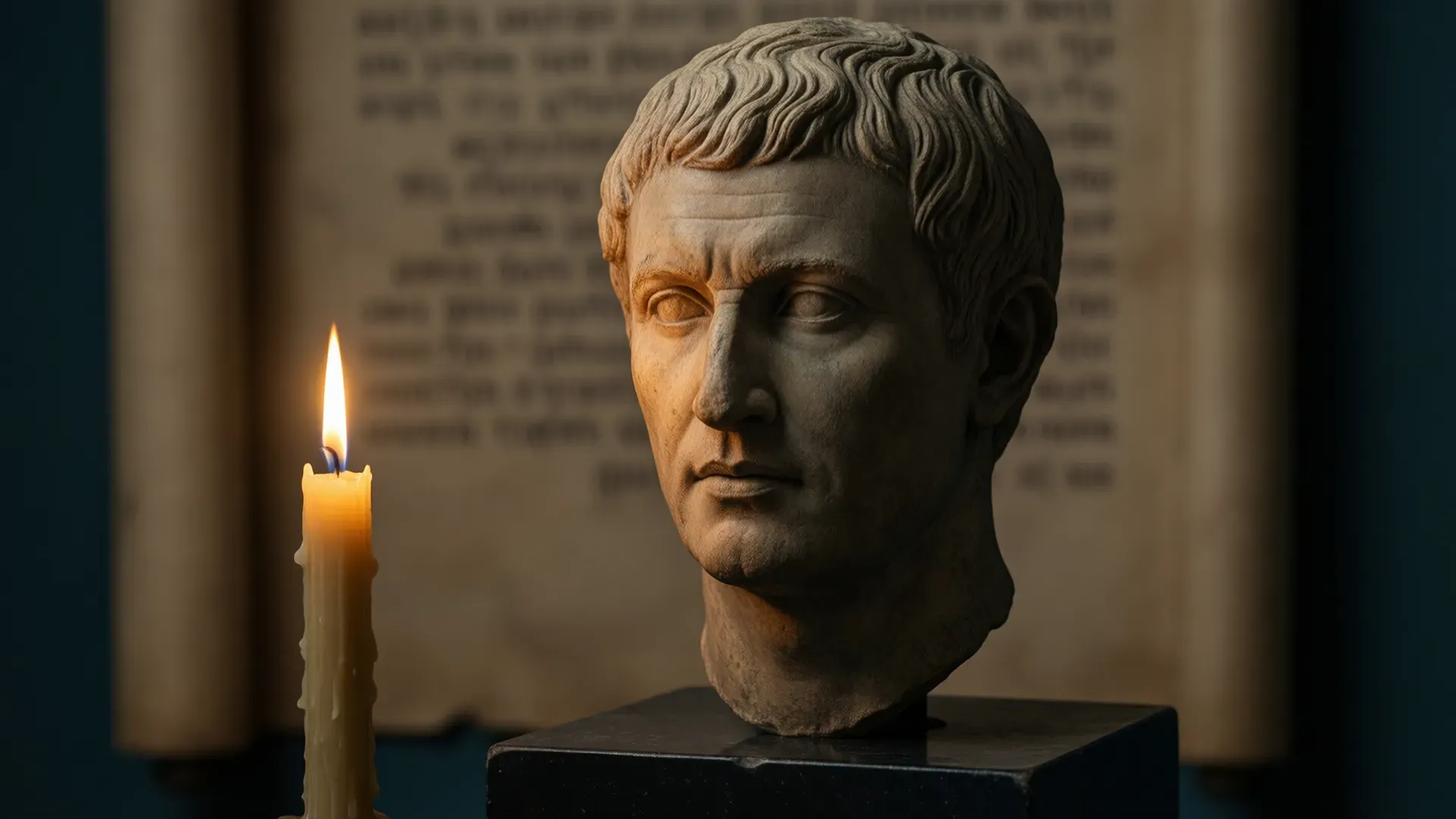
Marcus Aurelius on Identity — What the Meditations Found
How the Meditations use daily Stoic practice to strip away title, reputation, and role — and what remains
Marcus Aurelius on identity — what the Meditations reveal about who you are without your title, role, or reputation
Somewhere between the job title and the personality, most people lose track of themselves. Not dramatically. Not in a crisis. Just slowly, across years of becoming the person their role required — and then one day the role shifts, or ends, or is taken away, and the question surfaces: who was I before that? Or worse: is there anything there at all?
Marcus Aurelius had the largest possible version of this problem. He was emperor of Rome — a role so all-consuming that the man and the office were barely separable to anyone around him. And yet he spent his private notebooks, written with no intention of publication, returning again and again to a question that had nothing to do with empire: what is the thing I actually am? Not the emperor. Not the philosopher-king. Not the stoic example. The thing underneath all of that.
This is what makes the Meditations unusual. It is not a leadership manual. It is not a productivity system. It is a man with the world’s most impressive title systematically trying to locate what he would be without it.
What the Meditations Actually Are
Most books are written for readers. The Meditations were not. Marcus was writing to himself — working something out in real time, in Greek, in private. He never revised them for an audience. He never published them. What survived is closer to a practice log than a philosophy text: entries made at the end of campaigns, in winter quarters, between administrative decisions. The repetition is not laziness. It is the same man returning to the same problem because it kept needing to be solved again.
The problem he kept returning to is identity. Not in an abstract philosophical sense. In the most immediate sense: what is the part of me that is actually mine? What remains when the title, the reputation, the body’s comfort, and the opinions of others are removed from the equation?
He came back to this question so often that it functions as a kind of diagnostic. When a man with everything keeps asking what he actually has, the question tells you something about what he thought was real.
The Distinction That Changes Everything
The framework Marcus was working with had been stated plainly by Epictetus, whose Enchiridion he had absorbed. The opening passage of that work draws a line that the Meditations then spend years living inside:
There are things which are within our power, and there are things which are beyond our power. Within our power are opinion, aim, desire, aversion… Beyond our power are body, property, reputation, office.
Reputation. Office. Both explicitly outside the boundary of what is properly yours.
This is not a call to ignore your responsibilities. The Stoics were emphatic on duty — they had a whole framework for the obligations that come with social roles, and Marcus discharged his with scrupulous attention. What the distinction says is something more precise: your role is not your identity. You can perform a role with complete seriousness while understanding that the role is not the self. The emperor is something Marcus did. It was not something Marcus was.
Your role is not your identity. You can perform a role with complete seriousness while understanding that the role is not the self.
The question this opens is the uncomfortable one: if the role is not the self, what is? Marcus’s answer, returned to repeatedly across the Meditations, is the rational faculty — what he called the “rational mistress part.” Not the body. Not the reputation. Not the feelings about how the day went. The capacity to reason, to choose how to respond, to assess one’s own responses honestly. In Meditations he posed it as a direct self-interrogation:
What is the use that now at this present I make of my soul? Thus from time to time and upon all occasions thou must put this question to thyself; what is now that part of mine which they call the rational mistress part, employed about?
The question is not rhetorical. He expected an answer. And the practice of asking it — regularly, honestly, in private — was the practice of keeping the identity located in the right place.
What Happens When the Title Is Gone
Here is a concrete version of why this matters.
A person spends twelve years in a role that suited them — not just as a job, but as a way of being in the world. They were good at it. It gave them a place at the table, a reason to be taken seriously, a name that preceded them. Then the role ends. Redundancy, restructuring, a choice that needed to be made. The practical problems are manageable. The unexpected problem is that without the role, they are not sure who they are talking to when they talk to themselves.
This is not dramatic. It happens on an ordinary Tuesday. The inbox is quiet. There is no meeting to prepare for. And the question surfaces not in anguish but in a kind of flat blankness: what am I doing here, and who is it that is doing it?
The reason this is disorienting is not weakness. It is a predictable consequence of having located the self in something external. When the external thing is present, the identity feels stable. When it is removed, the ground goes with it. Identity built on role is structurally fragile — not because the person is fragile, but because the foundation was always borrowed.
Marcus’s framework does not make this less painful. What it does is clarify where the problem is. The person going through that quiet Tuesday did not lose their identity when the role ended. They were never their role. What they lost was the scaffolding they had mistaken for the building.
That distinction is not consolation. But it is accurate. And accuracy matters here more than comfort, because comfort based on a false picture does not hold.
The Practice He Left Behind
Here is what Marcus actually did with this understanding: he asked himself the question. Repeatedly. Not as a philosophical exercise. As a daily practice of keeping track of the self that was actually his.
The practice in the Meditations has a specific character — it is an examination, not a celebration. Marcus was not affirming his worth. He was checking what his rational faculty was doing, whether he had spent the day operating from the thing that was actually his, or from the noise of opinion and reputation and comfort. He described the soul in its best state as being like a sphere — complete in itself, neither grasping outward nor shrinking inward, shining all with light.
That state was not the default. It was the result of checking.
This is what connects the Meditations to what Viktor Frankl discovered under far more brutal conditions — that the one thing that cannot be taken away is the faculty of choosing how to respond. Frankl called it the last of the human freedoms. Marcus called it the rational mistress part. The vocabulary differs. The structure is the same.
And the practice is the same: review the day. Locate yourself. Ask what the part that is actually yours was doing.
The examined life in ancient philosophy comes down to exactly this — not a grand reckoning, but a daily habit of keeping track of where you actually are. Five minutes. A few honest questions. The same questions Marcus kept returning to, in different forms, across twenty years of notebooks.
Free download
Stop staring at a blank journal. Start here.
The Three-Question Evening Review — five minutes, three questions, no blank page.