
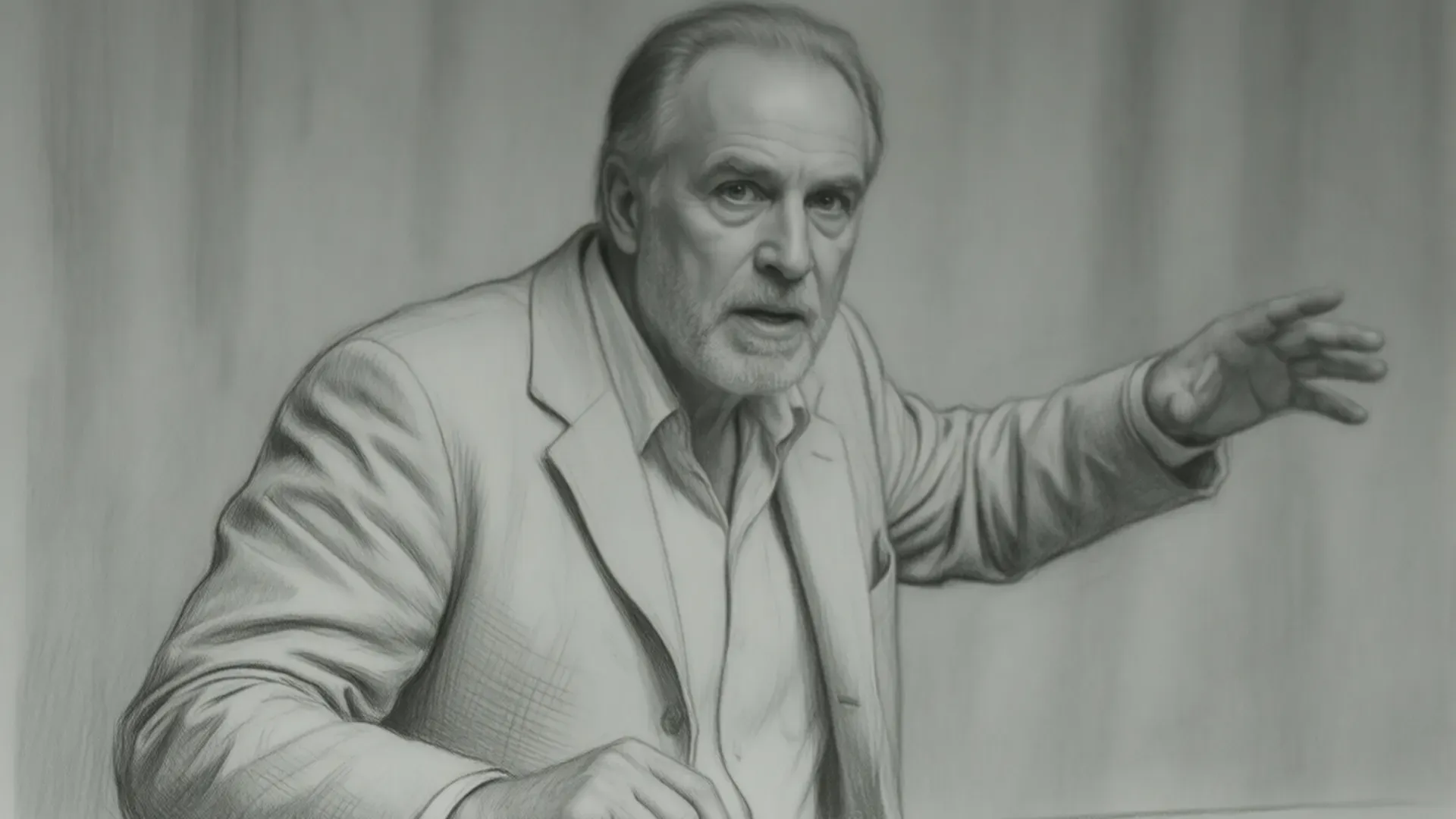
Logotherapy: The Method Viktor Frankl Built From the Camp
What logotherapy actually is: the three pathways to meaning, the three techniques, and where the method stops
What logotherapy is, and where it came from
When the Nazis arrested Viktor Frankl in 1942, he had a manuscript in his coat pocket. A decade of psychiatric work, compressed into pages he carried out of Vienna when everything else was taken. They took that too, at the camp gates.
He spent three years in four concentration camps — Auschwitz among them. His father died of pneumonia at Theresienstadt. His mother was gassed at Auschwitz. His wife died at Bergen-Belsen. He survived. When he returned to Vienna in 1945, he had no apartment, no family, no manuscript. What he had was an answer to a question the camps had forced him to ask with something approaching laboratory precision: what is the difference between a person who survives extreme suffering and one who does not?
Not physically survives. He had watched enough to know that physical survival was largely beyond anyone’s control. He meant something else. What separates the person who comes through with their mind and character intact from the one who disintegrates? What actually holds?
His answer was not courage. Not faith, though faith helped some. Not hope in the conventional sense. The thing that held, he found, was meaning. Not in any abstract philosophical sense — in a specific, locatable, daily sense. The prisoner who still had something to live for endured differently from the one who had lost that thread entirely.
The prisoner who still had something to live for endured differently from the one who had lost that thread entirely.
This was the foundation of what he called logotherapy — from the Greek logos, meaning. It is a form of existential psychotherapy built on a single clinical claim: that the primary human drive is the search for meaning, and that a life oriented toward nothing in particular produces a distinct kind of suffering which is not depression and does not respond to being treated as one. Where Freud’s therapy asked what you were driven by and Adler’s asked what you were compensating for, Frankl’s asks what you are answerable to.
He was still practising it in Vienna fifty years later.
What He Worked Out That Psychology Had Missed
Frankl trained as a psychiatrist under the dominant frameworks of his time. Freud had argued that human behaviour is driven by the pursuit of pleasure and the avoidance of pain. Adler had argued it is driven by the pursuit of power and status. Both were drive-based models. Something pushes you; you respond to it.
Frankl thought they had the structure right but the content wrong. Humans are not primarily pushed. They are pulled. Not by instinct or drive, but by something they are oriented toward — a purpose, a person, a work, a question they feel responsible for answering. He called this the will to meaning, and he argued it was the primary motivational force in human life, not a secondary one.
The distinction sounds subtle. It is not. A drive model says: when the drive is satisfied, the person is at rest. A meaning model says: a person without orientation toward anything is not at rest — they are in crisis. The absence of meaning is not neutral. It is its own kind of suffering, which Frankl called the existential vacuum.
This was the thing psychology had largely missed. It had pathologised symptoms — anxiety, depression, compulsion — while overlooking what Frankl believed was often the underlying condition: a life oriented toward nothing in particular. A person who wakes up, goes through the motions of surviving, and has no felt answer to the question of what any of it is for.
What made this a clinical observation rather than a philosophical position was that he had watched it operating under conditions of absolute extremity. In the camps, the external world had been stripped to almost nothing. No career, no property, no family nearby, no freedom of movement, no future that could be reliably planned. And yet — some people kept their bearing. They shared their last piece of bread. They told bad jokes. They noticed a sunset through the barracks window and said something about it to the person next to them.
Frankl’s argument was that what they retained was not resilience in any generic sense. They had something to turn toward. Some had a person they were determined to return to. Some had unfinished work. Some had, as Frankl himself did, the work of understanding what was happening to them — which itself became the meaning that carried him through.
Marcus Aurelius, writing to himself in the second century, described the structure of this in different terms — it is a recurring theme across the Meaning and Identity tradition. In Meditations, he wrote:
For whatever purpose each thing has been constituted, for this it has been constituted, and towards this it is carried; and its end is in that towards which it is carried; and where the end is, there also is the advantage and the good of each thing. Now the good for the reasonable animal is society.
He was describing a rational creature as something that cannot function well without direction. Not that it will be unhappy without direction. That it is, in some sense, not fully itself. The language is Stoic; the observation is the same as Frankl’s.
The Three Pathways Logotherapy Identifies
Logotherapy — from the Greek logos, meaning meaning — is the therapeutic system Frankl built from this foundation. Its clinical core is a claim about where meaning is actually found: not created, not invented, not assigned by the therapist. Discovered. Frankl was insistent on this. Meaning cannot be manufactured by willpower. It can only be found in the world, through specific kinds of engagement with it.
He identified three pathways.
The first is creative values — meaning found through what you make or contribute to the world. A project, a craft, a piece of work, a child raised with care. The person who is building something, however small, has a forward orientation. This is the most obvious pathway and the one most people already understand intuitively: meaningful work feels different from meaningless work, even when the tasks are identical.
The second is experiential values — meaning found through what you receive from the world. An encounter with something beautiful. A relationship in which you are genuinely known. A piece of music that does something inexplicable to you. Frankl’s point was that the capacity to be moved by something — to receive it fully — is not a passive state. It is an act of orientation. Love, in particular, he described as the highest form of this pathway: the act of seeing another person in their full particularity, not as a means to anything.
The third is attitudinal values — meaning found through the stance you take toward suffering you cannot change. This is the pathway that applies when the others are closed. When there is no work left to do, no one left to love, no beauty accessible. The camp prisoners who retained their bearing had, in most cases, located something here: a decision about how to carry what they were being forced to carry. Frankl called this the last of human freedoms — the freedom to choose your attitude toward a given set of circumstances, even when the circumstances themselves are beyond your control.
This is where the structural parallel with modern psychology becomes clearest without being identical. What Frankl described as attitudinal values shares the architecture of what cognitive approaches to therapy call reframing — the recognition that your relationship to an event is not the same thing as the event. But Frankl’s version goes further. It is not a technique for reducing distress. It is a claim that even unavoidable suffering can be the site of meaning, if it is suffered with dignity and awareness.
Seneca, in a different register entirely, circled the same idea — writing of the person who has made genuine inner progress as one who drags a looser chain: not yet free, but as good as free. The chain is still there. The conditions have not changed. What has changed is the relationship to the chain — and that relationship, it turns out, is not nothing.
Why Suffering Belongs in the Framework
The most common misreading of Frankl — and of Stoicism — is the inference that suffering is good for you. That hardship builds character, that struggle is necessary, that difficulty should be welcomed rather than avoided.
Frankl argued none of this. He was not romanticising suffering. He was making a narrower claim: that suffering which cannot be avoided need not also be meaningless. That the two are not the same thing. The goal is always to remove suffering where removal is possible. Logotherapy was a therapy, not a philosophy of voluntary hardship.
What the camps showed him was the edge case — conditions under which removal was not possible — and what operated there. His finding was that meaning could be located even at that edge. Not that it was easy. Not that everyone managed it. But that the pathway was structurally available in a way that the prevailing psychological models of his time had not accounted for.
This matters for people who are not in camps. Chronic illness that will not resolve. Grief that does not arc neatly toward recovery. Work that is genuinely bad, in a context where leaving is not currently possible. Relationships that demand from you more than they return, but cannot yet be changed. The attitudinal pathway does not transform these situations into good ones. It asks a different question: what can be done with this, as it is, now?
Marcus Aurelius knew this question well. He was ill for much of his reign, conducting a war he had not sought, governing an empire he had not designed. In Meditations, he wrote of keeping his mind fixed on what a rational creature is for, regardless of conditions — “taking care of this only all through life, that his thoughts turn not away from anything which belongs to an intelligent animal and a member of a civil community.” It reads like a private instruction. Do not let the conditions set the terms. Keep the orientation.
The Three Techniques of Logotherapy
The three pathways are the philosophy. But Frankl was a practising neurologist and psychiatrist, and for specific clinical problems he built specific methods — the parts of logotherapy that are techniques in the ordinary sense, even though the meaning-framework above is not.
The best known is paradoxical intention. A patient locked in a fear loop — afraid of blushing, of sweating, of not sleeping — is told to deliberately try to do the very thing they dread. Try to blush as hard as possible. Try to stay awake. The instruction breaks the loop because the symptom is being driven by the anticipatory fear of it, and you cannot fearfully will what you are cheerfully attempting. The insomniac who gives up trying to sleep and tries to stay awake instead tends, perversely, to fall asleep. It works by removing the second-order struggle — the fear of the symptom — that was keeping the first-order symptom alive.
The companion technique is dereflection: the deliberate turning of attention away from the self and toward something in the world. Much suffering, Frankl observed, is sustained by hyper-reflection — watching yourself perform, monitoring whether you are happy, anxious, aroused, asleep. Dereflection points the searchlight outward, at a task or a person, and the monitored function is left alone to resume on its own.
Marcus Aurelius described the failure state dereflection targets with unusual precision. Writing to himself in the second century, he warned against two opposite errors — being pulled outward by distraction, and being busy without direction:
Do the things external which fall upon thee distract thee? Give thyself time to learn something new and good, and cease to be whirled around. But then thou must also avoid being carried about the other way; for those too are triflers who have wearied themselves in life by their activity, and yet have no object to which to direct every movement, and, in a word, all their thoughts.
Triflers who have wearied themselves by their activity. That is the hyper-reflective person exactly: enormous effort, no object. Frankl’s instruction and Marcus’s are the same instruction — find the object, and let the monitoring stop.
The third technique is Socratic dialogue, and it is what most of a logotherapy session actually consists of. The therapist does not tell the patient what their life means; on Frankl’s account that would be a category error, since meaning is discovered rather than assigned. Instead they question — about commitments the patient has already made, moments that mattered, responsibilities they are still holding — until the patient says something they had not previously put into words. Frankl’s wager was that people usually know what they are answerable to and have simply never been asked directly. The method is a way of asking.
That scope matters more than it usually gets credit for. Paradoxical intention circulates online as a costless trick — wish for the panic attack, and it goes away — and for anticipatory anxiety it often does something close to that. But grief is not sustained by fear of grieving. Depression is not anticipatory. Where the fear is not the thing feeding the symptom, there is nothing for the instruction to interrupt. And even inside its intended range the evidence is thinner than the internet suggests: controlled trials for sleep-onset insomnia have gone both ways.
Frankl was a neurologist applying this to a patient whose diagnosis he already had. That is the context the technique was built for, and it is the part that gets dropped when the instruction travels as a one-line trick. If what you are afraid of is a physical event rather than the fear itself, the sensible move is to ask a clinician rather than to deliberately provoke it.
All three are recognisably ancestors of techniques that later cognitive and acceptance-based therapies would formalise — ACT’s defusion is close kin to dereflection, and cognitive restructuring inherits the Socratic questioning almost intact. None of them asks you to feel differently. They change what you are doing with your attention — and let the feeling follow.
How to Use It When Nothing Else Is Working
Frankl’s framework does not ask you to feel better. That is its most useful feature.
Most approaches to meaninglessness are mood-based — the implicit promise is that if you follow the steps, the flatness will lift, the motivation will return, things will feel worth doing again. This is sometimes true. It is also the reason people exhaust themselves on approaches that work occasionally and abandon them when they stop working.
Logotherapy asks a different question. Not: how do you feel? But: what are you oriented toward? Even if the answer is small. Even if it barely feels like an answer.
The three pathways give this a practical shape. If creative values are accessible — some work, some making, some contributing — start there. If they are not, or not today, look for experiential values. Not grand encounters. A conversation that was real. Something in the world that you noticed. If neither is available, the attitudinal pathway is always open: the decision about how to carry what you are currently carrying, and why.
This is not a technique in the clinical sense. It is closer to a reorientation. The question Frankl posed to his patients — and to himself, in the camps — was not “how do I make this less bad?” but “what does this moment demand of me?” He believed the question itself was load-bearing. That a person who had some answer, however provisional, was in a fundamentally different state from a person who had stopped asking.
A Stoic would not have been surprised by this. The Meditations are full of exactly this reorientation — the emperor reminding himself, in private writing, what he is for. Not performing equanimity. Locating it. Again, and then again.
You do not need to be in a concentration camp for the question to be urgent. If you are reading this because the standard answers have not worked — because the productivity systems, the motivational frameworks, the advice to follow your passion have left you roughly where you started — it may be worth asking whether the advice misdiagnosed the problem in the first place. What Frankl found in the most extreme conditions on record is worth taking seriously regardless. Not because suffering ennobles you. Because he found the mechanism while the conditions for any other kind of observation had been stripped away.
If you want something small and concrete to start with: five minutes at the end of the day, three questions. What did today ask of me? Did I answer? What am I oriented toward tomorrow? The Evening Review is a one-page structure for exactly this — a daily practice for when nothing feels worth doing, built around the kind of self-interrogation Frankl described and Marcus Aurelius practised every night.
The identity question Frankl’s work raises — who am I beneath the roles, the fears, the performance — is one Marcus Aurelius returned to constantly. He was the most powerful man in the world and still asked: what am I, really? connects that thread directly. And for the modern version of the same anxiety — the feeling of being about to be found out — imposter syndrome through a Stoic lens covers the same mechanism from a different entry point. One prior step: most people are already operating from a philosophy of life — they just haven’t examined it. You already have a philosophy of life makes that case, and shows why naming it is the first move.
Frequently asked questions
- What is logotherapy in simple words?
- Logotherapy is Viktor Frankl's form of psychotherapy, built on the claim that the main human drive is the search for meaning rather than pleasure or power. In practice it means a therapist helps you find what you are answerable to — through work or creating something, through love and encounter, or through the stance you take toward suffering you cannot change — rather than telling you what your life should mean. The name comes from the Greek logos, meaning.
- What are the three techniques of logotherapy?
- Paradoxical intention (deliberately wishing for the symptom you fear, which breaks the loop where fear of the symptom sustains it), dereflection (turning attention away from self-monitoring and toward a task or person), and Socratic dialogue (questioning that helps a patient articulate a meaning they already hold but have never stated). The first two treat specific clinical symptoms; the third carries most of the actual therapeutic work.
- Is paradoxical intention safe?
- Frankl specified it for phobias, anticipatory anxiety, obsessive-compulsive patterns and insomnia — cases where fear of the symptom is what sustains the symptom. Outside that scope it is not a general-purpose tool, because grief, depression and trauma are not driven by that loop. Even within its intended range the evidence is mixed: controlled trials for sleep-onset insomnia have gone both ways. It was designed as a clinician's technique applied to a known diagnosis, so if what you fear is a physical event rather than the fear itself, ask a clinician rather than provoking it deliberately.
- Is logotherapy still used today?
- Yes. The Viktor Frankl Institute still trains and credentials practitioners, but the method's clearest modern descendant is Meaning-Centered Psychotherapy, developed by William Breitbart's group at Memorial Sloan Kettering for patients with advanced cancer. It is explicitly built on Frankl's framework, it is manualised, and unlike logotherapy itself it has been tested in randomised controlled trials — showing improvements in spiritual well-being, quality of life and depressive symptoms. Frankl's influence is also visible in acceptance and commitment therapy's work on values.
- Is logotherapy based on religion?
- No. Frankl held that meaning is discovered in the world rather than assigned by any doctrine, and he was explicit that logotherapy must remain open to religious and secular patients alike — a therapist who supplied the content of a patient's meaning would be overstepping. He wrote about faith in his own later work, and he was himself Jewish, but the clinical method does not require a religious commitment and is practised by therapists and patients who have none.
- Did Viktor Frankl's wife survive the Holocaust?
- No. Frankl's first wife, Tilly Grosser, was deported with him and died in the Bergen-Belsen concentration camp; his mother and brother were killed at Auschwitz. Frankl himself survived several camps and learned of their deaths after liberation. That loss is inseparable from his work — Man's Search for Meaning was written in the aftermath, and his insistence that meaning can be found even in unavoidable suffering was not abstract theory but something he had been forced to test.
- What was Viktor Frankl's main message?
- That the primary human drive is not pleasure or power but meaning — and that meaning remains available even in the worst circumstances, because the one freedom that can never be taken is how you choose to respond to what happens to you. He argued meaning is found in three ways: through work or creating something, through love and connection, and through the stance you take toward unavoidable suffering. The line most associated with him — those who have a 'why' to live can bear almost any 'how' — is one he quoted rather than coined: it is Nietzsche's, from Twilight of the Idols (1889), and Frankl credits him for it.
Free download
Stop staring at a blank journal. Start here.
The Three-Question Evening Review — five minutes, three questions, no blank page.
This article is reflection, not treatment. If anything here describes your life and it is hard to carry, free and confidential help is available from trained services — see this list of support resources.