
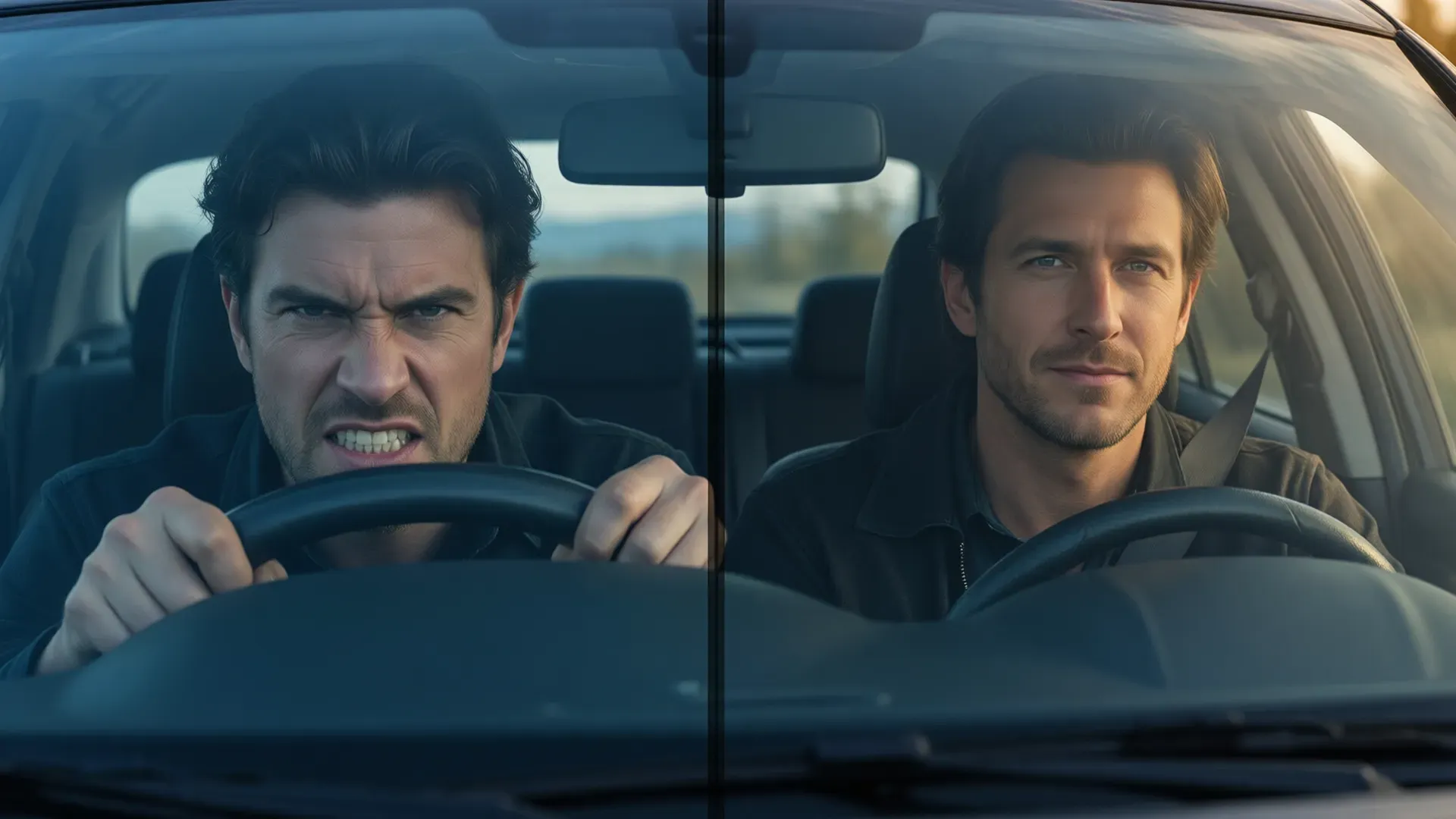
The Driver Who Cut You Off — Road Rage Psychology Explained
Road rage psychology: why the anger that fires after a near-miss isn't about safety at all
Road rage isn’t a fear response. It’s a status wound.
The driver who pulled out in front of you wasn’t a threat to your life — your body knows that, because your heart rate drops before you’ve finished braking. What fires a second later, the surge of heat, the urge to gesture or tailgate or mutter under your breath — that’s something else entirely. That’s the sting of being treated as though you didn’t count.
Seneca drew this distinction almost two thousand years ago, and it is more precise than anything modern psychology has added since. His full account of how anger works — and where it can be interrupted — is in On Anger, which remains one of the most clinically accurate documents on rage ever written.
What Road Rage Psychology Actually Shows
There’s a tendency to treat road rage as an overreaction to danger — as though the anger is fear running slightly too hot. It isn’t. The danger, such as it is, passes in under a second. The anger that follows can last minutes, sometimes the entire drive home.
What’s actually happening is closer to what Seneca describes in On Anger when he separates injury from insult:
“If you think fit, my Serenus, let us distinguish between injury and insult. The former is naturally the more grievous, the latter less important, and grievous only to the thin-skinned, since it angers men but does not wound them. Yet such is the weakness of men’s minds, that many think that there is nothing more bitter than insult; thus you will find slaves who prefer to be flogged to being slapped.”
The flogging is punishment. The slap says: you are not worth proper treatment.
That’s the mechanism behind road rage. The other car didn’t damage you. It ranked you. It communicated, without words, that its driver’s two-second advantage was worth more than your right of way. That’s not a physical threat. It’s a social one — and the part of your mind that tracks social position registered it as such.
Road rage is not a fear response. It is a status wound — the sting of being treated as though you did not count.
Why Road Rage Fires at All
Seneca goes further. He identifies something most modern explanations of road rage psychology miss entirely: the anger isn’t just about being treated badly. It’s about being treated badly unexpectedly.
“Men think some things unjust because they ought not to suffer them, and some because they did not expect to suffer them: we think what is unexpected is beneath our deserts… This is caused by our excessive self-love: we think that we ought to remain uninjured even by our enemies.”
We expect, in some pre-verbal way, to be treated as though we matter — even by strangers, even on a motorway, even by someone who has never met us and will never see us again. When that expectation is violated, the anger fires not because something was taken, but because something was assumed and then denied.
This is why road rage feels personal even when it clearly isn’t. The other driver wasn’t targeting you. They were in a hurry, or distracted, or just bad at merging. But your nervous system — calibrated for a village, not a six-lane carriageway — read the slight as a deliberate communication: you don’t matter here.
The anger is your response to that reading. It isn’t irrational. It’s misdirected.
Why the Stoic Response Isn’t “Stay Calm”
The standard advice on road rage is a variation of calm down, delivered with varying patience. It doesn’t work because it’s aimed at the wrong target.
You’re not overreacting to a physical near-miss. You’re reacting to a status signal — and being told to suppress a reaction your nervous system generated for a reason. Calm down treats the anger as irrational. It isn’t irrational. It’s responding accurately to something that genuinely happened. The problem is what it’s responding to.
Seneca describes how anger moves through three stages. The first is involuntary — the initial impression of injury, the flash. That’s not anger yet. The second is the wish to avenge: it is right that this person should suffer consequences. The third is where reason loses: “the subsequent mad rush, which not only receives the impression of the apparent injury, but acts upon it as true.”
By the third stage, reason isn’t available. The intervention can’t happen there. But at the first and second stage — in the gap between the flash and the decision to act on it — there is a question that changes everything.
The Question Seneca Asks
What, exactly, was taken from you?
Not rhetorically. Actually. Run the account.
Your safety? It passed. Your time? By seconds. Your dignity? Only if you lend it to someone who has already forgotten you exist.
This is the move that the “calm down” approach never makes. It doesn’t ask you to suppress the feeling. It asks you to look at what the feeling is pointing at — and to notice that when you look directly at it, the account is empty. The other driver is gone. The two seconds are gone. What remains is entirely a construction: the story you are telling yourself about what their behaviour meant about you.
Most road rage lasts longer than the incident because we keep re-litigating it. Refreshing the insult. Running the scenario where we responded differently, better, more decisively. We are not angry about what happened. We are angry about what we believe it said about us. And we keep saying it, to ourselves, for the rest of the journey.
The Stoic intervention is to catch that process at the second stage — before the mad rush, while reason is still available — and ask what the anger is actually spending itself on. Not to dismiss it. To examine it.
The driver who cut you off took two seconds. Everything that runs longer than two seconds is yours.
If you want a structured way to catch these patterns — the small things that got more attention than they deserved, the moments where the account was always empty but you couldn’t see it at the time — the Evening Review was built for exactly that. Five minutes at the end of the day. Three questions. No blank page.
A stranger’s anger is easy to hand back — they have already forgotten you exist. The harder case is anger from someone who hasn’t: when it’s a husband’s anger problem at home, the account isn’t empty, and the question becomes whether it’s a reflex he can retrain or control you need to leave.
Understanding why the anger fires is one part of emotional regulation. The technique that interrupts it — what therapists call cognitive defusion and the Stoics called something else — is covered in this piece on how the same method ended up in modern therapy.
Free download
Stop staring at a blank journal. Start here.
The Three-Question Evening Review — five minutes, three questions, no blank page.