
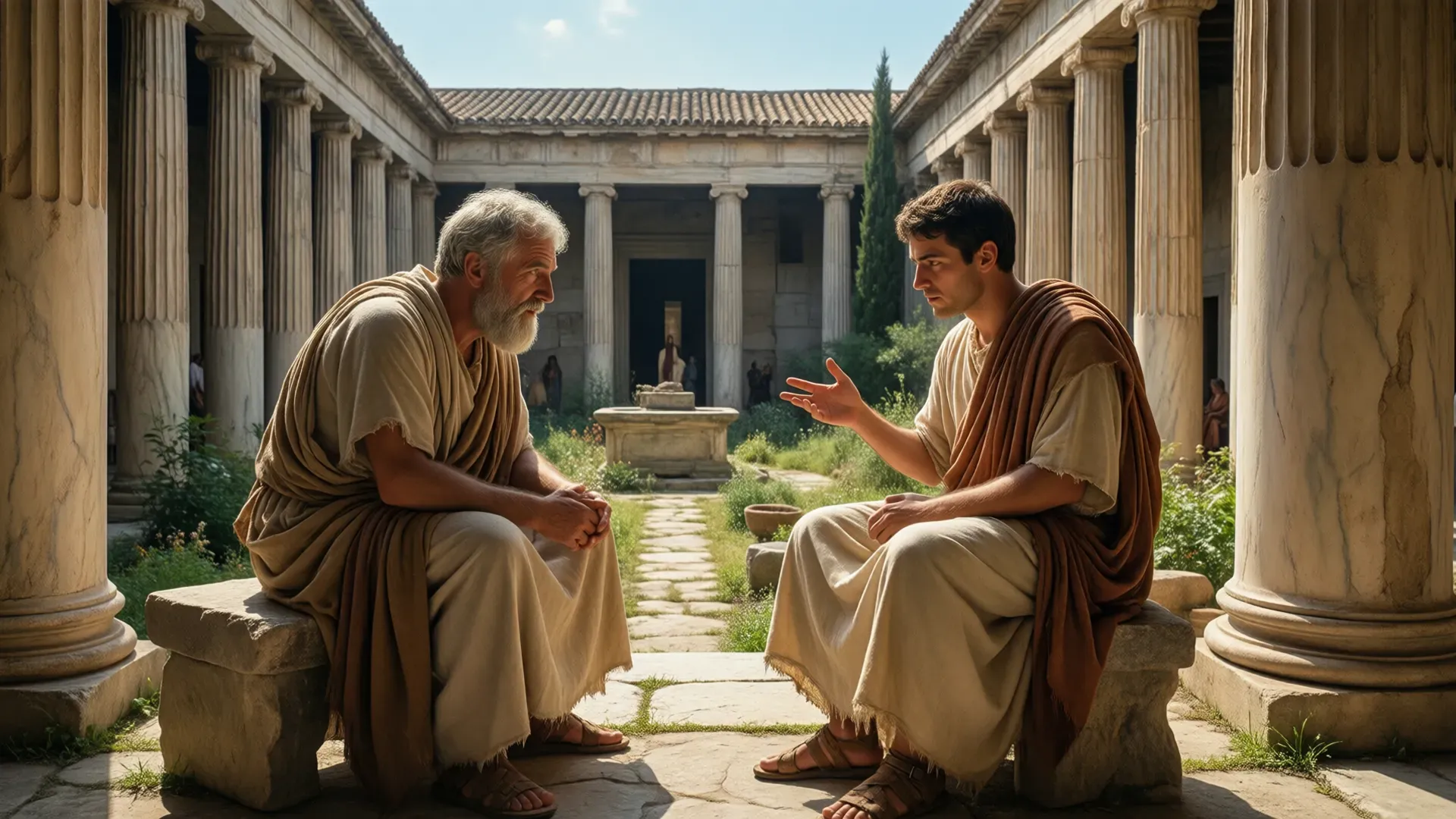
The Philosopher Who Couldn't Practise What He Preached — Seneca
What Seneca’s Letters from a Stoic actually argue about time, distraction, and the problem of the life not yet lived
He was one of the wealthiest men in Rome. He owned multiple estates. He lent money at ruinous rates in Roman Britain. When Nero, the emperor he tutored, ordered him to open his veins, Seneca did it — and spent his final hours dictating to his secretaries, because he had things left to say.
This is the man who wrote that wealth was an indifferent thing. That the wise man holds possessions lightly. That time is the only asset that matters, and most of us squander it without noticing.
The obvious objection is sitting right there.
It is the objection that stops a lot of people from engaging with Stoicism at all, and from Seneca specifically. The man preached detachment and practised excess. He wrote about the dangers of the court while living at the centre of one. He described what the good life looked like and then, apparently, lived a rather different one.
If you have read a page of Seneca and felt something like moral suspicion, that response is the right one. The question is whether it is the final one.
Why the Hypocrisy Charge Doesn’t Land the Way It Should
Seneca knew the objection. He wrote about it directly, in the same texts where he describes the good life. The question he fielded from critics was essentially: why should anyone take philosophical advice from a rich man who claims wealth doesn’t matter?
(This page argues that one question. For the life it sits inside — Córdoba, the illness that nearly ended him, the Corsican exile, the tutorship, and the death — start with who Seneca actually was.)
His answer is worth reading carefully, because it is not a deflection. He does not claim to have transcended his attachments. He claims something narrower and more useful: that the goal is not to refuse wealth but to hold it without being held by it.
“These things ought to be despised, not that he should not possess them, but that he should not possess them with fear and trembling.” — Minor Dialogues
The distinction is between ownership and captivity. A person who would be destroyed by losing their money is not, in any meaningful sense, free — regardless of what they claim to believe about material things. A person who holds the same money lightly, who would survive its loss without losing themselves, is demonstrating a different relationship to it.
A person who holds money lightly, who would survive its loss without losing themselves, is demonstrating a different relationship to it entirely.
Seneca puts it more precisely elsewhere: “My riches belong to me. You belong to your riches.”
That is the answer. Not “I have overcome wealth” — he clearly had not — but “I am not owned by what I own.” Whether he lived up to that distinction consistently is a separate question. Whether the distinction itself is correct is not.
This matters for how you read the Letters. Seneca is not a saint who has finished the project of self-improvement and is now transmitting the results downward. He is a man who understood the mechanism — precisely, clinically — and was still working on the application. The Letters are not wisdom delivered from a height. They are dispatches from someone still in the work.
That is exactly why they are useful. It is also why Seneca sits so naturally alongside Socrates — who made the same argument about the examined life with rather higher personal stakes: he said it at his own trial, and refused to stop even when the penalty was death.
What the Letters Are Actually Doing
The 124 surviving letters were written to Lucilius, a friend and provincial governor, in the last few years of Seneca’s life. They are among the most readable documents in ancient philosophy — not because they are simple, but because they are honest in a way that formal philosophical writing rarely is.
Each letter starts somewhere concrete. A visit to the gladiatorial games. A sea voyage. The sound of a crowd outside a bathhouse. Seneca uses these as the entry point for thinking, not as illustration after the thinking is already done. The observations feel live because they were — he was writing against a deadline, and he knew it.
The first letter opens with a line that has stayed in circulation for two thousand years: “Ita fac, mi Lucili: vindica te tibi.” Claim yourself for yourself. Or, in a translation that keeps the urgency: lay hold of yourself before it’s too late.
The thing that makes Letter I so disorienting the first time you read it is that it doesn’t describe a problem abstractly. It describes the mechanism of how time disappears — not through dramatic loss, but through the accumulation of small surrenders.
“Make yourself believe the truth of my words — that certain moments are torn from us, that some are gently removed, and that others glide beyond our reach.”
The robber, the borrower, and the leak. Seneca names three distinct ways the hours go. The robber is external — illness, emergency, the sudden demand on your attention. The borrower is social obligation — the time you hand over because you couldn’t find a way to refuse. And the leak is the worst kind: the time that goes without your noticing it went. No external pressure, no social demand. Just the hours, moving past while you were half-present.
Most people who feel they are not living the life they intend to live are not experiencing the first or second kind of loss. They are experiencing the third. The calendar is full of things they chose, and yet the days go and nothing accumulates.
This is the argument the Letters make. Not that you need more discipline. Not that you need a new system. That the problem is one of attention — chronic, habituated inattention to how time is actually passing.
What On the Shortness of Life Gets Right
The essay version of the same argument is On the Shortness of Life, which Seneca addressed to his father-in-law, Paulinus. It is shorter than the Letters, more compressed, and in places more brutal.
The line that has survived best is one that cuts directly against the standard complaint:
“We do not receive a short life, but we make it a short one, and we are not poor in days, but wasteful of them.” — Minor Dialogues
This is a harder claim than it looks. It is not just that we procrastinate or waste time in the obvious sense. It is that the most productive-looking life — full of commitments, appointments, meetings, duties, plans — can be among the most hollow, because business is not the same as living. Seneca’s word for the busy person is occupatus: the occupied, the preoccupied, the person whose interior life has been colonised by the demands of the exterior one.
The essay’s sharpest passage is about old age. Most people, Seneca writes, reach the end of their life and realise they have not yet started it. They were preparing to live. They were waiting for the right conditions. The conditions came and went.
This is not a counsel of despair. It is a clinical description of a common failure mode, paired with a specific correction: the examined life begins now, not when the external conditions are right, because the external conditions are never right.
The Stoic pillar on this site goes deeper into the tradition — Marcus Aurelius on the discipline of attention, Epictetus on the dichotomy of control. Seneca is the third leg of that framework, and the most psychologically direct.
How to Actually Read the Letters
Start with Letter I. Not because it is the most representative, but because it establishes what the correspondence is doing before you get drawn into the particular questions each subsequent letter addresses. Seneca is not building a systematic philosophy from first principles. He is thinking out loud, to a friend, about what it means to live carefully — and in Letter I he says that plainly.
From there, the letters reward reading without sequence. They are not chapters in an argument. They are conversations that return, from different angles, to the same persistent questions: how do I use time well, what is actually worth wanting, how do I remain myself under pressure.
On the Shortness of Life is the obvious companion piece, and the better place to start for a reader who wants the argument in concentrated form before the letters’ looser, more discursive style. Between them, they constitute something that two thousand years of Western philosophy has not significantly improved: a precise, honest account of why most people do not live the lives they intend to, and what to do about it.
As for the hypocrisy — Seneca was wealthy, politically compromised, and almost certainly not the man his letters described. He was also correct. Both things are true. The question to ask of philosophy is not whether the author was a saint. It is whether the argument survives scrutiny.
His does.
If you want to put it into practice
The Evening Review is a five-minute daily structure built on the same question Seneca kept returning to: what of today actually mattered? The specific practice — what Seneca’s audit actually involves and how to run it tonight — is here. Three questions, one page, no blank journal required.
Free download
Stop staring at a blank journal. Start here.
The Three-Question Evening Review — five minutes, three questions, no blank page.