
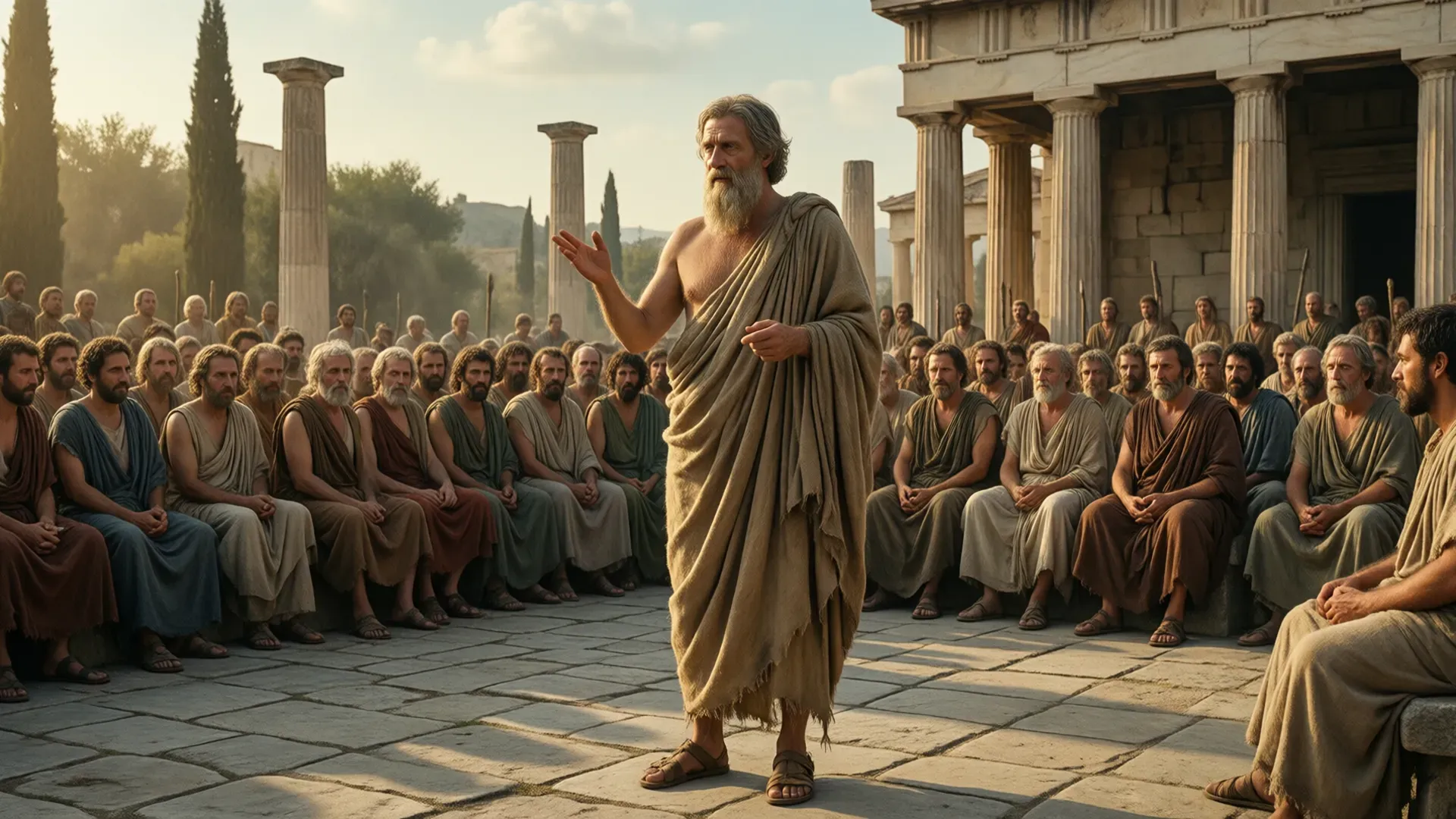
Why the Unexamined Life Is So Easy to Live — Socrates Was Right
What Socrates actually meant — and why the unexamined life is not worth living
The phrase has survived two and a half thousand years. Most people who encounter it nod along. Some highlight it. Almost none of them change anything.
The unexamined life is not worth living. Socrates said it at his own trial — not as a philosophical observation he was quietly proud of, but as the reason he would accept death rather than stop doing the thing Athens was prosecuting him for. That context tends to get stripped out when the quote circulates. What remains is a sentiment that sounds wise without being particularly demanding.
Understanding what Socrates actually meant — and why he meant it with enough conviction to die for it — requires knowing what examination actually is, why it is genuinely difficult, and what happens to a person who does not do it. The answers are not what the inspirational version suggests.
What Socrates Actually Meant by Examination
Examination, for Socrates, was not introspection. It was not sitting quietly with your feelings or journalling about your week.
It was interrogation. Specifically, it was the practice of taking the opinions you already hold — about what is good, what matters, what kind of person you are, how you should live — and subjecting them to questioning until you had found either their foundations or their cracks. Most people, Socrates observed, hold their opinions the way they hold their possessions: without having thought much about whether they were really theirs, or whether they were any good.
The examined life is not a life of constant reflection. It is a life in which you do not simply accept what you have been given — by upbringing, by habit, by the surrounding culture — without checking it. Diogenes Laërtius, recording the Socratic tradition, noted that accepting principles without examination was treated as a kind of absurdity: you would not accept an argument in logic without testing it, so why would you accept the principles you are actually living by without the same scrutiny?
The unexamined life is not a miserable life or a failed one by external measures. It can look entirely successful. What it lacks is a person at the centre of it who has actually decided what they believe — who is living from examined principles rather than inherited ones.
What the Unexamined Life Actually Looks Like
The unexamined life does not feel like a choice. That is its primary feature.
Epictetus, teaching in the generation after Socrates, identified what makes non-examination so durable. He observed two kinds of hardening that make a person resistant to inquiry: hardening of the understanding, and hardening of the sense of shame. The first is an intellectual matter — the person who has stopped engaging with evidence. The second is subtler and more common. When the sense of shame is deadened, when the capacity to feel that one’s life might not be going well has been suppressed, most people call this strength.
It is not strength. It is the absence of the signal that examination needs to function. You cannot examine a life you cannot feel the shape of.
The unexamined life tends to run on a small set of unverified assumptions: that the things you are pursuing are actually worth having, that your understanding of yourself is basically accurate, that the reactions you have to events are proportionate to what the events deserve. These assumptions are almost never stated. They operate below the surface, and because they are never stated they are never questioned.
The result is a person who is moved through life by responses they did not choose — by habit, by social expectation, by the accumulated drift of decisions that were never examined closely enough to count as real decisions at all.
The daily practice of examination sits at the heart of The Examined Life — and Seneca and Marcus Aurelius both left records of what it looked like in practice.
Why He Said It at His Own Trial
In 399 BCE, Socrates stood before a jury of five hundred Athenians and was found guilty of impiety and corrupting the youth of Athens. The penalty could be death. He was given the opportunity to propose an alternative.
He refused to stop philosophising. He refused to leave Athens. He refused to give up the practice of examining — both his own life and the lives of others willing to be examined. And then he said it plainly: that a life without this practice was not one he recognised as worth living.
This is not the statement of a man who thought examination was a pleasant intellectual hobby. Socrates had concluded, through the very practice he was defending, that the unexamined life produces a particular kind of damage. Not dramatic ruin — most unexamined lives look perfectly fine. But a slow erosion of the capacity to be genuinely responsible for what you think, feel, and do. A life lived at one remove from yourself, governed by opinions you have never interrogated.
He considered this damage serious enough to be worth dying rather than giving up the antidote. That weight, that seriousness, is almost entirely absent from the inspirational version of the quote.
He considered this damage serious enough to be worth dying rather than giving up the antidote.
What Examination Means in Practice
Here is what changes the frame: examination is not something you do once, at a moment of crisis, when something has gone obviously wrong.
The Stoics who inherited the Socratic tradition understood it as a daily practice — not a crisis intervention. Seneca described his own evening habit with a directness that makes the point better than any paraphrase:
When the lamp is taken out of my sight, and my wife, who knows my habit, has ceased to talk, I pass the whole day in review before myself, and repeat all that I have said and done: I conceal nothing from myself, and omit nothing.
That is the practice. Not dramatic self-recrimination. Not extended journalling. A daily review: what happened, what did I do, what did I make it mean, where was I governed by an opinion I have not examined. What self-reflection actually requires — and why most people never cross from replaying to examining — is the subject of a separate article.
Marcus Aurelius did the same thing in writing — the Meditations is, among other things, the record of a man reviewing his own responses and testing them against principles he had examined and chosen. Sextius, whom Seneca cites, asked himself three questions at the end of every day: what bad habit have you checked, what vice have you corrected, in what respect are you better.
This practice is not difficult in the way that physical training is difficult. It is difficult in the way that Epictetus described: the sense of shame has to be kept alive. You have to be willing to find that your opinions about your own behaviour do not hold up. Most people are not. The hardening Epictetus identified — the deadening of the capacity to feel the discrepancy between who you think you are and who you are being — is the default direction. Examination is what pushes back.
Socrates was not making a demand about how much you reflect. He was making a claim about direction. An examined life is one that moves toward checking its own foundations rather than away from them. It does not require a philosopher’s schedule or a Roman emperor’s discipline. It requires the habit of looking, regularly, at whether what you are doing is what you would choose on examination — or just what you have drifted into.
The Evening Review is a three-question structure built on exactly this principle. Five minutes, at the end of the day, before the lamp goes out. Not journalling for its own sake — the check Seneca described.
If you want to start examining your life tonight — not at some future point when conditions are better — the template is free. The trial in Athens was two and a half thousand years ago. The charge was examining things that should not be examined, and the penalty was drinking poison. Socrates thought this was preferable to stopping. The only thing that makes that comprehensible is taking seriously what he thought examination was protecting against: a life that runs on assumptions no one has ever checked, including you.
Free download
Stop staring at a blank journal. Start here.
The Three-Question Evening Review — five minutes, three questions, no blank page.