
What Delayed Gratification Actually Means — and When to Stop
Why it was never about willpower — and how to tell wise waiting from self-denial
Everyone tells you to delay gratification. Save instead of spend. Study instead of scroll. Wait for the better thing. And somewhere underneath the advice, a quiet objection forms: if I keep putting the good stuff off, when do I actually get to live? Tomorrow becomes today, and today there’s a new reason to wait. Follow the rule far enough and it starts to look like a life spent permanently in the waiting room.
That objection is the most common thing real people say about delayed gratification — and almost nothing written about it bothers to answer. The reason the question feels like a trap is that the popular definition is wrong. Delayed gratification was never a contest between willpower and desire. It is something quieter and more useful: a way of deciding which desires are worth acting on, and when.
What delayed gratification actually means
Delayed gratification is the capacity to forgo a smaller, sooner reward in favour of a larger, later one. That’s the textbook definition, and it’s correct as far as it goes. You skip the night out to pass the exam. You leave the money invested instead of spending it. You want the thing now; you decide the better version is worth the wait.
But the definition hides the part that actually matters. It isn’t really about waiting. It’s about judging — looking at two outcomes and deciding which one you’d genuinely rather have, then acting on that decision instead of on whichever impulse is loudest in the moment. The waiting is a by-product. The judgement is the skill.
This is why the willpower framing fails people. It casts the whole thing as a fight: your rational self gritting its teeth against an appetite that wants satisfaction now. On that model, success means winning the fight every time, and any slip is a failure of character. No wonder people give up. White-knuckling against your own wants is exhausting, and it can’t be sustained — which is roughly what the research on willpower as a finite resource has long suggested. If delayed gratification were really about out-muscling desire, the people who are good at it would be the most strained. They aren’t. They’re usually the ones who’ve stopped treating it as a fight at all.
What it looks like in real life
The clean examples are the financial ones — leaving savings untouched, paying down debt before upgrading the car. But the more revealing cases are smaller. The second drink you decide not to order because you’d rather feel good tomorrow morning than slightly better tonight. The reply you don’t fire off, because the satisfaction of being right now isn’t worth the argument later. The project you keep working on quietly while other people chase faster wins.
In each case you can feel the same internal move: a brief comparison, almost too quick to notice, between what’s available immediately and what’s available if you hold off. Sometimes you hold off. Sometimes you don’t — and choosing the immediate thing isn’t automatically a failure, which is a point we’ll come back to.
The marshmallow test — and what it really showed
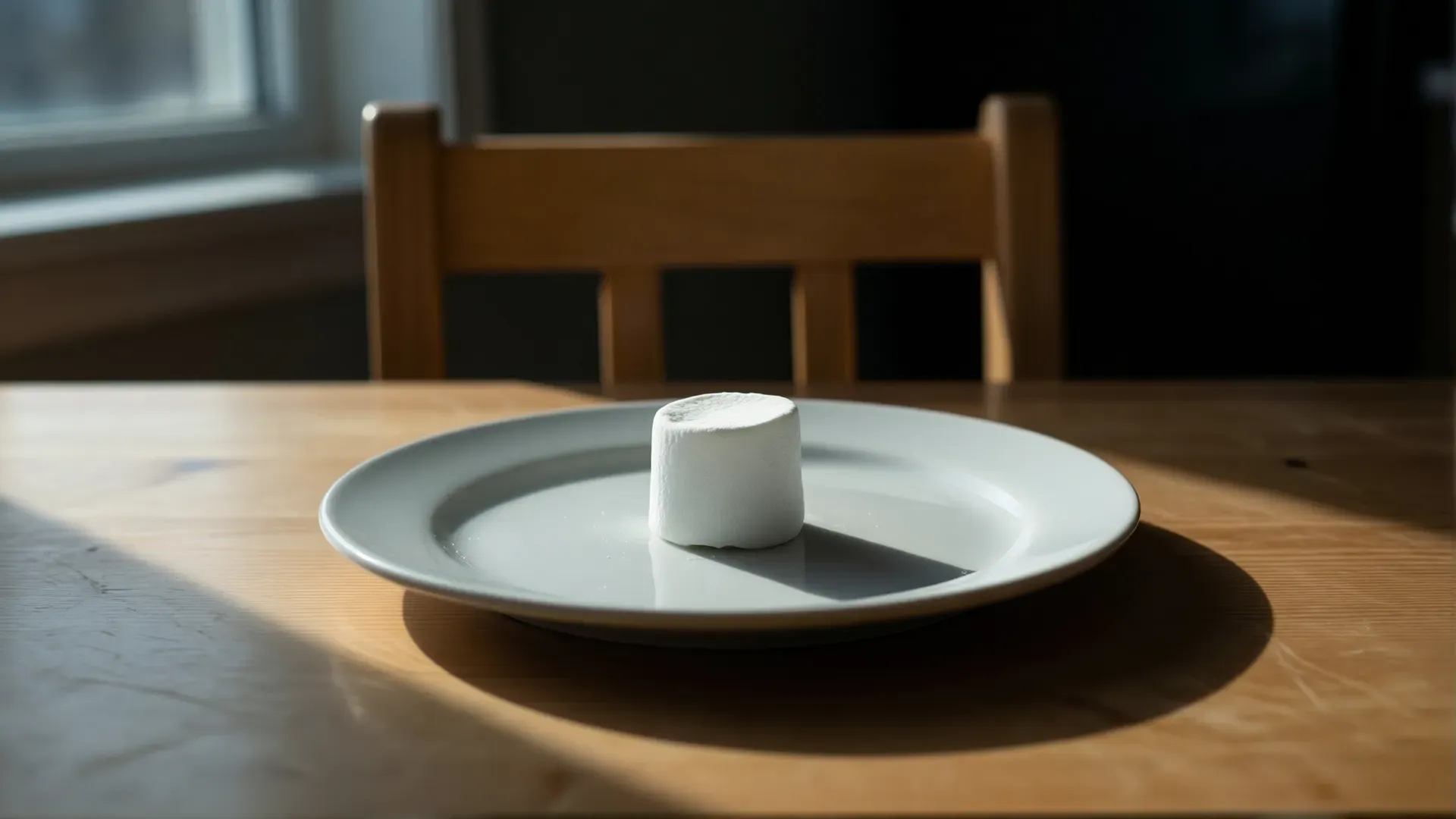
Any account of delayed gratification eventually arrives at a child and a marshmallow. In a series of experiments at Stanford beginning in the late 1960s, the psychologist Walter Mischel sat young children in front of a single marshmallow and offered them a deal: eat it now, or wait roughly fifteen minutes alone with it and get two. Some held out. Most didn’t. Years later, the children who had waited appeared to be doing better — higher test scores, better-rated by parents.
It became one of the most repeated stories in popular psychology: willpower at age four predicts success at forty. Tidy, flattering to the patient, and mostly wrong.
In 2018, a much larger replication by Tyler Watts, Greg Duncan and Haonan Quan revisited the test with a far bigger and more varied sample. The headline finding: once you account for a child’s family background — income, parental education, home environment — the predictive power of the marshmallow wait shrank dramatically. A child who waited wasn’t necessarily blessed with superior self-control. More often, they were a child who had grown up with enough stability to trust that the second marshmallow would actually arrive.
That correction matters for the rest of this. If much of delayed gratification is downstream of whether waiting feels safe, then the skill isn’t a fixed quantity you were born with or without. It’s a judgement you can get better at making — and, like most of what goes into living deliberately rather than by default, one that depends on whether the future reward is actually worth trusting.
Is delaying gratification always good? When waiting becomes self-denial
Here’s where we answer the objection we started with. Because the honest answer is no — delaying gratification is not always good, and the people quietly resisting the advice are onto something.
There’s a version of delayed gratification that has curdled into a habit of refusal. The person who can never justify the holiday, the nice meal, the unproductive afternoon — not because they’re saving toward something they’ve chosen, but because enjoyment itself has started to feel like a lapse. That isn’t discipline. It’s avoidance wearing discipline’s clothes. The reward keeps getting deferred to a “later” that never arrives, and a life organised entirely around the future quietly forgets to happen.
The distinction is the whole thing. Wise deferral is aimed at something you actually value more. You give up the smaller pleasure because you’ve judged the larger one worth it — and at some point you collect. Joyless self-denial has no such target. It defers for the sake of deferring, mistaking the withholding for the point.
Waiting for something you value is discipline. Waiting because enjoyment feels unsafe is just avoidance with better PR.
So the test isn’t “am I delaying gratification?” The test is: what am I delaying it for, and will I let myself arrive? If you can name the larger reward and you intend to actually take it, you’re exercising judgement. If the deferral is reflexive — if any pleasure triggers a vague sense that you ought to be doing something more useful — that isn’t self-mastery. It’s a different problem wearing the costume of one.
Why waiting is so hard
The difficulty isn’t a moral weakness, which is part of why scolding yourself about it doesn’t help. It’s structural. A reward available now is concrete; you can almost taste it. A reward available later is abstract, hypothetical, easy to discount. Your nervous system evolved in conditions where the later reward genuinely might not arrive, so weighting the sure thing in front of you was often the smart move. The bias toward now is not a flaw in the machine. It’s a feature that happens to misfire in a world of pensions and exam grades.
This is also why environment does so much of the work. If your experience has taught you that promised rewards tend to materialise, waiting is a reasonable bet and feels less like deprivation. If it’s taught you the opposite, grabbing the marshmallow is the rational choice, not the weak one. Understanding that takes some of the moralising out of it — and moralising was never going to be the thing that helped.
How to get better at it — without white-knuckling
If delayed gratification is judgement rather than willpower, then improving at it isn’t about building an iron grip. It’s about getting clearer on what you actually want, so the comparison in the moment becomes easier to make. And here the oldest answer turns out to be the best one.
Around 300 BC, Epicurus — a philosopher with an unfair reputation as a hedonist — did something more careful than anyone selling willpower has managed since. He sorted desires into three kinds: those that are natural and necessary, those that are natural but not necessary, and those that are neither, owing their existence, as he put it, to vain opinion. The first kind are easily met. The third kind are bottomless, and chasing them is where most unhappiness comes from. The skill of a good life, for Epicurus, was learning to tell them apart.
And — this is the part the marshmallow crowd never quotes — he was explicit that the point was not to refuse pleasure. As one ancient summary of his teaching put it, we do not choose every pleasure, but at times we pass over many pleasures when difficulty is likely to ensue from them; and we endure pain for a time when a greater pleasure will follow. That is delayed gratification, stated as a calculation, twenty-three centuries early — and notice it runs in both directions. You skip some pleasures because they cost too much later. You accept some discomfort because something better is coming. The aim was never abstinence. It was a clear-eyed accounting of which pleasures actually pay.
The Stoics, later, framed the same instinct as becoming master of your desires rather than slave to your impulses — useful as a reminder, though it’s Epicurus who supplies the actual method. Get specific about which of your wants are necessary, which are merely pleasant, and which are manufactured by comparison and habit. The desires worth deferring start to separate themselves from the ones worth dropping entirely. That clarity does more than any amount of gritted teeth — partly because it’s the same patient sorting of want from need that underlies most durable practical habits worth keeping.
None of which makes the waiting itself effortless. But it changes what you’re doing while you wait. You’re no longer suppressing a desire you still fully feel. You’ve decided, on reflection, that you’d rather have the other thing — and a desire you’ve genuinely set down is far quieter than one you’re holding back by force. That, and not willpower, is what the people who seem good at this have actually figured out.
It’s worth keeping one neighbouring trap in view. Delayed gratification answers whether to wait for a reward. It doesn’t protect you from the way satisfaction resets once the reward arrives — the thing you waited years for can feel ordinary within weeks. And it’s not the same problem as willpower running out under load, which is about depletion, not judgement. Three different mechanisms, often tangled together. Pulling them apart is most of the work of thinking clearly about any of them.
Frequently asked questions
- What is an example of delayed gratification?
- Skipping a night out to study for an exam that matters more to you than the evening does. The marker isn't the sacrifice — it's that you judged the later reward worth more than the immediate one, and acted on that judgement rather than the impulse in front of you.
- Is delayed gratification healthy?
- Usually, but not always. Deferring a reward toward something you genuinely value builds a life you've chosen. Deferring out of reflex — postponing every pleasure because enjoyment feels unsafe — is not discipline, it's avoidance. The health is in the judgement, not the waiting itself.
- What is delayed gratification in a relationship?
- Choosing the slower, harder thing because it serves the relationship more than the quick relief would — saying the difficult true thing instead of the easy reassuring one, or staying through a hard conversation instead of withdrawing. It's the same discernment applied to connection rather than money or work.
Free download
Stop staring at a blank journal. Start here.
The Three-Question Evening Review — five minutes, three questions, no blank page.