
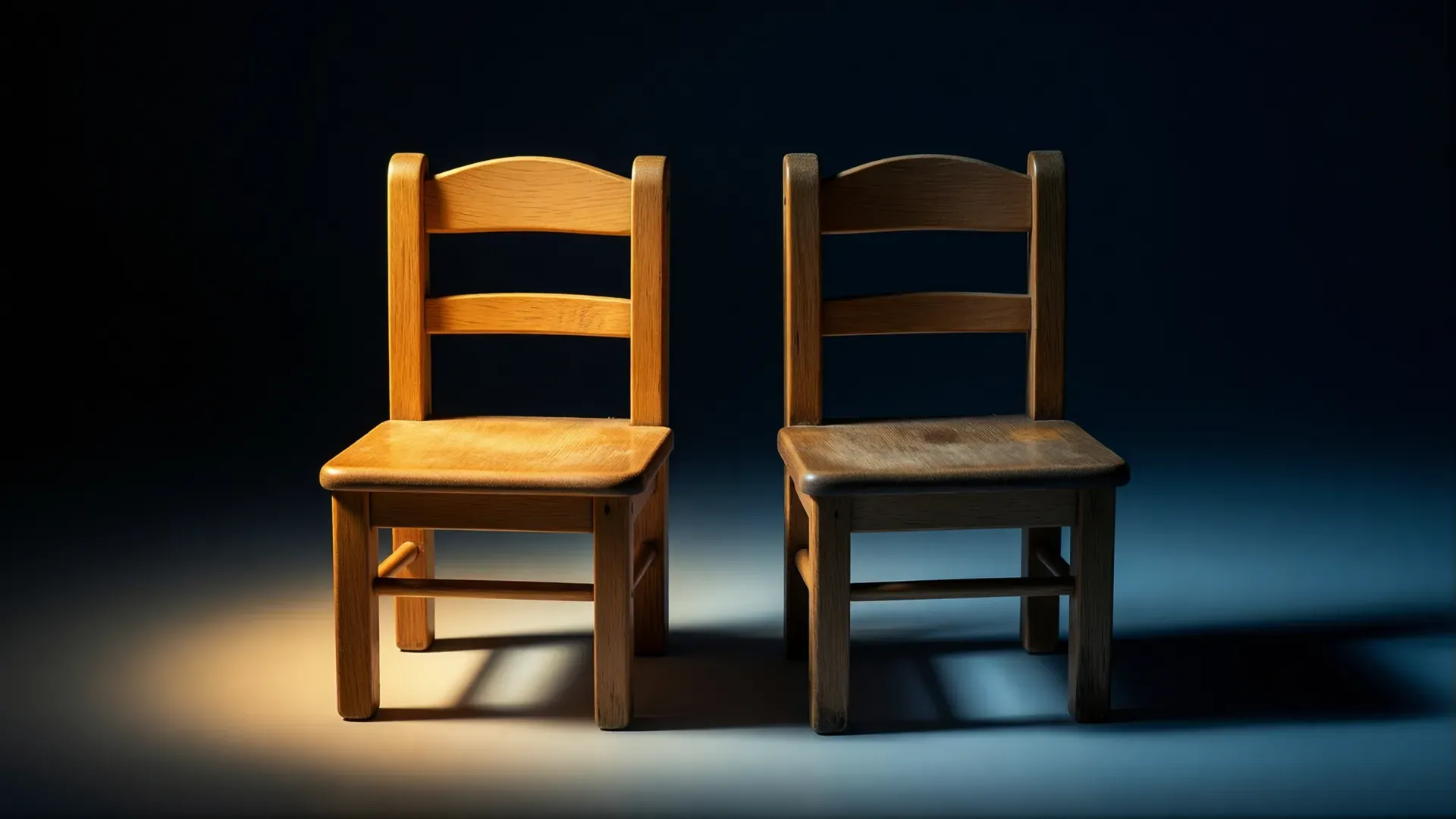
Daughters of Narcissistic Fathers: The Two Hidden Roles
The mirror and the scapegoat — why the same father produces two opposite daughters
Daughters of narcissistic fathers tend to carry a recognisable set of marks: a reflex to manage other people’s moods, a sense that love had to be earned by performance, difficulty trusting their own judgement, and a pull toward partners who feel familiar precisely because they are self-absorbed. But the symptom lists that fill the search results all miss the same thing — the mechanism underneath. A narcissistic father doesn’t shape every daughter the same way. He casts them into roles, and which role you were given explains almost everything the lists only describe.
There are broadly two. The psychology of narcissistic family systems calls them the golden child and the scapegoat — here, the mirror and the scapegoat. Knowing which one you were is more useful than any list of ten symptoms, because the symptoms are downstream of the casting.
What daughters of narcissistic fathers carry
The common thread is a self that was organised around someone else’s needs. A narcissistic father runs the family on his own emotional weather: approval and warmth arrive when you reflect well on him, and withdraw when you don’t. A child can’t reason with that, so she adapts — she becomes whatever keeps the weather mild. The adult results are the familiar ones: people-pleasing, a harsh inner critic, guilt that fires when she puts herself first, and relationships that recreate the original dynamic because the original dynamic is what “normal” was calibrated to — one of the clearest examples of how our earliest bonds quietly shape every later one.
That much the listicles get. What they don’t explain is why two daughters of the same father can turn out as near-opposites — one driven and entitled, the other apologetic and self-erasing. The answer is the role each was assigned.
Why it happens — the father as the family’s weather
A narcissist needs the people around him to serve his image. Children are useful for this in two opposite ways: one can be held up as proof of his greatness, and one can be made the receptacle for everything wrong in the family. The roles aren’t chosen on merit. They’re assigned by what the father needs, and they can be sticky for life.
The two daughters
The mirror — the golden child. She was the one who reflected well on him: gifted, praised, held up. The cost is hidden because it looks like favour. Her worth was always conditional on continuing to shine, so she becomes an achiever who cannot rest, who reads love as performance, and who may absorb some of the father’s own entitlement and contempt for “lesser” people — because that was the air she breathed and the role rewarded it. She is the daughter most likely to carry traits forward, not because narcissism is simply inherited, but because she was trained in it as a survival strategy that worked.
The scapegoat. She was the one who could never get it right — too sensitive, too difficult, the problem. Blamed for the family’s tensions, she learned that safety came from appeasing, shrinking, and reading danger early. She typically becomes the over-giver: the self-erasing one whose first instinct under any pressure is to manage the other person. That instinct has a name — the fawn response, the survival strategy of becoming useful and undemanding to defuse a threat. The scapegoat daughter is fawn made into a whole personality.
The symptoms are downstream of the casting. Name the role you were given, and the list stops being a list and becomes a shape.
Most daughters aren’t purely one or the other, and roles can shift — a golden child dethroned becomes a scapegoat overnight. But the frame holds: you were cast, and the casting, not some flaw in you, is where the pattern starts. This is the father-specific corner of the broader narcissistic-parent dynamic — the roles work the same with a narcissistic mother, but a father’s version often carries a particular charge around a daughter’s worth and how she expects to be treated by men.
Do narcissistic fathers raise narcissistic daughters?
This is the question under the fear, and it deserves an honest answer rather than a reassuring or a frightening one. Sometimes — most often through the mirror, the golden child who was rewarded for entitlement and never required to see other people as fully real. But far more often the daughter of a narcissistic father becomes the opposite: not too self-focused but not self-focused enough — anxiously attuned to everyone else, allergic to taking up space.
Narcissism isn’t simply handed down like eye colour. It’s part temperament and part what was modelled and rewarded — a disposition that some environments cultivate and others don’t. Which means the honest answer to “am I becoming him?” is usually no, and there’s a quieter piece of evidence in the question itself: the worry is the tell. A genuinely narcissistic person does not lie awake afraid they lack empathy. The fact that you are asking is the strongest sign you are not the thing you fear.
Why “go no contact” isn’t the whole answer
The internet’s standard prescription is to cut the father off. Sometimes that’s genuinely necessary, and no article should talk anyone out of protecting themselves. But no-contact addresses the source and leaves the installation untouched. The father can be a thousand miles away and the role still runs the show — you still manage moods that aren’t yours to manage, still earn love by performing, still pick partners who feel like home because home was him. Removing the man does not automatically remove the pattern he wrote into you.
What the oldest answer to “am I sentenced?” actually is
Here is where it would be easy to despair — to read all this as a verdict, to take “scapegoat daughter of a narcissist” as a fixed identity and a life sentence. It is the most dangerous misreading of the whole topic, and the answer to it is twenty-three centuries old.
Aristotle argued that character is not handed to us at birth and not unchangeable. We are, he wrote in the Nicomachean Ethics, “furnished by nature with a capacity” for virtue and “perfected” in it through habit — virtue comes “neither by nature nor in despite of nature.” And then the line that matters most for a daughter of a narcissistic father: whether we are accustomed this way or that straight from childhood makes — all the difference. He is saying exactly what the family-systems research says: you become what you are repeatedly trained to do, and childhood training runs deep.
But Aristotle’s point cuts the other way too, and that is the freeing half. If character is built by habit rather than fixed by birth, then it can be rebuilt by habit — slowly, deliberately, by acting differently than the role trained you to. You were shaped. You were not sentenced. The same mechanism that installed the pattern is the one you use to revise it: not insight alone, but repeated different action, until the new way becomes the one that runs without thinking.
If character is built by habit rather than fixed at birth, then it can be rebuilt by habit. You were shaped — not sentenced.
That is also why the role is not your fault and the revision is, in the most freeing sense, your responsibility. The casting was done to a child who had no say. What the adult does with it now is the one part that was never in your father’s hands — and never will be.
Free download
Stop staring at a blank journal. Start here.
The Three-Question Evening Review — five minutes, three questions, no blank page.
This article is reflection, not treatment. If anything here describes your life and it is hard to carry, free and confidential help is available from trained services — see this list of support resources.