
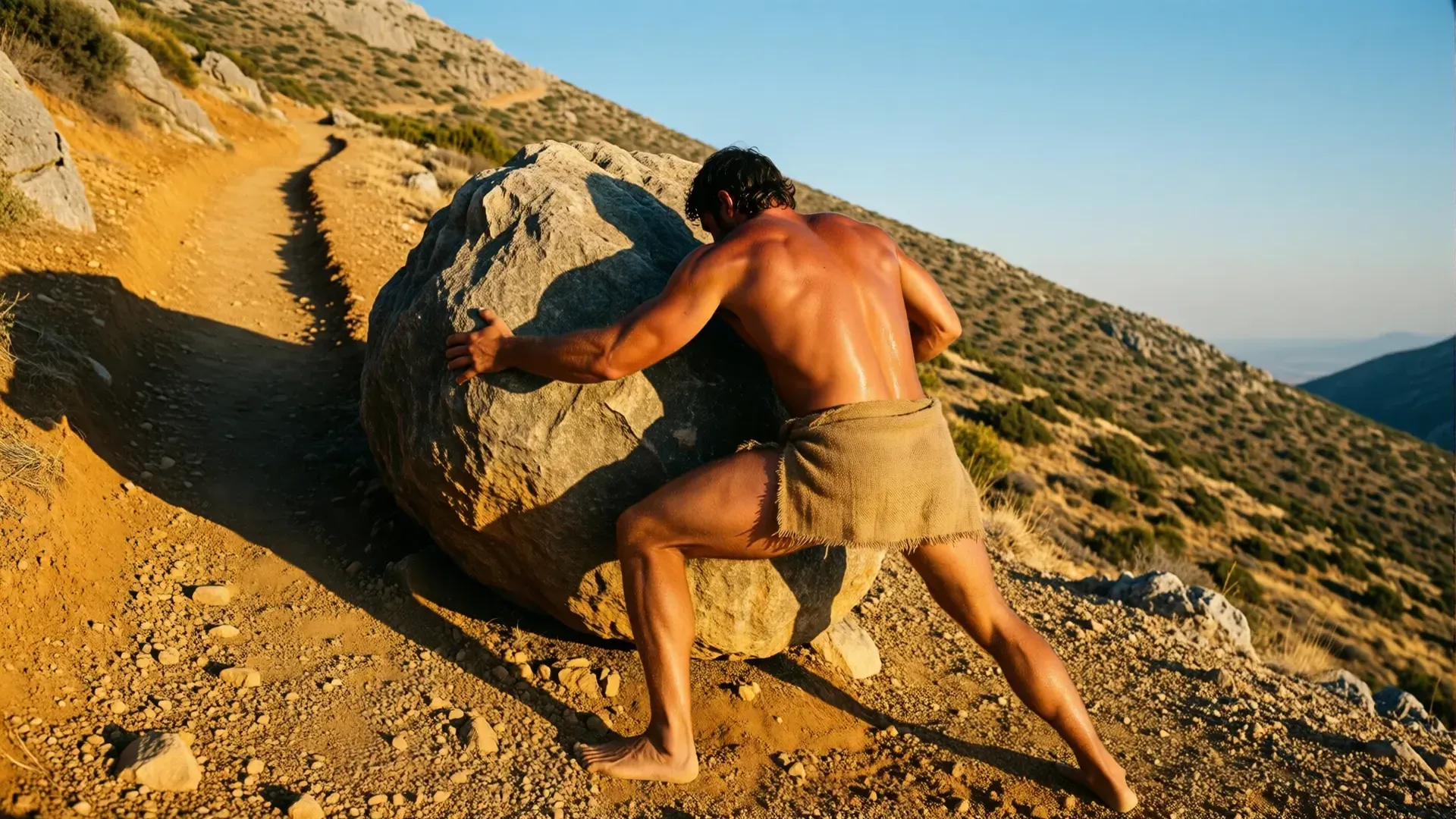
The Myth of Sisyphus: It's Not About Willpower, Says Camus
Camus's most quoted line is the one people most often get backwards.
You know the feeling before you can name it. You hit the deadline, close the project, clear the inbox — and the relief lasts about a morning before the next boulder appears at the bottom of the hill. The finish line was never a finish line. It was a turnstile. And somewhere in the back of your mind a tired voice asks what the point of all this pushing actually is.
That feeling has a name, and a 1942 essay built entirely around it. The myth of Sisyphus is Albert Camus’s image for exactly this: effort that never stays done, in a universe that hands out no final reward. But here is the part almost everyone gets wrong. Camus’s famous closing line — “one must imagine Sisyphus happy” — is not a command to push harder or grit your teeth. It is the opposite. The relief comes from lucid acceptance that the boulder will always roll back, which frees you from measuring your life by whether it stays up.
That single distinction — acceptance versus defiance — is the whole essay. Miss it, and Sisyphus becomes a motivational poster. Catch it, and he becomes something far more useful.
The myth of Sisyphus, in one minute
Sisyphus was a king in Greek mythology, famous for being too clever for his own good. He cheated death — twice, in some tellings, once by tricking the god of the underworld into chaining himself up. The gods were not amused. His punishment was precise and eternal: roll an enormous boulder to the top of a mountain, watch it roll back down, walk down after it, and begin again. Forever.
The genius of the punishment is that it is not painful. It is futile. Sisyphus is strong enough to do the work; what he can never do is finish it. The torment is the meaninglessness, not the effort.
Camus takes this ancient image and does something unexpected with it in his essay The Myth of Sisyphus. He does not read it as a tragedy. He reads it as a description of being alive — and then asks whether a person in that situation can be happy anyway.
What the myth of Sisyphus actually means
Most people assume the essay is about perseverance. It is not. It is about a problem Camus calls the absurd.
The absurd is not “life is hard” or “the world is cruel.” It is something more specific: the collision between our deep need for meaning and a universe that offers none back. We are built to ask why — why this happens, what it is all for, where it is going. The universe, in Camus’s reading, returns silence. The absurd is that gap. It is the sound of a question meeting no answer. (This is also the cleanest line between absurdism and existentialism: both start from that silence, but where the existentialist sets out to make their own meaning — the move Sartre grounded in existence precedes essence — Camus refuses to need one.)
This is why the essay’s actual first line catches people off guard. It is not about boulders at all. Camus opens: “There is but one truly serious philosophical problem, and that is suicide.” His real question is blunt — once you genuinely accept that life has no built-in meaning, is it still worth living? Everything else in the essay is an answer to that.
His answer is no to suicide, and also no to its quieter cousin: the leap into comforting belief, what he calls philosophical suicide — papering over the silence with a story that makes it bearable. Both are escapes. Camus wants a third option: stay in the gap, eyes open, and live there anyway.
Why Camus says “one must imagine Sisyphus happy”
Here is the move that makes the essay famous. Camus says to picture Sisyphus not at the top of the hill, but walking back down. That descent — the pause between efforts, when the work is undone and he knows it will be undone again — is the moment that matters. It is the hour of consciousness. He sees his fate completely, with no illusion that the boulder will one day stay put.
And Camus claims that in that clear-eyed moment, Sisyphus can be content.
Not because the work pays off. It never will. But because he has stopped needing it to. He has dropped the demand that his effort add up to something and found that the effort itself — the strain, the rock, the mountain, the sky — is enough to fill a life. “The struggle itself toward the heights is enough to fill a man’s heart,” Camus writes. The happiness is not a reward waiting at the summit. It is available in the climb, the instant you stop holding out for the summit.
The relief was never going to come from the boulder staying up. It comes from no longer needing it to.
That is a strange, almost vertiginous kind of contentment. And it is nothing like the version you have probably been sold.
It’s not about willpower — and that’s the part everyone gets wrong
Go looking for the meaning of Sisyphus online and you will mostly find resilience. Push through. Never give up. Prove the gods wrong by enjoying the grind. The boulder becomes your goals, and the lesson becomes: roll harder, with a smile.
This is the exact inversion of what Camus argued.
Defiant willpower still believes the boulder should stay up — it is just determined to win anyway. It is white-knuckle endurance powered by the hope that effort will eventually be vindicated. But that hope is the thing keeping you on the hill in the first place. As long as your contentment is hostage to the outcome, every roll-back is a small defeat, and you will spend your life bracing for the next one. The grit reading does not free Sisyphus. It traps him with a better attitude.
Camus’s acceptance does something different. It removes the demand for vindication entirely. The boulder will roll back; that is settled; there is nothing to prove. What is left, once the demand is gone, is the bare experience of the task — and that, surprisingly, turns out to be liveable. Even good.
How this differs from Stoic endurance
It is tempting to file this under Stoicism — accept what you cannot change, and so on. The resemblance is real but the foundation is opposite, and the difference is the whole point.
When Marcus Aurelius writes in his Meditations of the power a person has “to do nothing except what God will approve, and to accept all that God may give him,” his acceptance rests on trust: the universe is rational, ordered, governed by a logos that means your lot, however hard, has its place in a coherent whole. You accept because deep down it all makes sense.
Camus pulls that floor away. There is no logos, no plan, no hidden coherence — that is precisely what the absurd means. His acceptance is not “this is meant to be” but “this means nothing, and I will live it fully regardless.” Same posture, opposite ground. The Stoic accepts because the universe is trustworthy; Camus accepts despite the universe being silent. If you want the Stoic version of meaning-making, Citewise’s piece on where nihilism stops one step too early walks the ordered-cosmos route. The Sisyphus move is the one you make when that route is closed to you.
You are Sisyphus when the finish line keeps moving
Strip away the mythology and the philosophy and here is where it lands in an ordinary week.
The modern Sisyphus is anyone whose sense of being okay is permanently leased to the next outcome. The promotion that turns out to be a new set of expectations. The cleared to-do list that refills by lunchtime. The number — followers, revenue, weight, anything — that was supposed to be the point and instead became the new floor. You are not unhappy because you are failing. You are unhappy because succeeding does not stay won, and you keep waiting for a version of done that the world is structurally incapable of delivering.
The grit answer says: want it more, push harder, the boulder is character-building. And you already know how that ends, because you have tried it.
The Sisyphus answer is quieter and harder. Stop scoring the day by whether the boulder stayed up. The shift is from outcome-attachment — needing the result to justify the effort — to engagement with the task in front of you, which is the only part you actually inhabit. This is not a trick to make the boulder lighter or a five-step system for finishing the unfinishable. There is no technique here. It is a reframe, and the reframe is the whole of it: the meaning was never going to arrive at the top. It was always down here, in the doing, waiting for you to stop looking up.
That is also why this is not the same as giving up. Sisyphus still rolls the rock. Camus is not telling you to abandon the work — he is telling you to release the work from the impossible job of redeeming you. If the perpetual question underneath all this is why no achievement ever feels like enough, the longer answer to why you can’t find a purpose sits right next to this one; and if the feeling shows up as a low hum that you are squandering your life, that particular story is worth examining directly, because it is more often a story than a fact.
None of this requires you to be cheerful about the boulder. Lucid acceptance is not forced positivity. It is the plainer, sturdier thing underneath it — one of the more demanding answers in the long human argument about meaning and purpose: seeing your situation exactly as it is, and choosing to live it fully anyway. Camus thought that was the only honest happiness available to a person who has looked at the silence and refused to lie about it. He may have been right. Either way, it asks less of you than the grind does, and it gives back more.
Frequently asked questions
- What is the moral of The Myth of Sisyphus?
- Camus's essay resists a tidy moral, but its closest thing to one is this: a life can be worth living even if it has no built-in meaning, provided you face that fact clearly instead of escaping into false hope or despair. The point is lucidity, not perseverance.
- What is the metaphor of The Myth of Sisyphus?
- Sisyphus, condemned to roll a boulder uphill forever only to watch it roll back, is Camus's image of human life: effort that produces no permanent result, in a universe that offers no final reward. The metaphor is not about how hard the work is — it is about doing it without the consolation that it adds up to something.
- What is the first line of The Myth of Sisyphus?
- The essay opens: 'There is but one truly serious philosophical problem, and that is suicide.' Camus starts not with perseverance but with the question of whether life is worth living at all once you accept it has no inherent meaning — which is why reading the essay as a pep talk misses its actual subject.
Free download
Stop staring at a blank journal. Start here.
The Three-Question Evening Review — five minutes, three questions, no blank page.
This article is reflection, not treatment. If anything here describes your life and it is hard to carry, free and confidential help is available from trained services — see this list of support resources.