
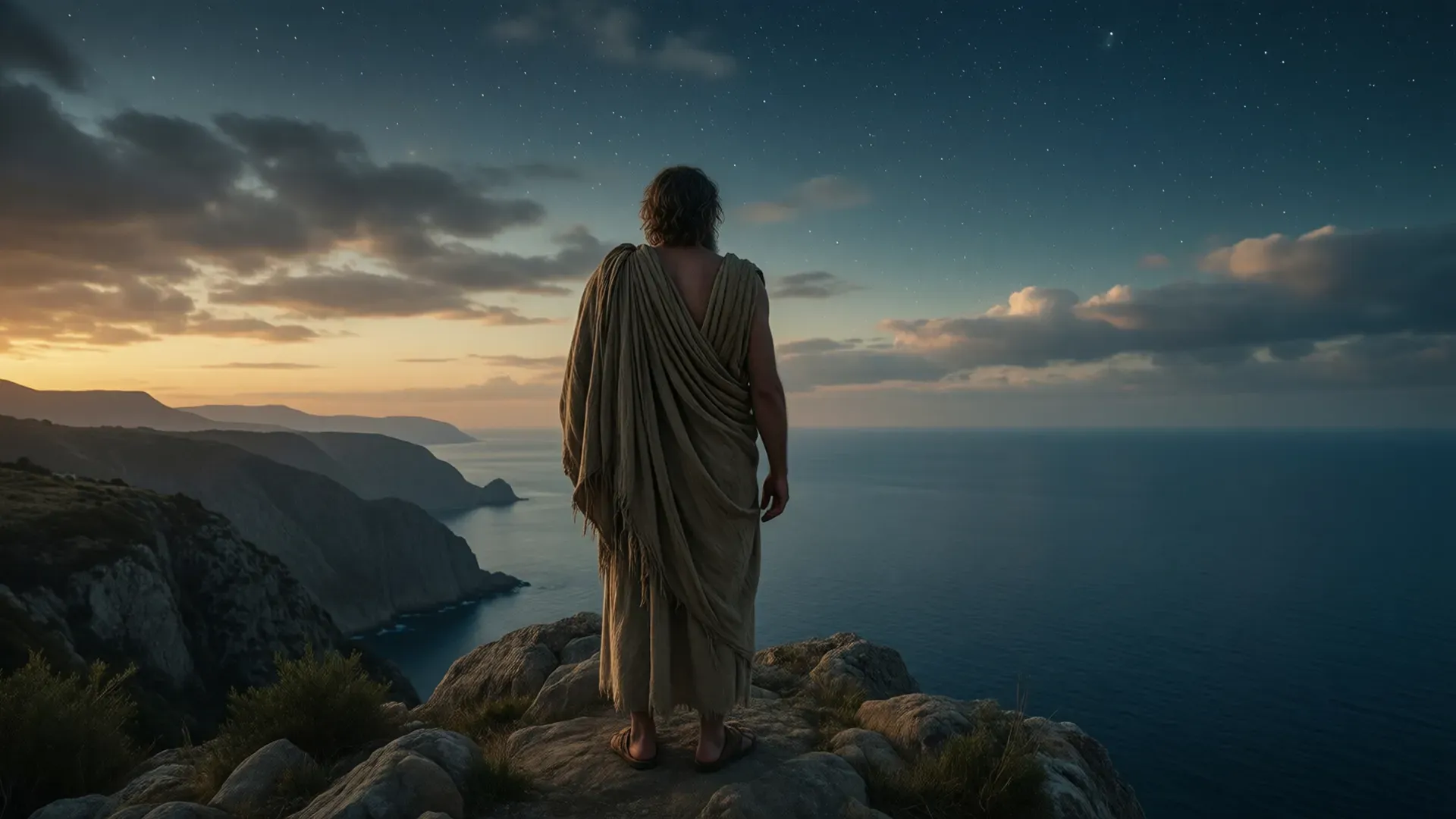
Nihilism Stops One Step Too Early — What the Stoics Did Instead
What the Stoic account of meaning actually says — and why it still works
There is a version of you that tried the obvious answers. Religion, maybe — and found you couldn’t make the commitment. Positive thinking — and noticed it didn’t survive contact with actual difficulty. The productivity system, the mindset coach, the therapeutic framework that worked for a while until it didn’t. At some point you landed somewhere colder: the universe doesn’t assign meaning to anything. Life isn’t pointed in any direction. Nothing, at the deepest level, matters.
That position feels like clarity. It has the texture of intellectual honesty — of having looked at things directly and refused to flinch. And it is, in a specific sense, correct.
The problem isn’t that nihilism is wrong. The problem is that it stops one step too early.
The Question You’re Actually Asking
When people ask whether life has meaning, they usually mean one of two different things.
The first is a metaphysical question: does the universe assign significance to human existence? Is there an objective fact about whether any of this matters?
The second is a practical question: what am I supposed to do?
These look like the same question. They are not. The metaphysical question may be unanswerable. The practical one has to be answered — you are answering it constantly, with every choice about where to direct your attention.
Nihilism addresses the first question. It answers it correctly, or at least defensibly: the universe appears to be indifferent to us. But it then treats the second question as settled by the first. If nothing matters cosmically, then nothing can be said about how to live. That inference is where the argument breaks.
The Stoics were asking the second question. That is what separates them.
What Nihilism Actually Says (and Why It Feels True)
Nihilism, in its serious form, is not a teenage posture. It is the conclusion that arrives after you notice the universe has no preference between your flourishing and your suffering. Stars explode. Civilisations end. The specific content of your life leaves no permanent mark on anything. Even the people who love you will die. Even the fact that they loved you will eventually be as if it never happened.
This is not comforting. It is also not false.
The Stoics were aware of it. Marcus Aurelius, in his private notebook, wrote: “Either this universe is a mere confused mass, and an intricate context of things, which shall in time be scattered and dispersed again: or it is an union consisting of order, and administered by Providence.”
He did not dismiss the first possibility. He sat with it — the universe as a random collision of matter, meaning nothing, going nowhere. He asked, honestly: if that is what this is, why should I continue?
That is not the question of a man who found the cosmic indifference easy to absorb. It is the question of someone who had genuinely considered it. What he arrived at was not a refutation of nihilism’s description of the universe. It was a different question about what follows from that description.
What the Stoics Answered Instead
The Stoic answer begins with a distinction so simple it almost seems too simple.
Some things are in your power. Some are not.
In the Enchiridion, Epictetus opens with it directly: “Of things some are in our power, and others are not. In our power are opinion, movement towards a thing, desire, aversion, and in a word, whatever are our acts. Not in our power are the body, property, reputation, offices, and in a word, whatever are not our own acts.”
Whether the universe has inherent meaning falls into the second category. It is not in your power. The question of cosmic significance — the one nihilism is answering — is, under Epictetus’s schema, nothing to you. Not because it isn’t interesting. Because your answer to it changes nothing about what you can actually do.
What is in your power: your opinions, your efforts, your choices, your character. These are yours completely — more completely than anything else you possess. Your reputation can be destroyed by someone else’s action. Your body can be taken from you. Your judgement, your values, the quality of your attention — these are the one domain where you are genuinely sovereign.
This is not optimism. It is not the claim that things will work out. It is the much harder claim that the only thing worth investing in is the one thing the universe cannot take from you.
Seneca makes this explicit in a letter to Lucilius: “The happy life depends upon this and this alone: our attainment of perfect reason… he keeps to the heights, leaning upon none but himself; for one who sustains himself by any prop may fall.”
The prop Seneca is warning against is not just wealth or status. It is any external condition — including the condition of the universe having a meaning that validates your existence. If the good life depends on the universe being ordered and purposeful, then you are leaning on a prop you do not control. If it depends only on the quality of your own reasoning and action, nothing can take it from you.
That is the Stoic counter-move. Not: the universe does have meaning. But: the question of whether it does is not the one your life depends on answering.
Why the Stoic Answer Isn’t Just Optimism
There is a version of this argument that is just rebranded positivity. “Don’t worry about what you can’t control” is the kind of thing printed on motivational calendars. That is not what this is.
The Stoic position is genuinely cold-eyed about the universe. Marcus entertained the possibility of a cosmos that is pure chaos — dispersing matter, no intelligence, no plan — and his answer was not “but it will be fine.” His answer was: even if that is true, the quality of my action today is still entirely mine. Dispersion will come regardless. The question is what I do before it arrives.
This matters because nihilism’s implicit argument is that cosmic indifference makes directed effort irrational. If nothing matters at the scale of the universe, why care at the scale of a human life? The Stoic answer is that this inference is a category error. The universe’s indifference to your suffering does not make your suffering less real. The universe’s indifference to your choices does not make your choices less yours.
The nihilist and the Stoic can agree on the description of the universe. They disagree about the implication.
Marcus again, from Meditations: “as for my mind, all things which are not within the verge of her own operation, are indifferent unto her.”
This cuts both ways. External facts about the universe — including whether it is ordered or chaotic, meaningful or empty — are outside the mind’s operation. What the mind does with what it has — that is never indifferent. That is the only game in play.
The nihilist and the Stoic can agree on the description of the universe. They disagree about the implication. For the Stoic, the fact that the universe assigns no meaning to your life is not a reason for paralysis. It is a clarifying fact. It removes a false dependency. It leaves you with what was always actually yours: the quality of your attention, your choices, your effort.
This is also what separates the Stoics from Aristotle, who argued that flourishing required external goods — health, friendship, material comfort — not just virtue. The Stoics rejected that directly: virtue is sufficient, not merely helpful. If you want to follow what philosophers have said about the meaning of life across the traditions — Aristotle, Epicurus, the existentialists — that piece maps the structural disagreement in full. This question sits at the centre of the meaning and purpose pillar: what grounds a life when external validation cannot.
That is not consoling. It is liberating in a way that is harder than consolation.
How the Stoic Account Works in Practice
None of this is a framework you adopt once and then possess. It is a practice — a repeated return to the same distinction.
The practical implication of the Stoic position is not a set of steps. It is a single question you can ask in any situation: is this in my power or not?
The metaphysical question about whether life has meaning is not in your power. What you do today — the quality of your attention, the character of your actions, the honesty of your self-examination — is entirely in your power.
This sits at the centre of the ancient philosophy tradition the Stoics inherited and sharpened: the good depends on nothing that is not yours. Everything else — what the universe is, whether it is ordered, whether your existence will be remembered — is a prop. Useful, perhaps, when present. Not load-bearing.
The Stoics practised this through a specific tool: the evening review. Each night, Seneca would audit his day’s judgements — not to punish himself, but to notice where he had treated something outside his control as though it mattered more than something inside it. What Plato’s allegory of the cave describes is the same underlying error: mistaking the shadow on the wall — external appearance, cosmic status, assigned meaning — for the thing that is actually real.
If this is a practice you want to try — five minutes, three questions, no blank page — the Three-Question Evening Review is the structure I use. It is not self-help. It is the same audit Seneca was doing, applied to a single day. The questions are designed to expose exactly the category error nihilism makes: treating external facts as the ones your life depends on.
The Stoics did not answer the question of whether life has meaning. They answered the question of what to do regardless.
That is the step nihilism missed.
Free download
Stop staring at a blank journal. Start here.
The Three-Question Evening Review — five minutes, three questions, no blank page.
This article is reflection, not treatment. If anything here describes your life and it is hard to carry, free and confidential help is available from trained services — see this list of support resources.