
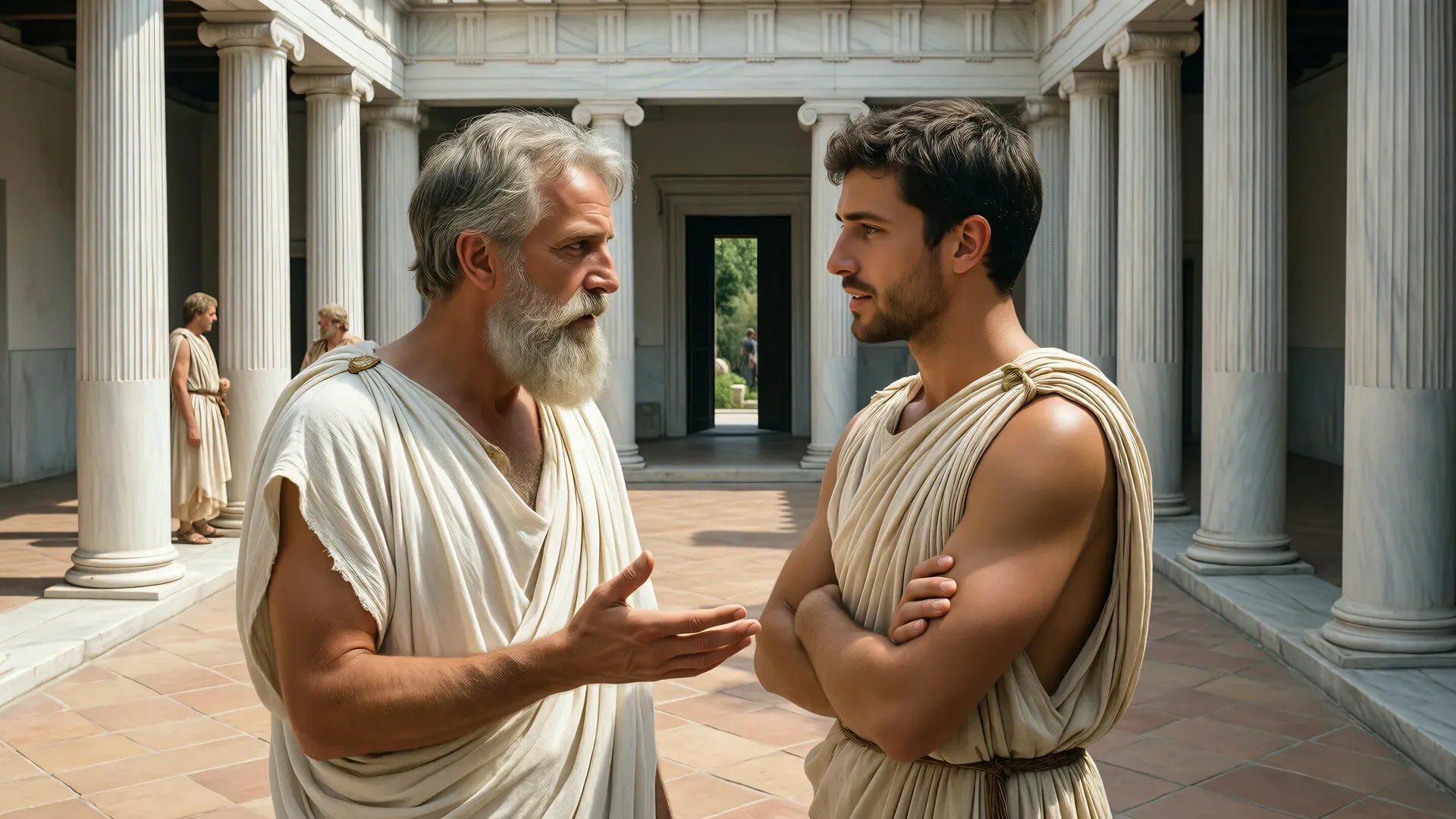
Nicomachean Ethics: What Aristotle Said About Living Well
The Nicomachean Ethics isn't a list of rules. It's a theory of how character forms — and why that matters more than what you do.
Most people trying to get better at something do the same thing. They change what they do. They add a habit, follow a system, build a routine. When it fails, they conclude the system was wrong and find a different one. Aristotle looked at this pattern and saw the mistake. The problem isn’t the action. It’s that the action is being treated as the goal.
The Nicomachean Ethics — Aristotle’s account of how to live well — is one of the most systematically misread texts in philosophy. It gets assigned as homework, summarised into lists of virtues, and mined for quotable maxims. But its central argument is not a list. It’s a theory of how a person becomes who they are. And it explains, more precisely than most modern psychology, why changing what you do is rarely enough.
The Question Nobody Thought to Ask Precisely
Most ancient philosophy asked what the good life is. Aristotle asked something different: how does a person actually build one?
His starting point is the observation that everything — a knife, a doctor, a human being — has a function. The question of whether something is good is inseparable from the question of whether it performs its function well. For a human, that function is not just staying alive or avoiding pain. It’s the activity of the soul in accordance with virtue. He called this eudaimonia — a word usually translated as happiness but closer to flourishing, to being fully alive in the way that suits your nature.
If eudaimonia is the goal, the next question becomes: what makes a person capable of it? This is where Aristotle’s answer gets interesting, and where most summaries stop too early.
The answer is not virtue in the abstract. It’s virtue as a disposition — a settled way of being that shows up reliably across situations, without deliberation, without performance, and crucially without effort. The person who is genuinely courageous doesn’t experience a battle between fear and bravery each time something frightening happens. They have become the kind of person for whom a certain response is natural. That’s the target. Not the decision. The disposition.
Why What You Do and Who You’re Becoming Are Not the Same Thing
The distinction sounds philosophical. It is also directly practical.
When you focus on behaviour — on the action — you are working on the surface. You might make the right choice in a given situation and still not be the person who makes it reliably. Aristotle was precise about this. A just act is not enough to make a person just. The act must proceed from a stable character. Someone who performs a just action accidentally, or under external pressure, or because it benefits them, has not moved closer to justice as a virtue. They have just done the right thing once.
This is what he meant by the distinction between acting virtuously and being virtuous. It’s a distinction most self-improvement frameworks quietly erase, because being virtuous is harder to measure, harder to sell, and takes much longer.
The mechanism Aristotle proposes is habituation. Character forms through repetition. You become courageous by doing courageous things — not because the act produces the disposition automatically, but because repeated action shapes the soul the way water shapes stone. Over time, the response becomes part of how you are, not just what you do.
Marcus Aurelius stated the same principle two centuries later in a different tradition — in Meditations, he wrote that the soul receives its character from what it rehearses, day after day, thought after thought. The Stoic version uses different vocabulary, but the underlying claim is identical. What you repeat, you become.
Such as thy thoughts and ordinary cogitations are, such will thy mind be in time. For the soul doth as it were receive its tincture from the fancies, and imaginations.
The implication for anyone trying to change: the question to ask is not “what do I need to do?” It is “what kind of person am I trying to become, and are my current actions actually building that person?”
The Pattern Behind Every Virtue Aristotle Named
Aristotle listed virtues — courage, temperance, generosity, justice, and several others — and this is where most summaries get distracted. The list looks like a catalogue, so commentators treat it as one — and modern psychology went further still, turning the virtues into a 24-item questionnaire. The deeper reason the list misleads — that virtue ethics asks who to become rather than what to do — is a framework worth understanding on its own terms. But the list is not the argument. It’s the evidence for a structural claim.
The claim is this: every virtue sits at a midpoint between two corresponding vices. Courage is the mean between cowardice and recklessness. Generosity sits between miserliness and extravagance. Temperance between self-denial and excess. What looks like a list of virtues is actually a demonstration of a single pattern — the doctrine of the mean — applied across the full range of human character.
This matters because it means Aristotle’s ethics are not a rule system. There is no universal specification for how courageous to be. The right action depends on the person, the circumstance, the stakes. What Aristotle is describing is a capacity for accurate judgement — the ability to perceive what a situation requires and respond accordingly. He called this phronesis: practical wisdom. It is the master virtue, the one that makes all the others functional.
This is why the virtue list misleads people who read it as a checklist. You cannot produce generosity by deciding to be generous in a given moment. You can produce a generous act. But generosity as a stable disposition — showing up reliably, with appropriate calibration, without resentment — only develops through practice over time, under the guidance of the kind of judgment phronesis makes possible.
If you are interested in how the philosophical tradition that produced this argument connects to questions of meaning and purpose, the full territory is worth exploring — this is one of its deepest seams.
The Part Aristotle Said That Self-Help Ignores
Here is where the Nicomachean Ethics parts company with most modern accounts of personal development, including Stoic-adjacent ones.
Aristotle was direct: virtue is necessary for eudaimonia, but it is not sufficient. External goods matter. Health matters. Friendship matters. Moderate prosperity matters. Not as luxuries, not as nice-to-haves, but as genuine components of a flourishing life that virtue alone cannot replace.
He was precise about the categories. As Diogenes Laërtius recorded, Aristotle divided goods into three kinds: goods of the soul (the virtues), goods of the body (health, strength), and external goods (friends, resources, circumstances). The soul goods are most important — he never walked that back. But the soul goods in isolation do not constitute the good life. They are necessary but insufficient. Aristotle was not consoling anyone about their circumstances. He was being accurate.
This is the point where Aristotle and the Stoics genuinely diverge. The Stoics argued that virtue is not just necessary but sufficient — that the truly virtuous person flourishes even in slavery, even in poverty, even in pain. It’s a more demanding claim, and a more bracing one. It is also, Aristotle might have said, not quite true to the facts of how human beings actually live.
Nihilism makes a related error from the opposite direction — denying that any of it matters, rather than overstating how much the internal can compensate for the external. Aristotle’s position is harder to inhabit because it admits both: character matters enormously, and circumstances matter too, and pretending otherwise is not wisdom.
The uncomfortable version of this argument is that some people trying to build a good life are working against genuine external obstacles, not just internal ones. Aristotle does not look past that. He names it.
What This Means in Practice
The Nicomachean Ethics is not a self-help book. Aristotle was not trying to sell you a system. But his argument does have practical implications, and they are more demanding than most of its modern inheritors suggest.
The first is a shift in orientation. If character is formed through repetition, then the relevant question about any repeated behaviour is not “does this produce the outcome I want?” but “what kind of person does this, practised consistently, produce?” These are not the same question. An action can produce a desired outcome while shaping a character you didn’t intend.
The second is the role of attention. Habituation is not automatic. The person who acts generously out of social pressure and the person who acts generously from genuine care are performing the same action but moving in different directions. What matters is what is happening underneath — and that requires the kind of honest self-examination that Aristotle associated with the practically wise person.
This is the same territory that Epictetus later mapped onto questions of psychology and self-knowledge — what you are when no one is watching, stripped of the roles you perform for others.
The third is accepting the limitation. You can build your character through careful, repeated, examined action over time. You cannot, through character alone, guarantee the external conditions that a fully flourishing life requires. Aristotle’s honesty here is not pessimism. It is accuracy. And accuracy is more useful than consolation.
The Method Aristotle Assumed You Were Already Using
Underlying all of this is an assumption Aristotle barely made explicit, because to his audience it was obvious: you can only shape your character through repeated action if you are paying attention to what you are doing.
The ancient practice of daily self-examination — reviewing what you did, how you responded, where the gap opened between who you intended to be and who you were — is what makes habituation conscious rather than accidental. Without examination, you repeat without learning. You accumulate habits rather than forming character.
Aristotle did not invent this practice. But the Nicomachean Ethics makes clear why it is not optional for anyone serious about the project. The virtues are not installed by reading about them. They are shaped by action, reviewed through reflection, and refined over time. The examination is the mechanism.
That’s not an ancient idea that has aged out. It’s a description of how character actually forms — which is why it still holds.