
What Nietzsche Meant by "God Is Dead" — It Was a Warning
Not an atheist's victory lap — a diagnosis of what's left when meaning loses its anchor
There is a particular kind of flatness that arrives without a name. The job you trained for still pays you, and you still show up, but the thing that made it matter has quietly gone out — and you can’t say when. The faith you were raised in still has its holidays and its phrases, and you still use them, but you notice you are going through the motions of a conviction you no longer hold. Nothing dramatic happened. A scaffold that used to hold your sense of what mattered just stopped bearing weight, and you kept walking on it anyway.
Nietzsche had a phrase for the largest version of that experience, and almost everyone gets it wrong. “God is dead” is a diagnosis, not a boast. He was not announcing that he had won an argument against religion. He was describing something that had already happened to an entire civilisation — the moral and meaning-giving framework that had organised European life for a thousand years had lost its hold, even among the people still attending church — and he was warning about what comes next. The phrase is usually quoted by people who think he was celebrating. He was grieving.
What Nietzsche actually meant by “God is dead”
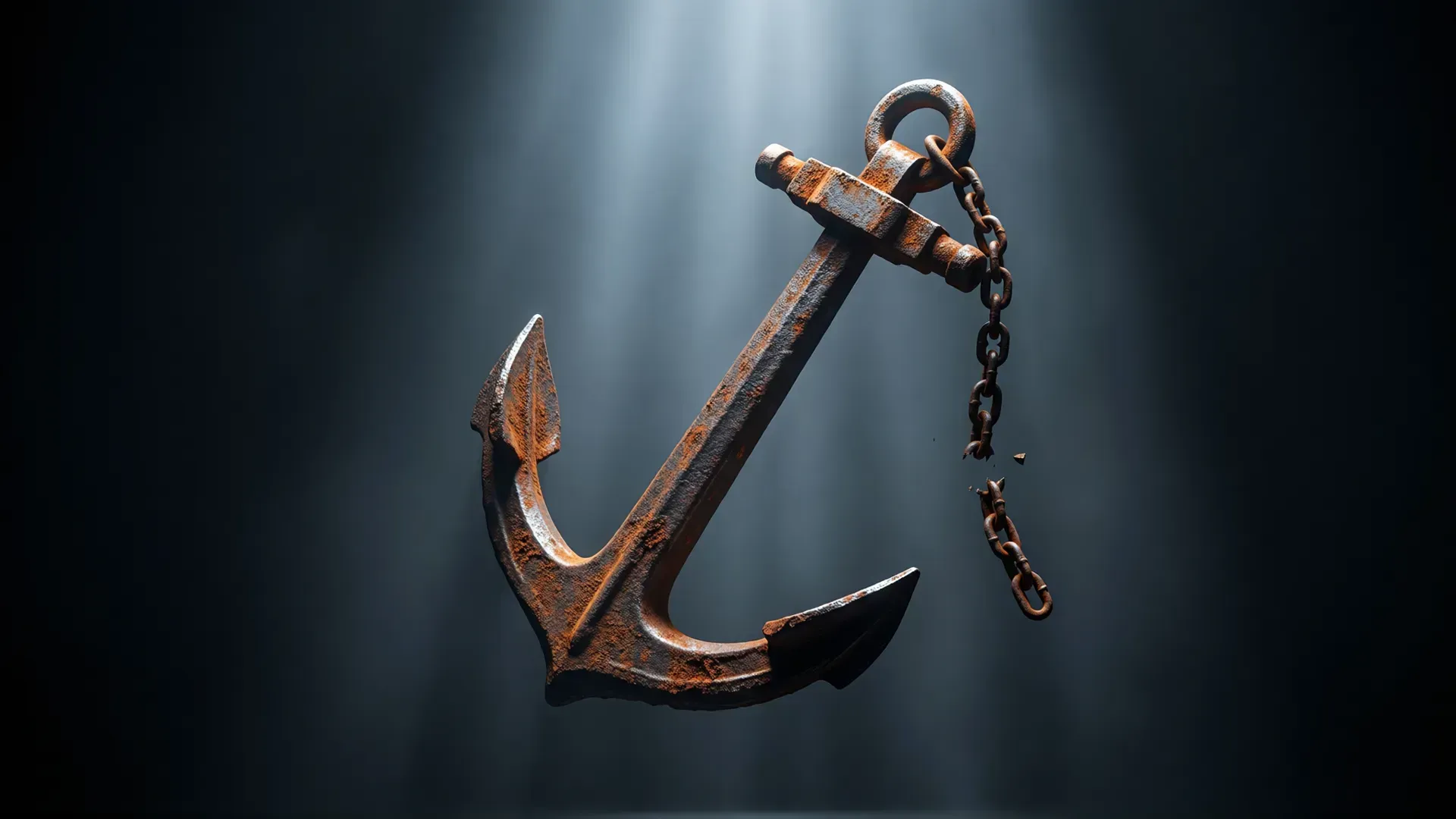
When Nietzsche wrote “God is dead,” he did not mean that a deity had literally existed and then stopped. He meant that belief in the Christian God — and the whole structure of values, meaning, and moral certainty that belief held up — was no longer credible enough to organise how people actually lived. “God” here is shorthand for the entire anchoring system: the thing that told you what was good, what your life was for, and why your suffering meant something. That anchor, Nietzsche argued, had come loose. The institutions remained; the conviction underneath them had drained away.
The line appears in The Gay Science, published in 1882, in a passage usually called “the madman.” A madman runs into a marketplace in the morning with a lit lantern, looking for God, and the people there — who no longer believe — laugh at him. Then he turns on them. “God is dead. God remains dead. And we have killed him.” The detail people skip is that he is shouting it at non-believers. His point is not that God never existed. It is that they have all, together, dismantled the thing they used to live by — and have not begun to grasp what they have done.
He wasn’t celebrating — it was a warning
Read the madman passage and the mood is unmistakable: it is closer to horror than triumph. “How shall we comfort ourselves, the murderers of all murderers?” he asks. “What was holiest and mightiest of all that the world has yet owned has bled to death under our knives.” This is not a man popping a cork. He is describing a wound.
The misreading — Nietzsche as the gleeful edgelord who killed God and high-fived about it — gets the single most important thing backwards. His worry was that people would lose the old source of meaning without noticing they needed a new one. They would keep the comfortable feeling of having values while quietly losing the foundation those values stood on, and then one day the foundation’s absence would make itself felt. The whole force of the phrase is in the dread, not the defiance. Strip out the warning and you have not simplified Nietzsche. You have inverted him.
Where he said it: the madman in the marketplace
It is worth being precise about the source, because the phrase gets attributed loosely. The famous formulation is in The Gay Science (1882), section 125 — the madman parable. Nietzsche returns to the idea the following year in Thus Spoke Zarathustra, where it becomes the backdrop for his attempt at an answer. He did not coin the bare sentiment from nothing; the sense that traditional religion was loosening was in the air across the nineteenth century. What was his was the framing: not “religion is false, good riddance,” but “the floor has gone, and most of you are still standing on the memory of it.”
That distinction is why the passage has outlived its century. A claim that God does not exist is an argument you can take or leave. A claim that a civilisation has knocked out its own foundation and not yet felt the drop is a description — and descriptions either fit your experience or they don’t.
The vacuum: why the death of God leaves nihilism behind
Here is the mechanism Nietzsche was pointing at. A value system holds a person up only while it is believed — not while it is argued for. You did not arrive at your deepest sense of what matters by weighing evidence; you absorbed it, lived inside it, felt it as simply the way things are. That is what gives such a framework its strength: it operates underneath the level of argument. But it is also what makes it fragile. Once the belief goes inert — once it becomes a thing you defend rather than a thing you inhabit — no amount of argument puts it back. You cannot reason your way into a conviction you have stopped feeling.
When the old framework loses its grip and nothing has replaced it, what is left is nihilism — the sense that nothing matters more than anything else, that all the old “shoulds” were arbitrary, that there is no longer any reason to prefer one way of living to another. Nietzsche did not recommend this. He named it as the danger — the thing that rushes into the empty space when meaning’s anchor is pulled and no new one is set. The death of God was not the destination. It was the edge of a drop he was trying to get people to see before they walked off it.
The death of God happens inside a person, too
You do not need to care about the history of European religion for any of this to describe you. The death of God is also something that happens on the scale of a single life.
A value system that organises your world can go inert exactly the way a civilisation’s can. The career you built your identity on stops meaning anything, though you keep performing it. The cause you gave your twenties to reveals itself as a thing you no longer believe, but you stay in the meetings. A relationship that told you who you were ends, and the version of you that it held up has nowhere to stand. In each case the structure was load-bearing — it quietly told you what mattered and why you got up — and when it failed, what arrived was not a clean grief you could name but that disorienting flatness, the private version of the madman’s marketplace.
The reason it is so hard to think your way out is the same mechanism. The value held you up because you believed it, not because you had arguments for it. So when belief drains away, arguments — “but I should still find this meaningful” — do nothing. You are standing in the gap between a meaning that has gone and one that has not yet been built. That vertigo has a name now: when the felt anchor of your values comes loose, the alarm that fires is what we usually call anxiety — not a flaw in you, but the nervous system registering that the ground it was relying on is no longer there.
If you recognise this, the first move is not to argue yourself back into the old conviction. It is to name what actually went: a specific value, in a specific part of your life, that stopped being something you believed and became something you were performing. Notice that what left was the conviction, not the logic. The logic was never what held you up.
What Nietzsche said we’d have to become to survive it
Nietzsche’s own answer was that the only way through the vacuum was to stop waiting for meaning to be handed down and to create values deliberately — to become the kind of person who authors their own sense of what matters rather than inheriting it. This is what the Übermensch points at, underneath the comic-book associations: not a superman, but a person who can stand in the absence of a given meaning and make one that holds. Sixty years on, Sartre pressed the same demand into three words — existence precedes essence: no given nature, no script, just the authoring.
It is worth being honest about how hard that is, because Nietzsche was. A value you author yourself is, at least at first, lonelier and weaker than one you inherited. The inherited kind came with a whole community believing it alongside you, a tradition behind it, the felt solidity of “this is just how things are.” The self-made kind has none of that scaffolding yet. Even the Stoics and Plato, who insisted the good life comes from within, granted that the opinion of the many has real force over a person — that inherited valuation, whatever its ultimate truth, genuinely moves us. That is precisely why Nietzsche treated the death of God as an emergency and not a liberation. Pulling the old anchor is easy. Setting a new one that actually holds your weight is the work of a life, and most of a life is spent in the gap.
Why “God is dead” still describes a modern condition
So the phrase endures not because most people are arguing about religion, but because almost everyone, at some point, lives through a smaller death of God — a framework that organised their world going quietly inert, and the flat, anchorless interval that follows before anything replaces it. Nietzsche’s contribution was to refuse the two easy responses: not the comfort of pretending the old meaning still holds, and not the bravado of pretending its loss costs nothing.
What he could not fully supply was the how — the practical method for rebuilding a structure of meaning once the given one has collapsed. That question is older than Nietzsche, and the people who worked on it most directly were the ones who argued that meaning was never safe to outsource in the first place. The Stoics held that if your sense of the good is built on anything external — a role, a belief handed to you, the approval of a crowd — it was always going to fail you eventually, because, as Seneca put it, “one who sustains himself by any prop may fall.” Their whole project was learning to set the anchor on the inside, where nothing outside you can pull it loose. That is the practical sequel to Nietzsche’s diagnosis — the Stoic answer to living without a given meaning, and where to go next once you have admitted the floor is gone.
Nietzsche’s gift was the diagnosis: he made the flatness legible, and named the danger in it before you walked off the edge. The framework this all belongs to — reading old philosophy as working psychology — treats a 140-year-old warning as something you can use, not just study. What you build in the space he cleared is the part he left to you. Which, in the end, was the whole point.
Frequently asked questions
- Did Nietzsche mean that God literally died, or that atheism is true?
- Neither. "God is dead" isn't a metaphysical claim that a deity existed and stopped, nor a simple declaration that atheism has won. Nietzsche meant that belief in the Christian God — and the whole structure of values and meaning it held up — had lost its grip on how people actually lived, even among those still attending church. He was describing a cultural event, not settling a debate about whether God exists.
- Where exactly did Nietzsche say "God is dead"?
- The famous formulation is in The Gay Science (1882), section 125 — the parable of the madman, who runs into a marketplace with a lit lantern looking for God and then tells the non-believers there that they have killed him. Nietzsche develops the idea further the next year in Thus Spoke Zarathustra. The line is often paraphrased loosely, but section 125 is the source.
- Why did Nietzsche himself stop believing in God?
- Nietzsche was raised in a devout Lutheran household — his father was a pastor — and lost his faith as a young man, partly through his study of philology and the historical origins of religious texts, partly through wider nineteenth-century currents of doubt. But the phrase "God is dead" isn't about his personal loss of faith; it's his diagnosis of what was happening to an entire culture, whether or not any individual still believed.
- Did Nietzsche think the death of God was a good thing?
- No — and this is the most common misreading. The madman who announces it is horrified, not triumphant: he calls those who killed God "the murderers of all murderers" and asks how they will comfort themselves. Nietzsche saw the death of God as a dangerous emergency that risked leaving nihilism behind. His hope was that people might eventually create new values to replace the old ones — but he treated the loss itself as a wound to survive, not a victory to celebrate.
Free download
Stop staring at a blank journal. Start here.
The Three-Question Evening Review — five minutes, three questions, no blank page.
This article is reflection, not treatment. If anything here describes your life and it is hard to carry, free and confidential help is available from trained services — see this list of support resources.