
12 Questions to Ask Yourself That Won't Turn Into Rumination
Twelve questions that create distance instead of a spiral — and the three a Stoic teacher answered in the dark
A question is worth asking yourself when it does one specific thing: turns a thought into an object you can examine, instead of a verdict you have to live inside. Psychologists call that move decentering, and it is the best-supported explanation we have for why naming a thought loosens its grip. It is also the property almost every list of questions to ask yourself ignores.
Under one of the most popular question lists on the internet — twenty-five of them, on a self-improvement forum — the top exchange is not about any question. It’s a reader admitting they saved the list, and another finishing the sentence: “and never returning.” Further down, someone asks what you’re supposed to do when you can’t answer half of them. Nobody replies with a method. That comment section says more about self-reflection than the list above it: the shortage was never questions. It’s that most questions aren’t built to be answered.
What makes a question worth asking yourself?
Three tests. It creates distance — you can look at the thought rather than from inside it. It points at something checkable — a behaviour, a fact, a moment, not your character. And it can be finished — a good question terminates in an answer or an action, not in more questioning. The twelve below pass all three. Most of the hundred-question lists fail at least two.
That’s the whole framework. What follows is why it works, the failure mode to avoid, and the questions themselves — grouped by the job each one does, because a question with no job is just a prompt for the mind to wander somewhere it’s already been.
Why the 100-question lists never work
Look at what actually ranks when you search for reflection questions: 154 questions, 100 questions, 51, 50, 25. The count is the tell. When every item mattered, nobody would need a hundred and fifty-four of them.
The people saving these lists already know this, which is why they behave the way that forum thread describes — save, feel briefly organised, never return. A list that long isn’t a practice; it’s a purchase. The saving is the ritual, and it costs nothing, which is exactly what it returns.
And the reader who asked what to do about the questions they couldn’t answer had found the deeper flaw: bulk lists assume your answers are lying around fully formed, waiting to be collected. For the questions that matter, they aren’t. An answer usually has to be built — out of observed facts, over days — and no list built for volume tells you that, because “here are 154 questions” and “you will need to gather evidence for weeks” make very different thumbnails.
What a good question does to a thought
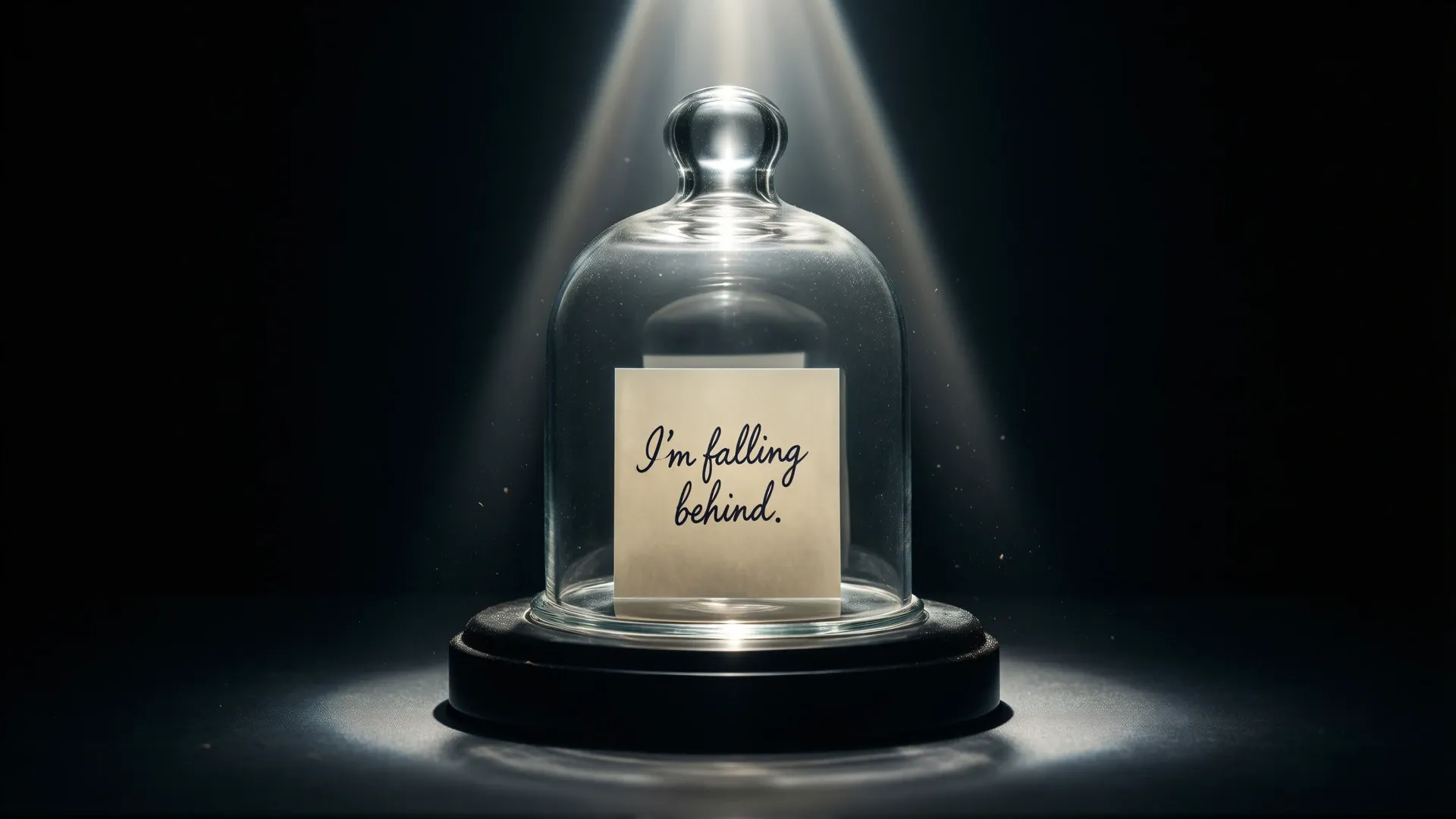
Most of the time you don’t have thoughts — you’re in them. “I’m falling behind” doesn’t feel like a sentence your mind produced; it feels like the weather. The thought functions as a lens you’re looking through, and a lens you’re looking through is invisible.
A well-built question forces a switch: the thought stops being the lens and becomes the exhibit. Ask “what is the exact sentence I keep thinking?” and you have to look at “I’m falling behind” — at which point it becomes noticeably shorter, flimsier, and more arguable than it felt from inside. Researchers who study this call it decentering, and it’s the strongest current explanation for why writing a worry down shrinks it, and why unhooking from a thought works in therapy rooms without anyone disputing whether the thought is true.
Two findings sharpen the craft. Self-distancing research by Ethan Kross and colleagues shows that people reason about their own problems markedly better when the framing pushes the problem away from the self — advising “a friend,” using their own name instead of “I,” imagining the view from five years out. And Tasha Eurich’s research on self-awareness — which suggests only around 10–15% of people who think they’re self-aware actually are — found that her most self-aware subjects had largely stopped asking why and started asking what. Why-questions invited stories. What-questions retrieved specifics.
Appearances, wait for me a little; let me see who you are, and what you are about; let me put you to the test.
Nineteen centuries before the terminology existed, a Stoic teacher was coaching the same move — talking to the thought, like something that had knocked on the door and could be made to wait on the step. That is decentering with a toga on. The tools have always been conversational. What changed is that we can now say roughly why they work.
The questions that cause rumination — and how to rewrite them
Some questions don’t create distance; they dig. You’ve met them: Why am I like this? Why does this always happen to me? Why can’t I just be normal?
Notice the shape. A why-question about yourself has no terminating condition — there is always another layer of story to generate, which is precisely what your mind will do at 2 a.m., fluently and forever. The question feels profound because it’s bottomless. Bottomless is the problem. The difference between reflecting and ruminating is its own subject, but at the level of question design the tripwire is simple: why-questions loop, what-questions move.
So rewrite them. Why am I like this? becomes what did I do this time, specifically — and what was different the time I didn’t? Why can’t I focus? becomes when did I last focus without trying, and what was true that day? The why version asks for a theory of you. The what version asks for a scene you can actually inspect.
Two mechanical guards finish the job. Time-box it: a question gets ten minutes and something to write on, not an open-ended night. Give it a stopping rule: a question has earned another visit only if the last visit produced a fact or an action. Two visits that produce neither — park the question. It isn’t ripe, and grinding on it is rumination wearing reflection’s clothes.
The 12 questions — and the job each one does
Numbered, so you can lift the set whole. Grouped by function, because the group tells you when to reach for it.
Questions that create distance
- What would I tell a friend who brought me this exact situation? You already own a wiser, calmer voice — you just reserve it for other people. Borrowing it back is the fastest distance available.
- What is the exact sentence I keep thinking — word for word? Write it down. In your head a thought is weather; on paper it’s an exhibit.
- How will this look in five years? Not to shrink it — to place it. Things that feel like verdicts are usually chapters, and you’ve closed chapters before.
Questions that surface evidence
- What actually happened — and what did I add? Split the event from the editorial. “She left early” is an event. “She’s losing interest” is authorship.
- If I could only use observable facts, how would I describe this? No adjectives about yourself, no mind-reading of anyone else. What survives that filter is smaller than the problem felt — and workable.
- When did this last go well — and what was different? Exceptions aren’t flukes. They’re instructions nobody transcribed.
Here’s the set working on a real shape of thought. The sentence in your head is “I’m failing at this job.” Question 4 splits it: what happened this week was two pieces of work delivered and one meeting fumbled — “failing” was added. Question 5 strips it further: the observable facts include a manager’s actual words, which were about the meeting, not about you. Question 6 finds the exception: the presentation that went fine last month, prepared the evening before instead of the morning of. Twenty written minutes, no ceiling-staring, and the verdict has become a scene with a lever in it: prepare the night before. That’s what evidence questions are for.
Questions that locate agency
- Which part of this is actually mine? Some of what you’re carrying belongs to other people’s choices, moods, and weather. Sorting your share from theirs returns the only part you can move.
- What did I do today that made this better or worse? Past tense. Behavioural. Answerable in one evening — a shape of question that turns out to be very old.
- What is the smallest thing I could do about this before tomorrow? If a question can’t end in an action yet, it goes back in the drawer until it can.
Questions that test direction
- What did I actually enjoy this week? Not what you were supposed to enjoy. Enjoyment is data about direction, and almost nobody collects it.
- If nothing about this changes in a year, am I fine with that? A yes is information. A no is a deadline.
- What am I pretending not to know? The unsparing one. Ask it last, answer it once, and don’t argue with the answer.
The three questions that survived 2,000 years
There’s a test for a question set nobody mentions in the listicles: does anyone still use it? Here is one with twenty centuries of field testing. Seneca, writing in On Anger, describes the nightly habit of the philosopher Sextius:
“What bad habit of yours have you cured to-day? what vice have you checked? in what respect are you better?”
Run those three against the framework and they score almost embarrassingly well. Every one points at behaviour, not essence — habits curbed, faults resisted, not am I a good person. Every one is past-tense and day-sized, so it can actually be answered before sleep: the time-box is built into the design. The third tracks trajectory rather than delivering a verdict. And there is not a single why among them. Sextius wasn’t asking for a theory of himself. He was taking evidence, locating agency, and checking direction — three of the four jobs above, nightly, in under five minutes.
Seneca, who adopted the practice, reports the result with the satisfaction of a man reviewing a completed day: “how sweet is the sleep which follows this self-examination.” Marcus Aurelius, a century later, kept his own versions in his notebook — “About what am I now employing my own soul?”, and the ruthless little audit “Is this one of the unnecessary things?” (Meditations). The full nightly practice — the trial framing, how the Stoics actually ran it — is already on this site in the Stoics put themselves on trial each evening. This piece’s point is narrower: one of the oldest question sets still in use passes a quality test written two thousand years after it, and that is unlikely to be a coincidence.
How often should you actually do this?
Less than you fear, more regularly than you’d guess. The best evidence points small and daily rather than deep and occasional. In one field experiment — call-centre trainees, in a working paper by Di Stefano, Gino, Pisano and Staats — people who spent fifteen minutes at day’s end writing reflections on what they’d learned scored about 23% better on their end-of-training assessment than those who just kept practising. One study, one context, trainees learning a job — it is not a law of productivity, whatever the internet has made of it. But its direction agrees with everything above: short, written, evidence-shaped reflection compounds; marathon self-audits mostly produce fatigue and a document you never reopen.
Written beats mental, most nights, because paper enforces the distance your head won’t — though journaling has its own failure modes when it slides from evidence into venting. And keep each session day-sized: interrogate the last twenty-four hours, not your entire character. Marcus again, on the temperament this produces: “He who follows reason in all things is both tranquil and active at the same time” (Meditations). Tranquil and active — reflection that ends in an action, not reflection as a hiding place from one. That’s the standard, and it’s a living well discipline more than an intellectual one.
A workable cadence, if you want one: Sextius’ three questions nightly, one direction question weekly, and the full twelve only when something is genuinely stuck. The nightly three take five minutes. You will skip nights. The practice survives skipped nights; it doesn’t survive becoming homework.
Seneca’s description of the setting has outlasted almost everything written about self-improvement since: the lamp carried out, the household gone quiet, the whole day summoned back and made to answer for itself. “I conceal nothing from myself, and omit nothing.” No saved list. No hundred questions. Three, asked in the dark by a man who intended to sleep well — and did.
Frequently asked questions
- What are 10 questions to ask yourself?
- Use the working set from this article and drop the two long-horizon ones. That leaves: what would I tell a friend with this problem; what's the exact sentence I keep thinking; what actually happened versus what I added; what would the observable facts say; when did this last go well; which part of this is mine; what did I do today that helped or hurt; what's the smallest action before tomorrow; what did I actually enjoy this week; what am I pretending not to know. Ten questions, each pointing at something checkable.
- What are 5 deep questions to ask yourself?
- Deep means distance, not drama. Five that go somewhere: what is the exact thought I keep having, word for word; what would I say to a friend who brought me this; when did this last go well and what was different; if nothing changes in a year, am I fine with that; what am I pretending not to know. Each one turns a feeling into something you can examine — which is what makes a question deep rather than just heavy.
- What are 7 questions you can use for self-reflection?
- Start with the three a Stoic teacher named Sextius answered nightly: what bad habit did I curb today, what fault did I resist, in what way am I better. Add four modern ones: what actually happened versus the story I added; which part of this is mine to carry; what's the smallest thing I can do before tomorrow; what did I actually enjoy this week. Three ancient, four modern — all seven end in a fact or an action.
- What if you can't answer the questions?
- Start with evidence questions, not identity questions. 'Who am I really?' has no data behind it yet; 'what actually happened today?' always does. Unanswerable usually means the question skipped the facts and went straight for a verdict. Collect a week of small, checkable answers first — what happened, what you did, what you enjoyed — and the bigger questions stop being blank. An answer you can't find in ten written minutes is a question to park, not force.
This article is reflection, not treatment. If anything here describes your life and it is hard to carry, free and confidential help is available from trained services — see this list of support resources.