
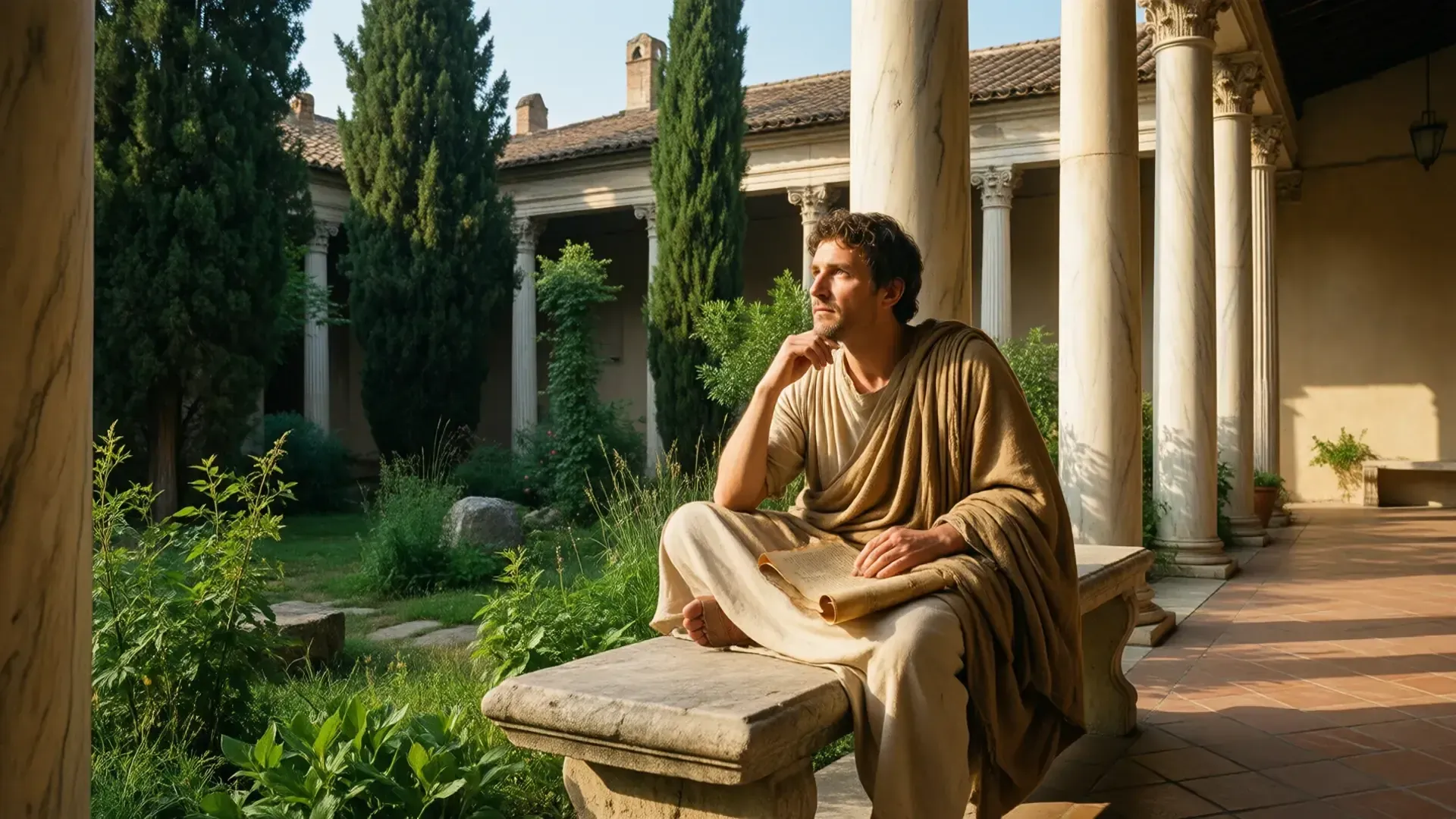
Self-Reflection Isn't a Feeling — It's a Practice with a Method
What self-reflection actually means, and the ancient practice that makes it work
Most people believe they are self-reflective. They think about their day. They notice when something bothers them. They occasionally wonder why they reacted the way they did. None of this is self-reflection — not in the sense that actually changes anything. It is rumination with better branding. And the reason most people never move beyond it is that nobody has told them what self-reflection actually requires.
It is not a feeling. It is not a mood. It is a practice — a specific act, performed deliberately, on a question you might otherwise avoid.
Reflection, Introspection, Rumination: The Words People Confuse
Part of the trouble is the vocabulary. Four words get used as if they meant the same thing, and the differences between them are exactly the differences that decide whether reflection works.
Start with the word itself. To reflect is to bend something back — light off a surface, a thought back onto the action that produced it. Self-reflection, in the plain sense, is turning that backward look on your own conduct: you take something you did and examine it to learn from it. The point is the action and what it reveals, not the mood it left behind.
Introspection is the near-synonym people reach for, and it is subtly different. Introspection is inspecting your inner states — what you are feeling, sensing, wanting — for their own sake. Early psychology tried to build a science on exactly this, training subjects to report their own mental contents, and the open-ended version of it ran aground: two carefully trained observers, given the same task, described their inner experience differently and there was no way to settle who was right. That is the warning. Looking inward at a feeling tells you what the feeling is. It does not tell you whether the feeling was right.
Rumination is the counterfeit — the one most people are actually doing when they believe they are reflecting. It replays rather than examines, and arrives nowhere. It is a measured construct with its own research literature and its own split between the half that harms and the half that helps: rumination vs reflection, and where the line actually falls.
And self-awareness is not a fourth activity at all — it is the result you are after. Awareness is noticing the pattern; reflection is the act that produces the noticing. You can be highly self-aware and never reflect, the way you can know a room is cold without ever asking why the window is open.
So the short answer to what self-reflection means: it is the deliberate examination of your own actions and the judgements behind them, in order to act differently next time. The definition is the easy part. The ancients worked out how to turn it into something you actually do — and that is where most modern advice quietly gives up.
Why Self-Reflection Fails Before It Starts
Type “self-reflection” into any search engine and what returns is a long list of wellness content: articles explaining that self-reflection is beneficial, studies confirming that introspection improves decision-making, listicles offering seven steps or five R’s or three daily prompts. None of it is wrong. Most of it is useless.
The problem is not that people lack information about self-reflection. It is that they have been given a category where they needed a method. Knowing that self-reflection matters produces the same result as self-awareness that never changes your behaviour — awareness without structure produces intention, and intention without a mechanism produces nothing.
The other failure mode is more insidious. When people do attempt self-reflection, they tend to rehearse the day’s events rather than examine them. They replay what happened. They feel things about it again. They might arrive at a verdict — that was bad, I should do better — without ever asking the question that produces actual insight: what did I believe that led me here? The shape of the question is most of the battle — there is a working set of questions to ask yourself, each built for a specific job.
Replaying is not examining. The Stoics understood the difference, and they built a tool specifically for crossing it.
Socrates did not ask “how do you feel about that?” He asked “what do you mean by that?” — and followed the answer until it either held or collapsed.
What Socrates Actually Meant by the Examined Life
The phrase most people know — “the unexamined life is not worth living” — is usually quoted as a call to be more thoughtful. It is actually a description of a specific activity.
Socratic examination, in practice, was not a solo activity. It was a dialogue — a process of questioning held beliefs until their contradictions became visible. Socrates examined beliefs, not feelings. He did not ask “how do you feel about that?” He asked “what do you mean by that?” and then followed the answer until it either held or collapsed. The discomfort was not incidental. It was the mechanism.
This matters for a reason the popular summaries miss. Socratic examination was not introspection in the modern therapeutic sense. It was interrogation — of the assumptions underneath your claims, the judgements underneath your reactions. The goal was not self-knowledge as a feeling of insight. It was the discovery of where your thinking was wrong.
Socratic examination was not introspection in the modern therapeutic sense. It was interrogation — of the assumptions underneath your claims.
The Stoics inherited this tradition and made one significant adaptation. They moved it from dialogue to solo practice, from public to private, from the agora to the end of each day. What had been a method for examining other people’s beliefs became a method for examining your own actions — specifically, the beliefs and judgements that had produced those actions.
These two practices are related but not identical. Socratic elenchus needed an interlocutor. The Stoic evening review needed only a lamp and honesty.
The Stoic Implementation: Seneca’s Evening Review
Seneca describes the practice in detail in his Minor Dialogues. He takes it from his teacher Sextius, who developed the habit of ending each day with a formal self-interrogation. Seneca adopted it, and the description he leaves is the most complete account of what the practice actually involved:
“I pass the whole day in review before myself, and repeat all that I have said and done: I conceal nothing from myself, and omit nothing: for why should I be afraid of any of my shortcomings, when it is in my power to say, ‘I pardon you this time: see that you never do that any more?’”
What Seneca describes is not journalling in the modern sense — writing about feelings, processing experiences, capturing memories. It is a formal audit. The whole day, in sequence. Nothing concealed. Nothing omitted. The explicit purpose: to locate where the judgements went wrong, name them, and correct them before sleep.
The self-examination is targeted. It does not ask “how did today go?” It asks: what did you say that you should not have said? What did you do that you should not have done? What did you judge to be important that was not? What assumption led you there?
Epictetus states the underlying principle in a single line: “Men are disturbed not by the things which happen, but by the opinions about the things.” The evening review is the practice of finding the opinions — the specific judgements — and examining them one by one.
This is the bridge the wellness content on self-reflection never crosses. It is not asking you to feel more deeply about your day. It is asking you to find where you were wrong, and be honest enough to say so before the day closes.
What This Looks Like Tonight
The practice Seneca describes takes five minutes. It does not require a journal, a prompt list, or a particular setting. It requires three questions, asked in sequence, without flinching.
What happened? Not an emotional summary — a factual account of the moments that mattered. The conversation you avoided. The reaction that surprised you. The decision you made on assumptions you did not examine.
What did you make it mean? This is the Socratic move. Not “how did you feel about it” — what did you judge it to be? What did you tell yourself it meant about the other person, the situation, yourself? This is where the opinion lives, and where the Stoic account locates the disturbance.
What would you examine more honestly? Not self-flagellation. Seneca is clear on this — he pardons himself, then asks for better. The question is: which of today’s judgements would not survive five minutes of scrutiny? Which assumption would you not want to defend aloud?
The examined life in the Stoic tradition is not a philosophical aspiration — it is this: the same three questions, practised every night, until examining becomes the reflex rather than the resolution.
The difference between people who change and people who intend to change is not insight. It is the practice that makes examination daily rather than occasional. Seneca did this by lamplight. Socrates did it in the agora, in public, at the cost of his life. The private version is considerably cheaper. For the distinction between reflection and awareness — which are related but not the same thing — self-awareness and reflection work differently, and failing to separate them is why one without the other tends to stall.
If you want a structured version to start tonight — three questions, one page, no blank page to stare at — the Evening Review is built on exactly this framework.
Frequently asked questions
- What is an example of self-reflection?
- A concrete example is the Stoic evening review: at the end of the day you run back over it and ask three things — what did I do badly, what did I do well, and what could I do differently tomorrow? Seneca described doing exactly this each night. The key is that it's specific and behavioural ('I snapped at a colleague because I was rushing') rather than a vague mood-check ('I felt off today'). That specificity is what separates reflection from rumination — one examines an action to learn from it, the other just replays a feeling.
- What is the meaning of self-reflection in simple words?
- Self-reflection means deliberately looking back at something you did and examining it — and the judgement behind it — so you can act differently next time. The word 'reflect' means to bend back, and that's the literal action: you turn your attention back onto your own conduct. It is not the same as feeling something about your day; it's examining the day to learn from it.
- What is another word for self-reflection?
- The closest single word is introspection, though it isn't an exact match — introspection means inspecting your inner states (feelings, sensations) for their own sake, while self-reflection examines your actions and judgements in order to change them. Related terms include self-examination, self-assessment, and contemplation. Rumination is sometimes used as a synonym, but it's actually the opposite: rumination replays an experience without examining it.
- What is the difference between self-reflection and introspection?
- Introspection inspects what's happening inside you — what you feel, sense, or want. Self-reflection examines what you did and the judgement that produced it, with the aim of acting differently. Introspection tells you what a feeling is; reflection asks whether the judgement behind it was sound. Early experimental psychology tried to make introspection a rigorous method and found that open-ended inner reports couldn't be verified — trained observers disagreed about the same experience — which is exactly why reflection works better when it targets actions, not moods.
Free download
Stop staring at a blank journal. Start here.
The Three-Question Evening Review — five minutes, three questions, no blank page.