
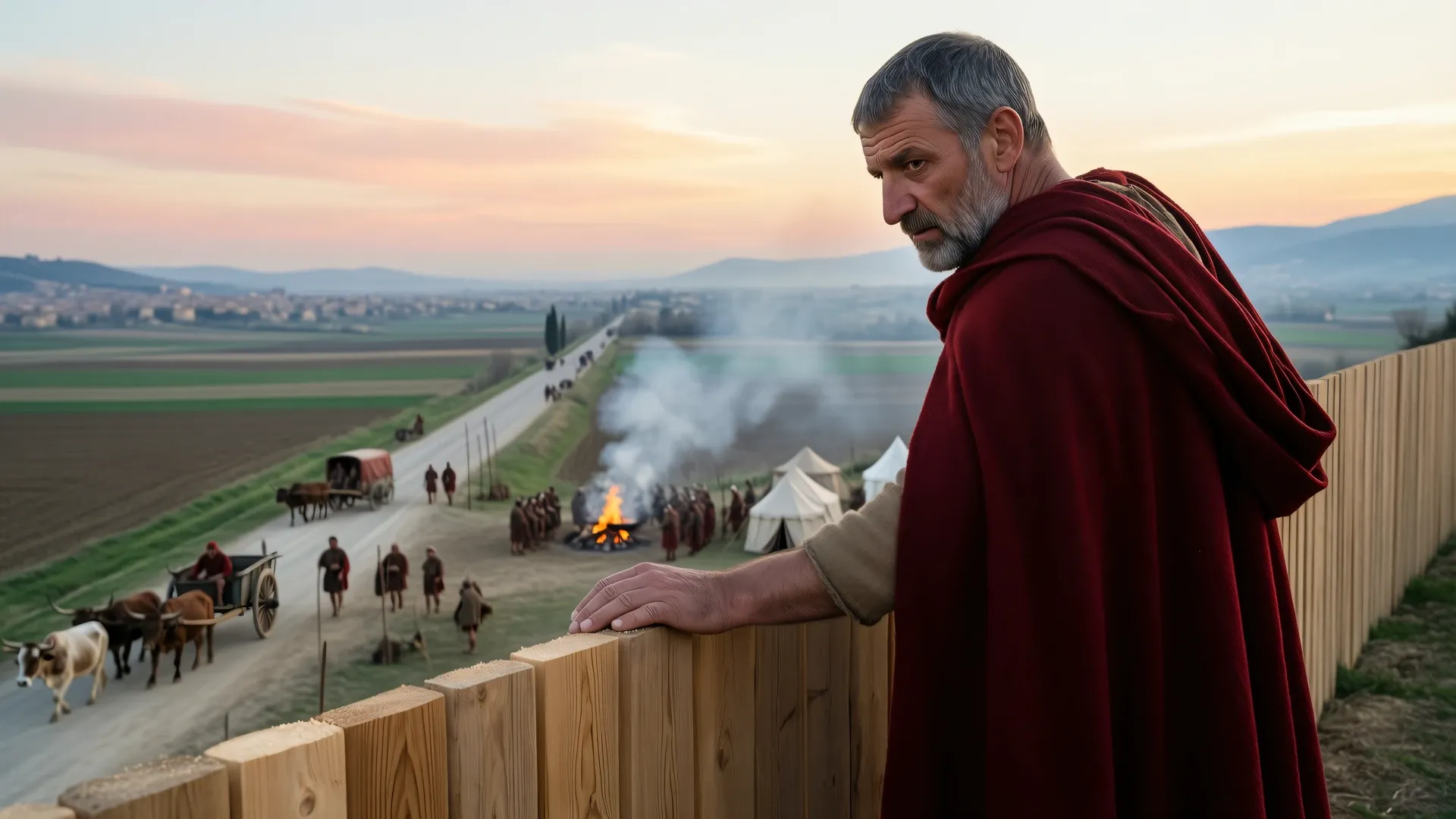
The View From Above: The Stoic Drill That Shrinks the Day
Everyone teaches the zoom out. Almost nobody teaches the way back.
Somewhere in the run of a bad afternoon, you have probably already done a version of this. You opened a map and zoomed out — past the street, past the city, until the whole country sat under your thumb and the meeting you are dreading was somewhere in there, invisible. Or you were on a plane, and the houses turned into a circuit board, and it occurred to you with unusual force that every single one of those roofs had someone under it having a day as detailed and urgent as yours.
For a moment the thing that had been filling your head went quiet. Not solved. Just resized.
That move has a name, and it is nearly two thousand years old. The Stoics ran it deliberately, as a drill, and Marcus Aurelius left it written down in the Meditations in the form of a note to himself. The modern label — the view from above — comes from the French philosopher Pierre Hadot, who spent a career arguing that ancient philosophy was less a set of doctrines than a set of exercises like this one, things you actually did to your own mind.
Almost every version you will encounter teaches you to go up. Very few teach you to come back. That omission is not a small one, and it is the reason a practice built to steady people reliably leaves some of them feeling considerably worse.
What the drill actually is
Marcus is unusually concrete about it, and he does not claim it as his own. He credits Plato:
This is a fine saying of Plato: That he who is discoursing about men should look also at earthly things as if he viewed them from some higher place; should look at them in their assemblies, armies, agricultural labors, marriages, treaties, births, deaths, noise of the courts of justice, desert places, various nations of barbarians, feasts, lamentations, markets, a mixture of all things and an orderly combination of contraries.
Read that list slowly, because the detail is the point. He is not picturing a serene blue marble. He is picturing everything at once — the weddings and the funerals, the courts and the markets, the armies and the farms, all running simultaneously, all equally urgent to the people inside them. It is a deliberately crowded image. Peace is not quite the word for what it produces. Proportion is closer: your own noise takes its place inside an enormous amount of other noise.
Elsewhere he does the same thing from higher up, and the tone hardens:
Look down from above on the countless herds of men and their countless solemnities, and the infinitely varied voyagings in storms and calms, and the differences among those who are born, who live together, and die.
He then adds the line that does the real work — that many people alive right now do not know your name, that many who do will soon forget it, and that “they who perhaps now are praising thee will very soon blame thee.” He is not consoling himself. He is talking himself out of caring about his reputation, which for a Roman emperor was the load-bearing wall of the entire self.
The Romans inherited this. A century and a half before Marcus, Cicero wrote the Dream of Scipio, in which a general is carried up among the stars, looks back, and finds his empire has shrunk to a point. The elder Africanus, standing beside him, is merciless about what follows:
I perceive that you are still employed in contemplating the seat and residence of mankind. But if it appears to you so small, as in fact it really is, despise its vanities… Is it possible that you should attain any human applause or glory that is worth the contending for?
Africanus’s argument is almost funny in its bluntness: the earth is barely populated, the populated bits are cut off from each other, and half of them are on the opposite side of the globe and will never hear of you no matter what you do. Fame is not merely fleeting. It is geographically impossible.
And Marcus ran the same exercise along a second axis — not space but time. “Constantly contemplate the whole of time and the whole of substance,” he writes, “and consider that all individual things as to substance are a grain of a fig, and as to time the turning of a gimlet.” A gimlet is a hand drill. One turn. That is your life, against the whole of time.
So: two axes, one instrument. Zoom out in space until your trouble is a dot among other dots. Zoom out in time until it is one turn of a drill. The Stoics used both, often in the same sitting.
The mechanism: it buys you space
If you ask what the zoom is for, the usual answer is humility — a useful reminder that you are not the centre of things. That answer is not wrong, but it is not what Marcus says. He gives the mechanism explicitly, and it is far more practical than humility:
Thou canst remove out of the way many useless things among those which disturb thee, for they lie entirely in thy opinion; and thou wilt then gain for thyself ample space by comprehending the whole universe in thy mind.
Gain for thyself ample space. The view from above is not a humbling exercise. It is a clearing exercise. It is a way of getting the junk off the desk.
Notice the clause in the middle, because it carries the whole Stoic system: the disturbing things “lie entirely in thy opinion.” They are not out there in the world with fixed dimensions; they have the size your judgement gives them. Your mind, left alone, will let today’s slight expand until it fills the entire visible frame — which is exactly what makes it feel like the world rather than a thing in the world. This is the same claim that sits underneath everything else on this site: your distress follows your judgements about events, not the events, which is the argument worked out in full in what Stoicism actually means, and turned into a practical sorting rule in the dichotomy of control.
The zoom is what gets you far enough away to see the actual dimensions. From the ground, the email fills the sky. From high enough, it is an email.
That is a mechanical claim, not a mystical one, and it explains why the drill reliably works on some things and does nothing at all for others. It resizes anything whose size came from your attention: status injuries, reputational panic, the sting of being slighted, the urgency of the inbox, the fear of what a group of people you will never meet again might think of you. It does nothing whatsoever for a sick child. That is not a defect of the exercise. It is a filter, and a genuinely useful one — the things that survive the zoom are the things that were always real.
How to run it
The whole point of a drill is that you can do it badly and still benefit, so do not aim for a mystical experience. Two minutes, eyes open or closed, no equipment.
- Name the thing that is filling the frame. One sentence. “I am dreading this conversation.” Be specific; the exercise needs a target.
- Go up in steps, not in one jump. The room. The building. The street with its several dozen simultaneous private crises. The city — everyone in it eating, arguing, being born, dying, none of them thinking about your conversation. The country. The curve of the earth, half of it in darkness.
- Look for Marcus’s crowded image, not a postcard. Do not float in serene emptiness. Populate it — the assemblies, the markets, the feasts and the lamentations, all at once. The relief comes from company, from the sheer volume of other lives running in parallel, not from emptiness.
- Now do the same thing in time. Everyone alive down there will be gone in a century. This day is one turn of the drill. The people whose opinion you are braced against will not remember this, and neither, in ten years, will you.
- Come back down. This step is not optional, and it is the one nobody teaches.
Some people need a physical crutch to get up there, and there is no shame in it. Open a map and zoom out until your shoulders drop; the mechanism doesn’t care whether the altitude is imagined or rendered by a satellite.
The trapdoor nobody warns you about
Go looking for the view from above and you will find it sold as guaranteed relief — a calm voice, a cosmic zoom, a promise that your problems will shrink. Read what people say underneath, and a different picture emerges. “Probably not a good idea to do this while depressed. Just made me feel worse.” “From the perspective of total existence, we do not exist.” “The thought of our lonely existence among the stars used to trouble me.”
These are not people who failed at the exercise. They are people who did exactly what they were told and arrived somewhere bleak.
The Stoics knew. Seneca went up to the same height and came back not with serenity but with the seven wonders of the world levelled with the ground and nothing lasting forever. The height does not guarantee what you find there. Zoom out far enough and the very same view that dissolves your petty status anxiety will also dissolve your reasons for getting up, because at sufficient distance nothing is large — not the slight, and not the work you care about either. The zoom is indiscriminate. It shrinks whatever you point it at.
A view from above you do not come back from is not Stoicism. It is dissociation with a classical reference.
This is why the exercise is a genuinely poor fit for some people at some times, and it is worth being plain about it rather than encouraging. If you are in a depressive episode, the conclusion the drill is designed to be a temporary corrective to — none of this matters, I don’t matter — is a conclusion you may already be holding with total conviction. An exercise whose method is loosening your grip on your own significance is relief if you are gripping too hard. It is confirmation if you have already let go. The same is true if you are prone to derealisation, where “the world seems unreal and far away” is the symptom, not the therapy.
The honest test is simple: if a perspective exercise reliably leaves you flatter than it found you, that is information, and the correct response is to stop — not to conclude you are doing it wrong and try harder. Feeling small is not the goal. It was never the goal. It is a side effect of the route, and if the side effect is where you get stuck, this is the wrong route for you at the moment, and a present-focused practice like the one described in living in the present is the safer place to be. This is also the kind of thing to raise with a professional rather than with a Roman emperor.
The return trip
So what did Marcus do at the top? He came down. Immediately, and on purpose, and this is the half of the exercise that has quietly gone missing.
Look at what he writes after the most vertiginous passage in the whole book — after “how small a part of the boundless and unfathomable time is assigned to every man,” after “on what a small clod of the whole earth thou creepest.” Having established that you are a speck on a clod, he does not stop there and stare into it. He turns on a sixpence:
Reflecting on all this, consider nothing to be great, except to act as thy nature leads thee, and to endure that which the common nature brings.
That sentence is the entire drill. The smallness is not the conclusion — it is the clearing. Everything gets levelled: your reputation, the slight, the imagined verdict of people you will never meet, the whole apparatus of caring what strangers think. And then, in the space that levelling opens, exactly one thing is permitted to stand back up: act as thy nature leads thee. Do your work. Do the next right thing in front of you.
Which is why it is a mistake to file the view from above as a resignation exercise. It is a prioritisation exercise. You go up to find out what is actually large. You come back down to find that almost nothing is — except the thing you were avoiding while you were busy being upset, which is still there, patiently, waiting to be done.
Marcus was not a monk contemplating the void. He wrote these notes in a military camp, at war, running an empire, and he wrote them so that he could go back to work with a clear head the next morning. The zoom out was in service of the zoom back in.
This is what separates the Stoic version from its modern cousin, the awe of a night sky, which quiets the self by scale alone and asks nothing of you afterwards. If you want that emotion on its own terms — the small self, the mental stretch, what actually triggers it — it has its own treatment in what awe is and how to feel it more often. The Stoic drill borrows awe’s mechanism and then puts it to work.
Where it sits among the other drills
The view from above is one of a small set of named exercises — the practical core of what living well meant to a Stoic — and it is worth knowing which lever each one pulls, because they are not interchangeable.
- Premeditatio malorum rehearses what could go wrong, so that the blow, if it lands, lands on prepared ground.
- Negative visualization takes one thing you have and imagines its absence, which restores its value without needing to lose it.
- Memento mori collapses the timeline to the single fact of an ending, which sorts the trivial from the urgent faster than any other tool the Stoics had.
- The view from above changes the scale rather than the outcome or the deadline. It doesn’t ask what if this goes wrong, or what if this ended. It asks: how big is this, actually, against everything that exists?
They stack. Marcus used them all, on rotation, as a working set — the daily rhythm described in the practice Marcus Aurelius actually used. The view from above is the one to reach for when the problem is one of proportion: when something small has swollen until it occupies the whole of your attention, and you need it back at its real size to get anything done.
The part worth keeping
Two thousand years before anyone could photograph the earth from orbit, a Roman emperor sat in a camp on a cold frontier and taught himself to see it anyway. Then he put the vision down and went back to the day’s business, which is the only bit of the exercise that ever actually changed anything.
Go up far enough to see the size of things. Do not stay. The view is not the point — the deck it clears is, and the work you do on the cleared deck afterwards is the whole of it.
Frequently asked questions
- What is the Stoic view from above?
- It is a deliberate perspective exercise: you picture yourself rising until your life, your city, and your present trouble appear at their true scale against the earth and the whole span of time. Marcus Aurelius describes it directly in the Meditations, surveying human affairs 'as if he viewed them from some higher place' — assemblies, armies, marriages, courts, feasts, lamentations, all at once. The philosopher Pierre Hadot gave the practice its modern name. Its purpose is not humility but clarity: seen from high enough, the thing filling your whole mind returns to its actual size.
- Why does the view from above make me feel worse, not calmer?
- Because the zoom has two halves and most versions only teach the first. Held at maximum distance, the exercise says nothing matters — and that is not calm, it is vertigo. Seneca went to the same height and came back with impermanence rather than peace. Marcus never stopped at the top: in the Meditations he moves from how small a part of time and substance you occupy straight to 'consider nothing to be great, except to act as thy nature leads thee.' The drill is complete only when you come back down and act. A view from above you don't return from isn't Stoicism — it's dissociation with a classical reference.
- Can you practise the view from above if you're depressed?
- Be careful, and consider not. The exercise works by loosening your grip on your own importance, which is relief if you are gripping too hard and harm if you are already convinced you don't matter. Depression frequently supplies the conclusion — nothing I do makes a difference — that the zoom is meant to be a temporary corrective to. If a perspective exercise reliably leaves you flatter, that is information, and the honest response is to stop rather than to try harder. Present-focused practices are the safer starting point, and this is a question worth putting to a professional rather than to a Roman emperor.
- Is the view from above the same as Carl Sagan's Pale Blue Dot?
- They are the same manoeuvre, roughly two thousand years apart, and readers spot the resemblance immediately. Sagan looks back at Earth from Voyager and finds a mote of dust suspended in a sunbeam; Cicero, in the first century BC, has Scipio carried among the stars and finds his entire empire touching the earth 'as it were, at a single point.' The difference is what each does next. Sagan's essay ends in wonder and moral caution. The Stoic version treats the view as a working instrument — you go up to clear the noise, and then you come back down to your actual life and do the next thing.
- How is the view from above different from negative visualization?
- They resize a trouble along different axes. Negative visualization runs a specific fear forward in time until you see that you could survive it — it works on one imagined loss. The view from above works on scale rather than outcome: it doesn't ask what if this goes wrong, it asks how large this actually is against everything else that exists. One rehearses a particular disaster; the other shrinks the whole day. They pair well, which is why the Stoics kept both.
Free download
Stop staring at a blank journal. Start here.
The Three-Question Evening Review — five minutes, three questions, no blank page.