
Rumination vs Reflection: Seneca Replayed His Whole Day
Both look inward, and only one of them helps. The difference is not how long you spend in there
At two in the morning you are running the conversation again. Not the whole conversation — the four seconds of it where you said the wrong thing, on a loop, with commentary. You have been told this is unhealthy. You have also been told, by roughly the same wellness internet, that self-examination is the beginning of wisdom and you should be journalling about your feelings.
Both pieces of advice are correct. That is the problem. Nobody tells you where the line is, so you end up either avoiding your own interior life or drowning in it. Self-reflection genuinely works — but only in a specific form, and the form is what nobody names.
There is a line, and it has been drawn twice — once by psychologists with a measurement scale, and once, two thousand years earlier, by a Roman who replayed every single day of his life before he slept.
The thing that has a name
The 2 a.m. loop is not a personality trait. It is a response style — what you habitually do when you feel bad.
Susan Nolen-Hoeksema set out the theory in 1991 and spent the rest of her career mapping it. Her response styles theory made a simple, testable claim: when distress arrives, people differ in what they do next, and what they do next shapes what happens to the distress. Some people distract. Some people act. And some people turn inward and repetitively examine the feeling, its causes, and what it says about them.
She called the third one rumination, after the cow — the stomach that brings food back up to chew it again.
The finding that made the theory matter is prospective. People who reported a ruminative response style while not depressed were more likely to go on and develop a depressive episode than people who reported distracting themselves. The style came first and the episode followed. The evidence is strongest for rumination predicting the onset of depression; its relationship to how long an episode lasts is real but less consistent, and appears to depend on what other thinking habits it combines with.
Note what is missing from that description. There is nothing in it about how much you think. Rumination is not overthinking measured in hours. Plenty of people spend an enormous amount of time on their inner lives and come out of it better than they went in.
The split inside the scale
The most useful thing Nolen-Hoeksema’s work produced is not the headline finding. It is what happened when researchers took her own questionnaire apart.
The Ruminative Responses Scale asks people how often they do things like think “why do I always react this way?” or go away by yourself and think about why you feel this way. When Wendy Treynor and colleagues factor-analysed it in 2003, the items did not hang together as one thing. They split cleanly into two.
Brooding is the moody, comparative half: why do I always react this way, why can’t I handle things better, why do I have problems other people don’t have. It measures yourself against a standard you are failing and asks a question with no answer at the end of it.
Reflective pondering is the other half: turning inward deliberately to analyse what happened and work out what to do. Same introspection, same subject, entirely different result.
Brooding predicted higher depression a year later, even after accounting for how depressed people were at the start. Reflection predicted lower depression a year later.
But the detail worth having is the one that gets left out of every summary of this study. Reflection was associated with feeling worse in the moment — at the time it was measured, it went with more depressive symptoms, not fewer. Only over the following year did it pay.
That is not a flaw in the finding. It is the finding. Honest examination of something you handled badly does not feel good while you are doing it; that is what distinguishes it from the versions that promise insight without discomfort. What separates it from brooding is not that it hurts less. It is that it goes somewhere.
This is the line. Not thinking versus not thinking. Two different questions wearing the same clothes.
Brooding asks why you are like this. Reflection asks what happened and what you will do.
The clue is grammatical, and once you notice it you cannot stop noticing it. Brooding runs on why questions about the self — permanent, characterological, unanswerable. Reflection runs on what questions about events — specific, bounded, answerable. Tasha Eurich found the same pattern from a different direction in her self-awareness research: the people who scored highest had largely stopped asking themselves why and started asking what.
A why-question about your own character has no terminating condition. That is not a moral failing. It is a structural one. You are asking your mind to solve something that is not shaped like a problem, and it will keep trying, because that is what minds do.
The Roman who did it on purpose
Here is where it gets strange, because the ancient world’s most famous advocate of nightly self-examination prescribed something that sounds exactly like brooding.
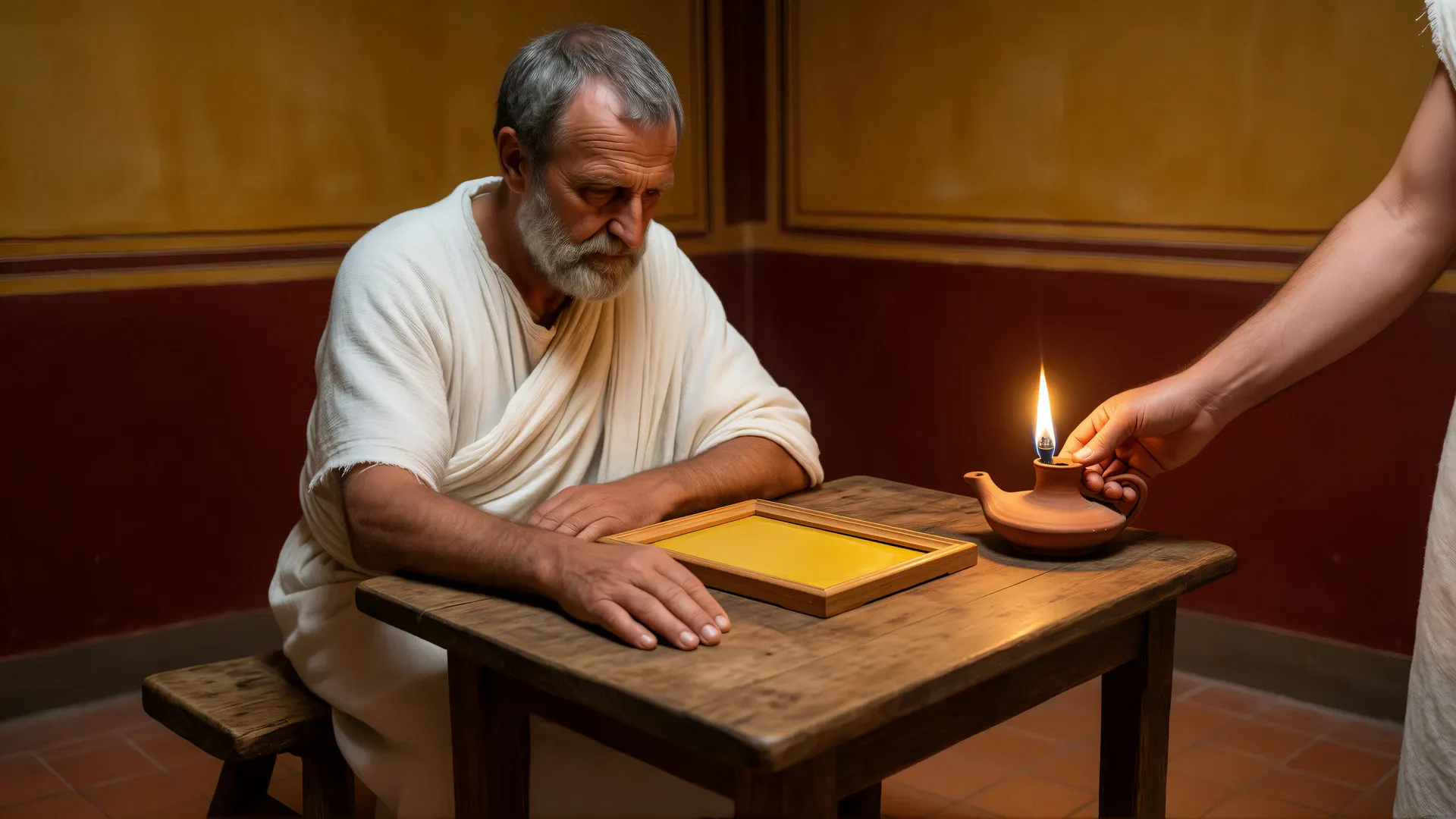
Seneca describes his practice in Minor Dialogues, having taken it from his teacher Sextius. Every night, once the lamp was out and his wife had stopped talking, he went back over the day. Not the highlights. All of it.
“I pass the whole day in review before myself, and repeat all that I have said and done: I conceal nothing from myself, and omit nothing.”
Read that with the Ruminative Responses Scale in your hand and it is alarming. Exhaustive replay of the day. Nothing omitted. Deliberate, nightly, for years. If a patient described that practice to a clinician in 1990, they would have been scored high on rumination.
And Seneca was not hedging. In the Letters he makes looking backwards a duty and names the alternative as the actual danger:
“For this is what makes us wicked: that no one of us looks back over his own life. Our thoughts are devoted only to what we are about to do.”
So either Seneca was recommending the thing that predicts depression, or he was doing something the description misses.
What Seneca adds that brooding lacks
He was doing something the description misses, and he tells us exactly what it is. Three things, none of them optional.
The questions are fixed and closed. Sextius asked the same three every night: what bad habit of yours have you cured to-day? what vice have you checked? in what respect are you better? Every one of those names a category and demands an instance. None of them is why am I like this. You cannot answer them with a mood. (This is the practice in full — a trial rather than a diary, and the reason the Stoic version does not spiral.)
There is a verdict. Seneca calls the practice appearing before a judgment seat, and describes himself as his own “secret inquisitor and censor” who “has made his report about our morals”. A report closes. The case is heard and something is decided — which is precisely the terminating condition brooding does not have.
It ends, and the ending is the point. “How sweet is the sleep which follows this self-examination,” he writes. And when he catches himself in a fault, the sentence he passes is not punishment: “I pardon you this time: see that you never do that any more.”
That last line is the whole difference. A review that ends in a pardon and an instruction has done its work. A review that ends in and this is why I am the way I am has not ended at all.
The other half of the day
Seneca governs the night. He is not, though, the only Stoic voice on this, and the other one is talking about a completely different moment — the one where the thought first arrives.
Marcus Aurelius, in Meditations, gives the instruction for that phase:
“Thus then always abide by the first appearances, and add nothing thyself from within, and then nothing happens to thee.”
His example is deliberately plain. It has been reported that someone speaks ill of you. That has been reported. That you have been injured — that has not been reported. You added it.
This is not the same advice as Seneca’s, and it is not in competition with it. They are governing two different phases of the same day. Marcus is on duty at the moment of impact, where the job is to not elaborate — to keep the event the size it actually is. Seneca is on duty at the end of the day, where the job is to go back deliberately, with criteria, and close the books.
The failure mode is running the wrong one at the wrong time. Elaborating in the moment is how a passing remark becomes an injury. Refusing to review at all is Seneca’s wickedness — the unexamined life running on autopilot. And doing Seneca’s review without Seneca’s structure, at 2 a.m., with no criteria and no verdict, is brooding.
Why distraction is not the answer, quite
Ask a room full of people what actually helps and the most common answer is distraction. Podcasts. Audiobooks. Anything to put a voice in your head that is not your own.
It works, and the research agrees it works. Distraction inductions reliably interrupt a rumination episode and lift mood relative to sitting with it — Nolen-Hoeksema built exactly that comparison into her experiments, and people who habitually distract rather than ruminate tend to do better over time, not worse. So this is not the bad advice it is sometimes made out to be.
Its limit is narrower than “it doesn’t work”. Distraction ends the episode without touching what the episode was about. Used as the only tool, it starts to do the job of avoidance — the material never gets processed, and it is still there the next time something reopens it. This is why people can honestly say that audiobooks saved their nights and also that they have been circling the same three memories for fifteen years. Both are true. One is an interruption; the other is the thing that was never resolved.
If you want the loop to resolve rather than pause, the lever is the shape of the question — and there is a reliable way to change it.
The move that converts one into the other
Ethan Kross’s work on self-distancing found that the same event, examined from a small distance, gets processed rather than replayed. The mechanisms are unglamorous and they work: use your own name instead of I. Ask what you would tell a friend in this position. Look at it from five years out.
What each of those does is shift you from being inside the experience to being an observer of it. Immersed, you re-feel the event — which is brooding, and is why replaying a humiliation still makes your face hot years later. Distanced, you can see its shape and reason about it.
Notice that this is structurally identical to what Sextius’s three questions do. What vice have you checked today forces you to look at your own conduct as an item to be assessed, not a feeling to be re-entered. A verdict requires a judge, and a judge sits at a distance from the accused. The ancient practice and the modern finding are describing the same move — and if you want the questions themselves, there is a longer set, grouped by the job each one does.
None of this makes the 2 a.m. loop disappear on command. Response styles are habits and they took years to build. But it does mean the thing you have been told to stop doing and the thing you have been told to start doing are not opposites, and you have not been failing at both.
You have been running the right practice without its structure. Seneca kept the replay and added three questions, a verdict and a pardon. Strip those out and what remains is the loop — the same material, chewed and chewed, and never swallowed.
The rest of living well has this shape too: the practices that work are rarely the ones that feel best while you are doing them.
Frequently asked questions
- Is rumination the same as overthinking?
- Not quite, though the words are used interchangeably in ordinary speech. Overthinking is the everyday term for thinking more than a situation warrants, and it can point forwards or backwards. Rumination is the narrower research construct: repetitive, passive, self-focused thought about distress and its causes, usually directed at the past. Worry is its future-facing sibling. The distinction matters because rumination has been studied specifically — it is measured with its own scale and predicts its own outcomes, which vague overthinking does not.
- If I think about a problem and conclude that thinking won't solve it, has that helped?
- It can, and this is the paradox people notice: reaching the conclusion that a problem is not solvable by further thought is itself the product of thought. The difference is that the conclusion terminates the process — you have reached a verdict and the loop has somewhere to stop. Rumination never issues a verdict. It re-poses the same unanswerable question, most often a why-question about your own character, and the absence of an answer is precisely what makes it repeat.
- Does distraction actually stop rumination?
- Yes, for the episode. Distraction reliably interrupts a rumination episode and lifts mood relative to sitting with it, and people who habitually distract rather than ruminate tend to fare better over time — Nolen-Hoeksema built that comparison into her experiments. Its limit is that it ends the episode without addressing what the episode was about, so used as the only tool it shades into avoidance and the material returns intact. Treat it as a legitimate way to break a specific loop, not as the thing that resolves what the loop is circling.
- Is journaling rumination or reflection?
- Either, depending on what you write. A page that re-narrates how bad you felt and asks why you are like this is brooding with a pen. A page that names a specific action, measures it against a standard, and records what you would do differently is an audit. The physical act is identical, which is why journaling produces such mixed results across studies — the format is not the active ingredient. The structure of the question is.
This article is reflection, not treatment. If anything here describes your life and it is hard to carry, free and confidential help is available from trained services — see this list of support resources.