
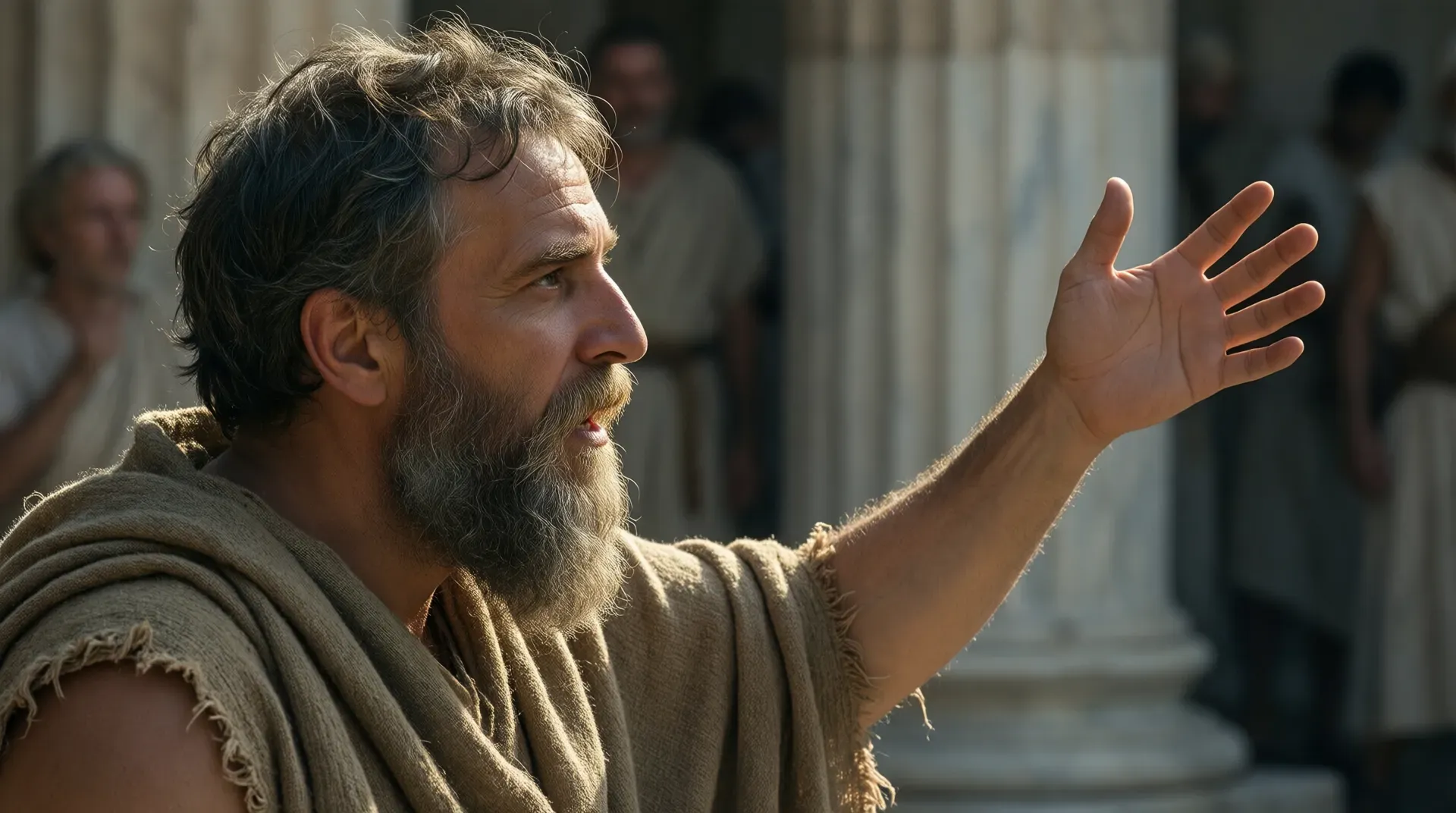
What the Examined Life Actually Means — Socrates' Argument
What Socrates actually argued in the Apology — and what self-examination requires
Most people who encounter the Socrates quote treat it as encouragement. The unexamined life is not worth living — it sounds like an invitation to be more reflective, to journal more, to take stock occasionally. What it actually is, is an argument. Socrates made it at his own trial, as the reason he would accept death rather than stop doing the thing he was being prosecuted for. The quote without the trial is a sentiment. The quote with the trial is a philosophical claim with stakes attached.
What the claim actually says — and what examination actually means — is harder and more specific than the inspirational version suggests. Understanding it requires following the argument, not just the aphorism.
What “Know Thyself” Actually Meant
The Delphic inscription know thyself was the starting point for the Socratic project. Most readings treat it as a call to self-awareness — understand your personality, your patterns, your tendencies. Cicero, who had read the Greek sources closely, gave a different account of what the God of Delphi meant by it:
When, therefore, he says, “Know yourself,” he says this, “Inform yourself of the nature of your soul;” for the body is but a kind of vessel, or receptacle of the soul.
This is not a call to personality inventory. It is a call to understand what kind of thing you are — specifically, what the rational faculty is and what it is capable of. The soul, in this sense, is not the emotional interior. It is the reasoning agent. Know thyself means: understand what you are as a thinker, what you actually believe, and whether those beliefs hold up.
That is already more demanding than the modern version. Most self-examination stops at feelings and preferences — what do I enjoy, what am I afraid of, what kind of person do I seem to be. The Socratic version starts at beliefs and values. Not what do I feel but what do I actually hold to be true, and have I ever checked whether it is.
Why the Trial Context Changes Everything
In 399 BCE, Socrates was charged with impiety and corrupting the youth of Athens. He was found guilty by a jury of five hundred. Under Athenian law, he could propose an alternative penalty — and there were viable options. He could have proposed exile. He could have agreed to stop philosophising, which some on the jury would have found acceptable.
He refused both. Then he said it:
The unexamined life is not worth living for a human being. (Plato, Apology 38a)
The context matters because it shows what he was actually committed to. This was not a man offering a gentle recommendation about the benefits of self-reflection. This was a man explaining, to the people who were about to kill him, why stopping was not an option. He had concluded — through the very practice he was defending — that living without examination produced a specific kind of damage. Not dramatic ruin. Most unexamined lives look perfectly ordinary. The damage was subtler: a life organised around principles you never chose, values you never tested, a self-image that has never been interrogated.
He considered that damage serious enough to prefer death over perpetuating it.
The Crito makes his reasoning visible. When his friend Crito urges him to escape — the jury may be corrupt, public opinion is on his side — Socrates responds:
Why, my dear Crito, should we care about the opinion of the many? Good men, and they are the only persons who are worth considering, will think of these things truly as they occurred.
The examined life is, in part, about this: not being governed by what the crowd thinks. Not living by received opinion. The unexamined person takes their values from the surrounding culture in the same way they take their opinions from whoever they last spoke to. The examined person has done the work of finding out what they actually believe — and that work confers a kind of independence. Socrates’ willingness to die rather than compromise is the most extreme demonstration of what that independence actually looks like.
The unexamined person takes their values from the surrounding culture in the same way they take their opinions from whoever they last spoke to.
What Examination Requires — and What It Doesn’t
The article on why the unexamined life is so easy to live covers the psychology of non-examination: why it is the default, why the hardening Epictetus describes is so common, why most people mistake drift for decision. What it does not cover is what examination is actually doing when it works — what the activity produces, not just why people avoid it.
Cicero gives the clearest account of the payoff:
A mind employed on such subjects, and which night and day contemplates them, contains in itself that precept of the Delphic God, so as to “know itself,” and to perceive its connection with the divine reason, from whence it is filled with an insatiable joy.
The phrase “divine reason” is doing philosophical work here, not theological work. It means: the rational order of things — the way causes connect to effects, the way values produce lives, the way the beliefs you hold shape what you are able to perceive. Examination connects you to that order not by reading about it but by testing your own mind against it. What results — “insatiable joy” sounds hyperbolic, but Cicero means something specific — is the experience of actually knowing why you believe what you believe, and finding that it holds up.
This is not the same as feeling good about yourself. It is more demanding than that, and more stable. A person who has examined their values and found them coherent has something that reassurance cannot provide and flattery cannot shake. Marcus Aurelius, working through the same tradition, put it this way: every man is worth just so much as the things are worth about which he busies himself.
What you value is what you are. Examination changes what you value, not just what you know about yourself.
Notice what examination does not require. It does not require a philosopher’s schedule. It does not require extended solitude or formal study. The Stoics who inherited the Socratic tradition were not recommending withdrawal from ordinary life. They were recommending a particular habit of attention within it — the habit of checking, regularly, whether the beliefs operating in your life are ones you would endorse on reflection, or ones you have simply accumulated.
What examination does require is the willingness to find that some of those beliefs do not hold up. That is the part most people are not prepared for.
There is also a limit worth naming, because the tradition named it. In the Phaedo, Socrates admits “there is a danger in the contemplation of the nature of things” — he was “afraid that I might injure the eye of the soul.” Examination questions your beliefs and values; it is not the same as turning relentlessly on yourself, picking over every failure. That is rumination, and it corrodes rather than clarifies. The examined life interrogates your assumptions, not your worth.
The Difference Between Self-Reflection and Self-Examination
Self-reflection and self-awareness — attending to your inner life, noticing patterns, developing a more accurate picture of how you function — is genuinely valuable. It is also not the same as examination.
Examination has a verdict. When Socrates questioned people, he was not interested in understanding their perspectives — he was interested in whether their positions were coherent. Did their beliefs contradict each other? Did the value they claimed to hold actually govern their behaviour? Was the thing they said they wanted the thing that would make them what they claimed to want to be?
These are harder questions than “how am I feeling about this?” They are also more consequential. A person can spend years becoming more self-aware — more attuned to their emotional responses, better at identifying their patterns — without ever subjecting the values underneath those patterns to actual scrutiny. The self-reflection is real. The examination has not happened.
The evening practice Marcus Aurelius maintained — the Meditations is, at bottom, a man checking his own responses against principles he had examined and committed to — is the closest historical example of what regular self-examination looks like. Not journalling. Not venting. A structured audit: was what I did today consistent with what I hold to be true? Where did I act from inherited habit rather than examined principle?
That practice sits at the heart of The Examined Life as a way of living — and it is more demanding than it sounds.
What the Examined Life Produces
Seneca said something about contemplation that is more useful than his more confident pronouncements:
Some make it the object of their lives: to us it is an anchorage, but not a harbour.
Examination is not the destination. It is what makes the destination findable. A person who examines their values but never acts on the conclusions has changed their self-knowledge without changing their life. The examined life produces different behaviour, not just better self-understanding. That was Socrates’ point. The man who died rather than stop philosophising was not choosing abstract knowledge over survival. He was demonstrating that examined values organise a life differently — that what you choose, when you have actually checked what you value, is different from what you choose on habit and social reflex.
The practical question is how to do this without a philosophical education or a Roman emperor’s discipline. The answer is simpler than both. Three questions, at the end of the day, before the lamp goes out: what happened, what did I make it mean, and where was I living from an assumption I have not examined. Not every evening will produce a revelation. The practice is what matters — the habit of looking, regularly, at whether the life you are leading is one you have actually chosen.
The Evening Review is built on exactly that structure. If you want to start tonight, the template is free.